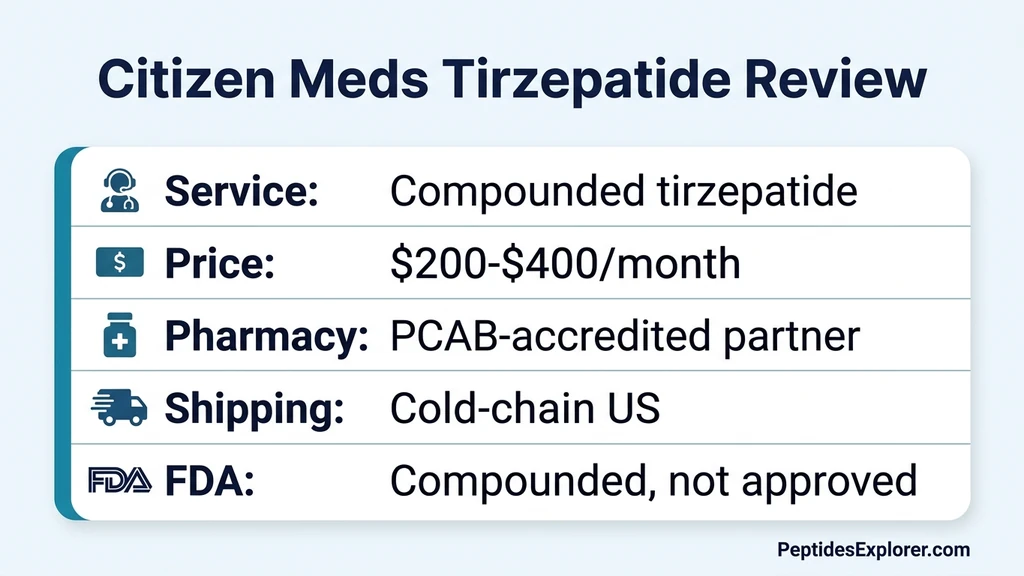
You are evaluating Citizen Meds as a telehealth route to tirzepatide and you want a straight answer on whether the service is legitimate before you hand over a card number. Citizen Meds is a US-based telehealth brand in the same category as Henry Meds, Ivim Health, and Mochi: asynchronous intake with a licensed provider, prescription of compounded tirzepatide fulfilled by a partner compounding pharmacy, and monthly subscription delivery. Typical pricing sits in the $200-$400 per month band depending on dose and subscription term, which is roughly 60-80% cheaper than cash-pay brand Zepbound. The things that actually matter before subscribing are not Citizen Meds-specific: verify the compounding pharmacy's state licensure and PCAB status, confirm the formulation is disclosed (pure tirzepatide versus tirzepatide + B12 or niacinamide), read the refund and cancellation policy word for word, and understand that compounded tirzepatide is not FDA-approved and its legal status has shifted multiple times in 2024-2026. Pricing, shipping states, and regulatory footing change on a monthly basis in this industry. Always verify current terms directly on Citizen Meds' website and with your healthcare provider before subscribing.
| Quick Reference | Detail |
|---|---|
| Company type | Telehealth-to-compounding-pharmacy provider |
| Service | Compounded tirzepatide prescription + shipping |
| Price range | ~$200-$400/month (varies by dose and term) |
| Consultation | Asynchronous intake, licensed provider review |
| Shipping | Cold-chain to most US states (availability shifts) |
| Not available in | States with compounding or GLP-1 restrictions |
| Compared to brand Zepbound cash price | ~60-80% cheaper |
| FDA status of product | Compounded, not FDA-approved |
The framework for deciding whether any telehealth tirzepatide provider is right for you is the same regardless of brand: insurance-covered brand Zepbound is the first choice when available, LillyDirect self-pay is the second choice for FDA-approved product without insurance, and compounded telehealth services like Citizen Meds are the third choice when cost is the binding constraint and you have done the due diligence. For the broader safety framework on this whole category, see is compound tirzepatide safe and compound tirzepatide dosage chart.
This article is educational. Verify current Citizen Meds pricing, state availability, pharmacy partners, and regulatory footing directly with the company and a licensed clinician before starting any medication.
Get your custom peptide protocol:
- Tailored to your body and goals
- Precise dosing and cycle length
- Safe stacking combinations
- Backed by peer-reviewed studies
- Ready in under 2 minutes
What Citizen Meds Actually Is
Citizen Meds operates the telehealth-to-compounding-pharmacy model that scaled during the 2022-2024 GLP-1 shortage and continues in a narrower regulatory window today. The typical patient flow:
- 1.You complete an intake questionnaire on Citizen Meds' website covering medical history, current medications, weight, target weight, and goals
- 2.A medical provider licensed in your state reviews the intake asynchronously
- 3.If appropriate, the provider writes a prescription for compounded tirzepatide at a starting dose
- 4.A partner compounding pharmacy fills the prescription and ships cold-chain to your address
- 5.Monthly portal follow-ups support dose titration, side-effect management, and refill requests
What makes Citizen Meds different from buying brand Zepbound at a retail pharmacy: - Citizen Meds dispenses compounded tirzepatide, which is not FDA-approved as a finished dosage form. Eli Lilly's Zepbound and Mounjaro are. Tirzepatide itself is a 39-amino-acid dual GIP/GLP-1 receptor agonist with a fatty-acid side chain that extends its half-life to roughly five days, supporting weekly subcutaneous dosing (Bastin & Andreassen, 2023). - Citizen Meds is typically cheaper than cash-pay Zepbound, sometimes dramatically cheaper. - Formulations may or may not include additives such as B12 or niacinamide; this varies by pharmacy partner. - The prescribing provider is employed or contracted by the telehealth service, not your primary care doctor.
What Citizen Meds has in common with other telehealth tirzepatide brands (Henry Meds, Ivim Health, Mochi, Form Health, Sequence, Vitastir, and others): - Asynchronous or semi-synchronous provider access through a portal - Subscription billing, typically monthly with multi-month discount tiers - Cold-chain shipping with ice packs - Dose escalation workflows through the same portal - A formulary constrained by what partner compounding pharmacies can legally produce at a given moment
What Citizen Meds does not do: - Dispense brand-name Zepbound or Mounjaro directly - Accept commercial insurance for compounded tirzepatide (no commercial plan covers compounded weight-loss drugs as a covered benefit) - Provide in-person care, bloodwork draws, or injections - Replace the primary-care relationship for labs, comorbidities, and non-GLP-1 prescriptions
For side-by-side context on providers with similar models, see Ivim health reviews, Henry Meds reviews, Mochi health reviews, and Vitastir tirzepatide.
Is Citizen Meds Legit? The Legitimacy Checklist
Before trusting any telehealth tirzepatide provider including Citizen Meds with your money and your metabolism, walk through the following checklist. It applies to every player in this category, not just Citizen Meds, and it is the right lens whether the brand name is Citizen Meds, Henry Meds, Ivim, Mochi, or anyone else.
1. State medical licensure of the prescribing provider. - The clinician writing your prescription must be licensed in the state where you reside, not merely "a US-licensed provider." - Request the specific provider's name and verify with your state's medical board licensee lookup. - Red flag: the company cannot or will not tell you which specific provider signed your prescription.
2. The compounding pharmacy's state licensure and accreditations. - Compounding pharmacies must be licensed in the state where they operate and typically in the states they ship into. - Look for PCAB (Pharmacy Compounding Accreditation Board) accreditation, or registration as a 503A or 503B facility. - Red flag: the company refuses to name the compounding pharmacy, or the pharmacy does not appear in state licensure databases.
3. The specific formulation of the product. - Pure tirzepatide reconstituted with bacteriostatic water is the cleanest baseline. - Tirzepatide + B12 (cyanocobalamin) is a common additive, generally considered safe. - Tirzepatide + niacinamide is another common additive, also generally considered safe. - "Proprietary blends" or undisclosed additives are a red flag because they cannot be independently verified. - The label and documentation you receive should state concentration (mg/mL), total volume, additives, lot number, and expiration.
4. Refund, cancellation, and billing policies. - Green flags: cancel anytime, prorated refunds for unshipped doses, clear documentation of what each price tier includes. - Yellow flags: multi-month prepaid plans with no refund, auto-renewing subscriptions without advance reminder, dose-escalation upcharges not disclosed upfront. - Red flag: the only way to cancel is a phone call with long hold times or email that never gets answered.
5. Provider responsiveness and dose management. - Green flags: 48-hour portal response on medical questions, explicit pathway for side-effect management, clinician review before every dose escalation. - Yellow flags: template-only replies, AI-generated responses, no mechanism to reach a human urgently. - Red flag: dose escalations happen automatically on a calendar without clinical review.
6. Regulatory transparency. - Compounded tirzepatide legality depends on FDA's current position on the tirzepatide shortage list and on 503A/503B rules. This position has shifted multiple times in 2024-2026. - A legitimate provider will tell you, in plain language, what legal basis supports their current product. - Red flag: the company dismisses regulatory questions, claims compounded tirzepatide is "FDA-approved," or refuses to discuss FDA actions.
For the broader regulatory landscape, see FDA peptide crackdown and is compound tirzepatide safe.
Citizen Meds Pricing in Context
Citizen Meds' pricing, like every telehealth GLP-1 provider, varies by dose, by subscription term, by ongoing promotions, and by how long you have been a customer. Do not treat any number in this section as an exact current quote; treat it as the typical price band for this category. Verify current pricing on Citizen Meds' own site before subscribing.
Typical price bands across the compounded tirzepatide telehealth segment:
Starter doses (2.5-5 mg weekly): Roughly $200-$250/month on month-to-month billing. Often $150-$200/month if prepaid across 3-6 months.
Intermediate doses (7.5-10 mg weekly): Roughly $250-$325/month. The tiered pricing mostly reflects compounding pharmacy cost per milligram of active ingredient, not provider-side markup.
High doses (12.5-15 mg weekly): Roughly $300-$400/month. At this tier some providers switch to higher-concentration vials, which changes injection volume but not much else.
Reference comparisons: - Brand Zepbound at Eli Lilly list price: roughly $1,060/month - Brand Zepbound with Lilly savings card (commercial insurance, not covered): roughly $550/month - LillyDirect self-pay (FDA-approved Zepbound shipped directly): roughly $350-$550/month depending on dose - Commercial insurance copay for covered Zepbound (uncommon for obesity indication): roughly $25-$100/month
Competitor telehealth pricing for compounded tirzepatide: - Henry Meds: roughly $300/month flat for compounded tirzepatide (verify current) - Ivim Health: roughly $270-$370/month by dose and term - Mochi Health: roughly $260-$375/month - Vitastir: roughly $200-$400/month - Form Health: roughly $350-$450/month (broader clinical scope)
Hidden costs to account for when comparing Citizen Meds to alternatives: - Dose escalation charges: some providers charge a per-escalation consultation fee, others include it - Injection supplies: most providers include syringes and alcohol swabs but confirm - Cold-chain shipping surcharges in hot months or rural areas - Required lab work: some services require baseline or periodic labs at your expense
Value math: If insurance covers brand Zepbound at a low copay, brand is almost always the right move: FDA-approved, stability data, standardized across every fill. If you are paying cash, the cheapest FDA-approved option is typically LillyDirect at $350-$550/month. Telehealth compounded providers like Citizen Meds make sense when LillyDirect is still unaffordable, you have walked through the legitimacy checklist, and you have realistic expectations about regulatory turbulence.
Use the peptide cost calculator to run your own numbers. For a deeper breakdown of insurance mechanics, see tirzepatide cost with insurance and where to buy tirzepatide.
Red Flags to Watch For in the Compounded GLP-1 Industry
These red flags apply to the entire compounded tirzepatide telehealth industry, not specifically to Citizen Meds. If you see any of these on Citizen Meds' site or a competitor's, treat it as a signal to slow down and verify.
Doses above the FDA-approved titration ceiling (above 15 mg weekly). There is no high-quality clinical evidence supporting tirzepatide doses above 15 mg weekly. The pivotal SURMOUNT-1 trial that established tirzepatide's weight-loss efficacy capped doses at 5, 10, and 15 mg weekly and showed 20.9% mean body-weight reduction at 15 mg over 72 weeks (Jastreboff et al., 2022). Any provider marketing 20 mg, 25 mg, or "mega-dose protocols" is operating outside evidence-based practice and outside the label on which the entire safety profile is built.
Before-and-after photos without disclaimers or verifiable provenance. Marketing photos can be recycled, purchased from stock databases, stolen, or AI-generated. Real clinical results live in trial reports, not on a hero image.
"Proprietary blend" tirzepatide. Legitimate compounded tirzepatide discloses exact concentration in mg/mL, the bacteriostatic water content, and any additives such as B12 or niacinamide. Language like "proprietary peptide matrix" or "our special formulation" without numeric disclosure is a red flag.
Countdown timers, "only 3 spots left," and FOMO sales tactics. Tirzepatide is a long-term metabolic medication, not a seasonal promotion. Legitimate providers do not use pressure sales tactics on a medication you may take for years.
No refund for unshipped doses. If a prepaid subscription cannot be refunded on unshipped product, that is the provider gambling with your money on the assumption you will not cancel.
Vague "US-based pharmacy partners" without names. "Our partner pharmacies across the United States" without naming them is not transparency. A legitimate provider will tell you which specific pharmacy or short list of pharmacies fills your prescription.
Claiming compounded tirzepatide is "FDA-approved." Compounded tirzepatide is not FDA-approved as a finished dosage form. The active ingredient goes through its own review, but the compounded product is regulated differently from brand-name Zepbound or Mounjaro. FDA pharmacovigilance review of FAERS reports for compounded GLP-1 products has documented cases of dosing errors, adverse events, and product quality concerns that the agency directly attributes to the regulatory gap between compounded and FDA-approved finished dosage forms (Hoffman et al., 2025). Any marketing copy that blurs this line is misleading.
No medical provider in the loop. If the signup path does not include a licensed clinician reviewing your intake before a prescription is written, that is not compliant with US prescribing law and not safe.
Automatic dose escalation with no review. Legitimate clinical practice requires reassessment of side effects, tolerance, and weight response before each dose increase. A system that auto-increases doses on a calendar regardless of how you feel is poor practice.
For the broader safety frame, see tirzepatide long-term side effects, and for the compounded regulatory context see FDA peptide crackdown and is compound tirzepatide safe.
How Citizen Meds Compares to Alternatives
If you are weighing Citizen Meds against other options, here are the most common alternatives and how they differ on model, price, and patient experience.
Citizen Meds vs Henry Meds: - Similar price band, both roughly $200-$400/month depending on dose and term - Henry Meds has a longer operating history and one of the larger patient footprints in the category - Henry Meds typically concentrates fulfillment with a smaller number of compounding pharmacy partners - Citizen Meds may offer more formulation flexibility; verify current menus - See Henry Meds reviews
Citizen Meds vs Ivim Health: - Ivim Health runs a more concierge-style model with more frequent clinician touchpoints - Ivim is generally slightly more expensive ($300-$450/month) - Ivim publicly lists its pharmacy partners, which simplifies due diligence - See Ivim health reviews
Citizen Meds vs Mochi Health: - Mochi bundles lifestyle coaching and nutrition resources into the subscription - Pricing bands are similar to Citizen Meds - Mochi tends to be more explicit about maintenance-phase planning after weight loss - See Mochi health reviews
Citizen Meds vs Vitastir: - Both are mid-tier telehealth-to-compounding models with similar pricing - Vitastir's disclosure of pharmacy partners and formulations is the right comparison standard - Choice often comes down to which provider ships to your state and which has better provider responsiveness - See Vitastir tirzepatide
Citizen Meds vs Calibrate: - Calibrate is an entirely different model: holistic, insurance-navigating, often routing patients to brand products - Calibrate costs significantly more ($1,600+ annual program) and targets employer-benefit populations - Calibrate is more appropriate if you have commercial insurance and want help getting brand Zepbound covered - See Calibrate weight loss reviews
Citizen Meds vs LillyDirect (going direct to Eli Lilly): - LillyDirect dispenses FDA-approved Zepbound directly to cash-pay patients at roughly $350-$550/month - Zero compounding regulatory uncertainty, full stability data, standardized product - Often within price range of Citizen Meds at intermediate-to-high doses - For most patients without insurance coverage for weight-loss drugs, LillyDirect is now the default recommendation
Citizen Meds vs a local compounding pharmacy: - Bypasses the telehealth subscription entirely - Requires finding a PCAB-accredited local pharmacy willing to compound tirzepatide - Also requires an in-person prescriber, which some patients already have - Often the cheapest monthly cost but requires meaningful self-advocacy
The decision heuristic: if your insurance covers brand Zepbound, use it. If not and you can afford $350-$550/month, use LillyDirect. If neither works and you are committed to tirzepatide, a telehealth compounded provider like Citizen Meds is the next tier, contingent on the legitimacy checklist above and a clear-eyed read of the regulatory landscape. For the full breakdown, see where to buy tirzepatide and is compound tirzepatide safe.
When Citizen Meds Makes Sense and When It Does Not
Citizen Meds is a reasonable choice when:
- Brand Zepbound is not covered by your insurance and LillyDirect self-pay is not sustainable
- You have verified the compounding pharmacy partner and confirmed PCAB accreditation or 503A/503B status
- You have confirmed the prescribing clinician is licensed in your state
- The formulation is disclosed in writing (tirzepatide concentration, additives, lot number format)
- The refund and cancellation policy is clear and allows you to walk away
- You are comfortable with the fact that compounded tirzepatide is not FDA-approved and that FDA's stance on compounded GLP-1s has shifted in recent years
Citizen Meds is a bad fit when:
- Your insurance covers brand Zepbound at a low copay (use the brand)
- You have a history of pancreatitis, medullary thyroid cancer, or MEN-2 (contraindications for tirzepatide; discuss with a clinician regardless of provider)
- You want in-person care, frequent lab monitoring, or extensive clinical touch
- You are using GLP-1s to treat a diabetes indication specifically and need close coordination with primary care
- You find multi-month prepaid commitments uncomfortable without having seen the product quality first
- Your state has active enforcement against compounded GLP-1 shipments from out of state
A pragmatic first-month approach: 1. Sign up on a single-month plan, not a multi-month prepay 2. On arrival, photograph the vial label, the lot number, and the pharmacy name 3. Verify the pharmacy's PCAB or state licensure with a web search 4. Start at the lowest prescribed dose and monitor for injection-site reactions, nausea, and energy changes 5. Keep a dated log of doses, weight, and side effects 6. If anything feels off (quality, responsiveness, formulation changes, price jumps), cancel before the next billing cycle
For what to monitor during the titration, see compound tirzepatide dosage chart and tirzepatide long-term side effects.
Frequently Asked Questions
Is Citizen Meds legit?
Citizen Meds operates in the same compliance framework as most telehealth compounded tirzepatide providers: asynchronous intake, state-licensed clinician review, and fulfillment by a partner compounding pharmacy. Whether it is right for you depends on whether the compounding pharmacy discloses state licensure and PCAB accreditation, whether a provider licensed in your specific state reviews your intake, and whether you are comfortable with compounded (non-FDA-approved) product. The legitimacy checklist in the body of this article applies to Citizen Meds and every competitor. See is compound tirzepatide safe for the broader framework.
How much does Citizen Meds tirzepatide cost?
Citizen Meds pricing typically falls in the $200-$400 per month range depending on dose level and subscription term, consistent with the broader compounded tirzepatide telehealth segment. Higher doses (12.5-15 mg weekly) cost more than starter doses. Multi-month prepay plans usually cut the monthly cost by $30-$80. Exact pricing changes; verify on the current Citizen Meds site. Run cost scenarios with the peptide cost calculator.
Is Citizen Meds tirzepatide the same as Mounjaro or Zepbound?
No. Mounjaro and Zepbound are Eli Lilly's FDA-approved brand-name tirzepatide products. Citizen Meds dispenses compounded tirzepatide, produced by a partner compounding pharmacy using the tirzepatide active ingredient. The active molecule is the same, but the finished product is regulated differently: compounded tirzepatide is not FDA-approved as a finished dosage form. For the full context on the difference, see is compound tirzepatide safe.
Is compounded tirzepatide from Citizen Meds legal?
The legality of compounded tirzepatide depends on FDA's current position on the tirzepatide shortage list and 503A/503B rules. When tirzepatide is listed as in shortage, 503A compounding is explicitly permitted. When it is off the list, compounding is restricted to documented individual clinical needs (such as an allergy to a component of the brand product). This position has shifted multiple times in 2024-2026. A legitimate provider will state the current legal basis for its product. See FDA peptide crackdown for the regulatory history.
Does Citizen Meds ship to every US state?
No. Telehealth compounded GLP-1 providers generally cannot ship to states where their partner compounding pharmacies are not licensed, and some states (notably New York, Texas, Mississippi, and California at various points) have specific restrictions on compounded GLP-1 shipments. Verify shipping to your state during the intake process. If the answer is unclear, that itself is a signal to look elsewhere. See where to buy tirzepatide for state-by-state context.
What should the Citizen Meds tirzepatide label say?
A legitimately compounded tirzepatide vial label should state: the drug name (tirzepatide), concentration (mg/mL), total volume (mL), any additives such as B12 (cyanocobalamin) or niacinamide, lot number, expiration date, the compounding pharmacy name and address, and the dispensing patient name. Refrigerate on arrival per the included instructions. If any of those elements are missing or illegible, contact the provider before using. See compound tirzepatide dosage chart for dose-volume math.
Can I switch from Citizen Meds to brand Zepbound later?
Yes, and it is increasingly common when insurance coverage changes or when a patient prefers the FDA-approved product. You can typically continue at the same milligram dose without restarting titration as long as the prescribing clinician coordinates the handoff. For dose conversion between compounded and brand, see compound tirzepatide dosage chart and tirzepatide cost with insurance.
What do I do if something goes wrong while using Citizen Meds tirzepatide?
For any medical emergency, contact local emergency services or urgent care first. For drug-specific concerns, reach out to Citizen Meds' medical support line listed on their site. Stop the medication and seek in-person evaluation if you develop severe abdominal pain (especially radiating to the back), persistent vomiting, signs of pancreatitis, gallbladder symptoms, or severe allergic reactions. Suspected compounded-product quality issues should be reported to the compounding pharmacy and to FDA MedWatch. For what to watch for during therapy, see tirzepatide long-term side effects.
The Bottom Line
Citizen Meds sits in the crowded middle of the compounded tirzepatide telehealth market, offering the same general value proposition as Henry Meds, Ivim Health, Mochi, and Vitastir: a licensed clinician reviewing an asynchronous intake, compounded tirzepatide fulfilled by a partner pharmacy, cold-chain shipping, and monthly pricing in the $200-$400 band that undercuts brand Zepbound cash price. Whether it is the right choice for you depends entirely on the legitimacy checks that apply to every provider in this category: state licensure of the prescribing clinician, PCAB or state licensure of the compounding pharmacy, disclosed formulation, clear refund and cancellation policy, and transparent handling of the regulatory uncertainty that still surrounds compounded GLP-1s.
Because pricing, state availability, pharmacy partners, and regulatory footing all move on a monthly basis in this industry, treat any specific number in this article or on Citizen Meds' website as a snapshot that may already be stale. Verify current terms directly before subscribing. Start on a single-month plan rather than a multi-month prepay. Document what arrives. Cancel at the first sign of opacity or quality drift.
The decision tree for most patients remains: insurance-covered brand Zepbound first, LillyDirect self-pay second, and telehealth compounded services like Citizen Meds third when cost is the binding constraint and you have done the due diligence. The price delta between brand and compounded is real, but so is the regulatory gap and the variability in product quality across compounding pharmacies. Go in with eyes open.
For the competing providers with full reviews, see Ivim health reviews, Henry Meds reviews, Mochi health reviews, Vitastir tirzepatide, and Calibrate weight loss reviews. For the safety and regulatory framework that underpins all of these choices, see is compound tirzepatide safe, FDA peptide crackdown, where to buy tirzepatide, and tirzepatide cost with insurance.
Related Articles: - Is Compound Tirzepatide Safe - Vitastir Tirzepatide - Henry Meds Reviews - Ivim Health Reviews - Mochi Health Reviews - Where to Buy Tirzepatide - Tirzepatide Cost With Insurance - Compound Tirzepatide Dosage Chart - FDA Peptide Crackdown
Related Articles
Fifty 410 Tirzepatide Review 2026
Fifty 410 tirzepatide review: what the brand is, how compounded tirzepatide sourcing works, what to verify before buying, and 2026 pricing context.
Vitastir Tirzepatide: Review & What to Know
Vitastir tirzepatide review: telehealth compounded tirzepatide service. Pricing, legitimacy checklist, red flags, and comparison to peers.
Orderly Meds Tirzepatide: Complete Evaluation Guide
Orderly Meds GLP-1 review: legitimacy checklist, pricing, red flags, and how Orderly Meds tirzepatide compares to Henry Meds and brand Zepbound.
Priority Meds Tirzepatide Review & Pricing
Priority Meds tirzepatide review: compounded GLP-1 telehealth evaluation, pricing, legitimacy checklist, red flags, and how it compares to Henry Meds.