The number of units you inject depends on your vial's concentration. Compounded tirzepatide comes in multiple concentrations (5, 10, 17, or 20 mg/mL), and the same prescribed dose requires different injection volumes depending on which concentration you have. Getting this wrong means underdosing or overdosing.
The conversion formula: Units = (Dose in mg / Concentration in mg/mL) x 100
| Dose | Units at 5 mg/mL | Units at 10 mg/mL | Units at 20 mg/mL |
|---|---|---|---|
| 2.5 mg | 50 units | 25 units | 12.5 units |
| 5 mg | 100 units | 50 units | 25 units |
| 7.5 mg | 150 units | 75 units | 37.5 units |
| 10 mg | 200 units | 100 units | 50 units |
| 12.5 mg | 250 units | 125 units | 62.5 units |
| 15 mg | 300 units | 150 units | 75 units |
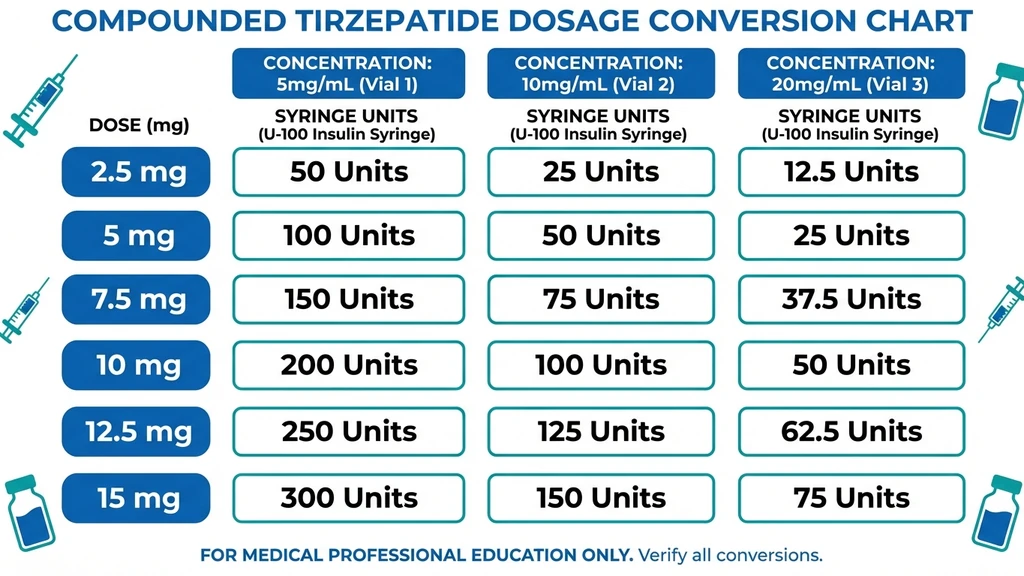
Always check the concentration printed on your vial label before calculating. Use our tirzepatide dosage calculator for exact measurements.
This is educational content. Follow your prescriber's dosing instructions exactly.
Get your custom peptide protocol:
- Tailored to your body and goals
- Precise dosing and cycle length
- Safe stacking combinations
- Backed by peer-reviewed studies
- Ready in under 2 minutes
Standard Titration Schedule
The FDA-approved tirzepatide titration follows a gradual dose escalation to minimize GI side effects.
| Weeks | Weekly Dose | Purpose | Min dose increases every 4 weeks |
|---|---|---|---|
| 1-4 | 2.5 mg | Starter dose (tolerability) | N/A |
| 5-8 | 5 mg | First maintenance option | Required increase |
| 9-12 | 7.5 mg | Optional step-up | If 5 mg insufficient |
| 13-16 | 10 mg | Second maintenance option | If 7.5 mg insufficient |
| 17-20 | 12.5 mg | Optional step-up | If 10 mg insufficient |
| 21+ | 15 mg | Maximum dose | If 12.5 mg insufficient |
Maintenance doses are 5, 10, or 15 mg per week. Not everyone needs the maximum dose. Many patients achieve significant weight loss at 5 or 10 mg. Your prescriber determines your target maintenance dose based on response and tolerability.
In the SURMOUNT-1 trial (Jastreboff et al., NEJM 2022), mean weight loss at 72 weeks varied by dose: 15.0% at 5 mg, 19.5% at 10 mg, and 22.5% at 15 mg. About 57% of patients on 5 mg achieved 15% or greater weight loss, versus 78% on 15 mg. These percentages apply to FDA-approved tirzepatide; compounded versions use the same active ingredient.
For complete clinical data on what each dose produces, see our tirzepatide dosage chart in units and tirzepatide before and after results.
Complete Concentration Conversion Table
This is the reference table for all common compounded tirzepatide concentrations. Print or save this table if your pharmacy sends lyophilized (freeze-dried) powder that requires reconstitution.
| Weekly Dose | 5 mg/mL (units) | 5 mg/mL (mL) | 10 mg/mL (units) | 10 mg/mL (mL) | 17 mg/mL (units) | 17 mg/mL (mL) | 20 mg/mL (units) | 20 mg/mL (mL) |
|---|---|---|---|---|---|---|---|---|
| 2.5 mg | 50 | 0.50 | 25 | 0.25 | 14.7 | 0.147 | 12.5 | 0.125 |
| 5 mg | 100 | 1.00 | 50 | 0.50 | 29.4 | 0.294 | 25 | 0.25 |
| 7.5 mg | 150 | 1.50 | 75 | 0.75 | 44.1 | 0.441 | 37.5 | 0.375 |
| 10 mg | 200 | 2.00 | 100 | 1.00 | 58.8 | 0.588 | 50 | 0.50 |
| 12.5 mg | 250 | 2.50 | 125 | 1.25 | 73.5 | 0.735 | 62.5 | 0.625 |
| 15 mg | 300 | 3.00 | 150 | 1.50 | 88.2 | 0.882 | 75 | 0.75 |
Note: At 5 mg/mL, doses of 10 mg and above require more than 1 mL per injection. This may require a 3 mL syringe rather than a standard 1 mL insulin syringe. The 20 mg/mL concentration keeps all doses under 1 mL.
Use our peptide unit converter for custom calculations.
How to Calculate Your Dose
Three numbers determine your injection volume.
- 1.Your prescribed dose (in mg). Your provider tells you this.
- 2.Your vial concentration (in mg/mL). This is printed on the vial label.
- 3.Your syringe type. Most patients use U-100 insulin syringes where 100 units = 1 mL.
The formula: mL = Prescribed Dose (mg) / Concentration (mg/mL)
Then: Units on a U-100 syringe = mL x 100
Example: Your prescribed dose is 7.5 mg. Your vial is 10 mg/mL. - mL = 7.5 / 10 = 0.75 mL - Units = 0.75 x 100 = 75 units
Example 2: Your prescribed dose is 5 mg. Your vial is 20 mg/mL. - mL = 5 / 20 = 0.25 mL - Units = 0.25 x 100 = 25 units
Always double-check the concentration on the actual vial before drawing. Compounding pharmacies may change concentrations between refills. If your new vial has a different concentration than your previous one, recalculate before injecting.
For reconstitution from lyophilized powder, see our reconstitution calculator and our guide on how to reconstitute tirzepatide.
Vial Sizes and How Long They Last
Compounded tirzepatide vials vary by pharmacy. Common configurations:
| Vial Size | Concentration | Total mg | Lasts at 5 mg/wk | Lasts at 10 mg/wk | Lasts at 15 mg/wk |
|---|---|---|---|---|---|
| 2 mL at 10 mg/mL | 10 mg/mL | 20 mg | 4 weeks | 2 weeks | 1.3 weeks |
| 5 mL at 10 mg/mL | 10 mg/mL | 50 mg | 10 weeks | 5 weeks | 3.3 weeks |
| 2 mL at 20 mg/mL | 20 mg/mL | 40 mg | 8 weeks | 4 weeks | 2.7 weeks |
| 5 mL at 20 mg/mL | 20 mg/mL | 100 mg | 20 weeks | 10 weeks | 6.7 weeks |
Reconstituted compounded tirzepatide should be refrigerated and used within 28 days unless your pharmacy specifies otherwise. Larger vials may require discarding unused medication if you cannot use it within the stability window.
For storage guidance, see our tirzepatide storage guide and general peptide storage guide.
Side Effects by Dose Level
GI side effects increase with dose escalation. SURMOUNT-1 data shows clear dose-response patterns.
| Side Effect | 2.5 mg | 5 mg | 10 mg | 15 mg | Placebo |
|---|---|---|---|---|---|
| Nausea | 12% | 24% | 24% | 31% | 4% |
| Diarrhea | 12% | 19% | 16% | 23% | 7% |
| Vomiting | 5% | 6% | 11% | 12% | 2% |
| Constipation | 6% | 8% | 8% | 12% | 3% |
| Decreased appetite | 7% | 18% | 18% | 22% | 2% |
Side effects are worst during the first 4 weeks of each dose increase. Most patients who tolerate the 2.5 to 5 mg transition tolerate later increases better. Slower titration (staying at each dose for 6 to 8 weeks instead of 4) reduces GI severity.
For managing specific side effects, see our guides on tirzepatide and diarrhea, constipation on tirzepatide, and headaches on tirzepatide.
What to Do If You Miss a Dose
Tirzepatide has a 5-day half-life, which means blood levels decline gradually after a missed dose. The FDA prescribing information for Zepbound provides clear rules.
| Situation | Action |
|---|---|
| Within 4 days (96 hours) of scheduled dose | Inject as soon as possible |
| More than 4 days past scheduled dose | Skip it, inject on your next scheduled day |
| Minimum gap between any two doses | 72 hours (3 days) |
| Missed 2+ consecutive weeks | Contact prescriber about dose adjustment |
| Double dosing | Never. Do not inject twice to make up for a missed dose |
Changing your injection day: You can shift your injection day at any time as long as 72 hours separate doses. If you normally inject Friday and want to switch to Monday, wait until the following Monday (72+ hours from Friday).
For timing strategies, see our guide on best time to take tirzepatide. For maintenance dosing after reaching your goal, see our tirzepatide maintenance dose guide.
Compounded vs Brand-Name Tirzepatide
Compounded tirzepatide and brand-name Mounjaro/Zepbound contain the same active ingredient. The differences are in manufacturing, delivery, and regulatory status.
| Factor | Compounded | Mounjaro/Zepbound |
|---|---|---|
| Active ingredient | Tirzepatide | Tirzepatide |
| Manufacturer | 503A/503B pharmacy | Eli Lilly |
| Delivery | Vial + syringe | Pre-filled pen |
| FDA approved? | No (not as finished product) | Yes |
| Monthly cost | $200-400 | $550-1,086 (cash) / $25 (savings card) |
| Concentration options | 5, 10, 17, 20 mg/mL | Fixed per pen |
| Impurity testing | Pharmacy-level QC | Full FDA cGMP |
| Storage | Refrigerated, 28-day BUD | Per label, longer shelf life |
2026 regulatory update. The FDA declared the tirzepatide shortage resolved in October 2024. Compounding discretion ended for 503A pharmacies on February 18, 2025 and for 503B outsourcing facilities on March 19, 2025. As of 2026, compounded tirzepatide is legally available only for patients with a documented medical need that cannot be met by Mounjaro or Zepbound, such as a verified allergy to an inactive ingredient (source: NCPA, FDA.gov).
Patients currently using compounded tirzepatide should discuss continued access with their prescriber. For compounded product safety, see is compound tirzepatide safe. For cost details, see our tirzepatide cost with insurance guide.
Common Mistakes to Avoid
1. Confusing concentrations between refills. Your pharmacy may send a different concentration than last time. A patient accustomed to drawing 50 units at 10 mg/mL (5 mg dose) who receives a 20 mg/mL vial and draws the same 50 units will inject 10 mg instead of 5 mg. Always check the label.
2. Using the wrong syringe. U-100 insulin syringes measure in units where 100 units = 1 mL. U-40 syringes (common in veterinary medicine) measure differently. Using the wrong syringe type will result in incorrect dosing.
3. Not accounting for dead space. Some syringe types retain a small amount of liquid in the hub after injection. Low dead-space syringes minimize this waste. At higher concentrations (20 mg/mL), the wasted volume can represent a meaningful portion of the dose.
4. Shaking the vial. Peptides are fragile. Shaking can cause denaturation (breaking the protein structure). Gently swirl or roll the vial to mix. Never shake.
5. Drawing from a room-temperature vial. Compounded tirzepatide should be stored refrigerated. Remove the vial 15 to 20 minutes before injection to reduce injection site discomfort, but return it to the refrigerator immediately after drawing your dose.
For injection technique, see our how to inject tirzepatide guide. For understanding units, see our guide on how many mg is 20 units of tirzepatide.
Frequently Asked Questions
How many units is 5 mg of compounded tirzepatide?
It depends on your vial's concentration. At 5 mg/mL: 100 units. At 10 mg/mL: 50 units. At 20 mg/mL: 25 units. Always check the concentration on your vial label and use the formula: Units = (Dose / Concentration) x 100.
What concentration does compounded tirzepatide come in?
Common compounded tirzepatide concentrations are 5 mg/mL, 10 mg/mL, 17 mg/mL, and 20 mg/mL. The concentration varies by pharmacy. Higher concentrations require smaller injection volumes, which can be more comfortable but require more precise measurement.
How long does a compounded tirzepatide vial last?
It depends on the vial size, concentration, and your dose. A 5 mL vial at 10 mg/mL (50 mg total) lasts 10 weeks at 5 mg/week or 5 weeks at 10 mg/week. Reconstituted vials should be used within 28 days of mixing.
Is compounded tirzepatide the same as Mounjaro?
Compounded tirzepatide contains the same active ingredient as Mounjaro and Zepbound but is prepared by a compounding pharmacy rather than manufactured by Eli Lilly. It is not FDA-approved as a finished product. The active compound is identical; the inactive ingredients and delivery format may differ.
How do I convert tirzepatide mg to units?
Use the formula: Units = (Dose in mg / Concentration in mg/mL) x 100. Example: 7.5 mg dose with a 10 mg/mL vial = (7.5 / 10) x 100 = 75 units on a U-100 insulin syringe. Always verify your vial's concentration before calculating.
What is the maximum dose of compounded tirzepatide?
The maximum FDA-approved tirzepatide dose is 15 mg per week. The standard titration reaches this dose by week 21 or later. Many patients achieve adequate weight loss at 5 or 10 mg and do not need the maximum dose. Your prescriber determines your target dose.
What happens if I miss a dose of compounded tirzepatide?
If within 4 days of your scheduled injection, take it as soon as possible. If more than 4 days have passed, skip the missed dose and resume on your next scheduled day. Never double dose. Maintain at least 72 hours between any two injections. Contact your prescriber if you miss two or more consecutive doses.
Is compounded tirzepatide still available in 2026?
The FDA resolved the tirzepatide shortage in October 2024 and ended compounding discretion in early 2025 (503A: February 18, 503B: March 19). As of 2026, compounded tirzepatide is legally available only for patients with a documented medical need not met by FDA-approved Mounjaro or Zepbound, such as a verified allergy to an inactive ingredient.
The Bottom Line
The critical step with compounded tirzepatide is matching your prescribed dose to your vial's concentration. The same 5 mg dose requires 100 units at 5 mg/mL, 50 units at 10 mg/mL, or 25 units at 20 mg/mL. Getting this conversion wrong means underdosing or overdosing.
Always check the concentration on your vial label. Note that compounding regulations changed in 2025, and access to compounded tirzepatide is now restricted. Discuss your options with your prescriber. Use our tirzepatide dosage calculator for exact measurements, and see our full tirzepatide dosage chart for the complete clinical titration schedule.
This is educational content. Follow your prescriber's dosing instructions exactly. Do not adjust your dose without medical guidance.
Related Articles
Olympia Tirzepatide Dosage Chart Guide
Olympia Pharmacy tirzepatide dosage chart by concentration. mg-to-units conversion at 5, 10, and 20 mg/mL, legitimacy checks, and how to read your vial.
Empower Tirzepatide Dosing Guide
Empower Pharmacy tirzepatide dosing guide: concentrations, mg-to-units chart, partner telehealth providers, and how to read your Empower vial.
Tesamorelin Dosage Chart: Clinical Doses
Full tesamorelin dosage chart: the 2 mg/day clinical dose, research tiers, reconstitution math in syringe units, timing, titration, and cycle length.
Sermorelin Dosage Chart by Goal & Weight
Sermorelin dosage chart: 200-500 mcg nightly before bed. Doses by goal and body weight, unit conversions for every vial size, timing, and titration.