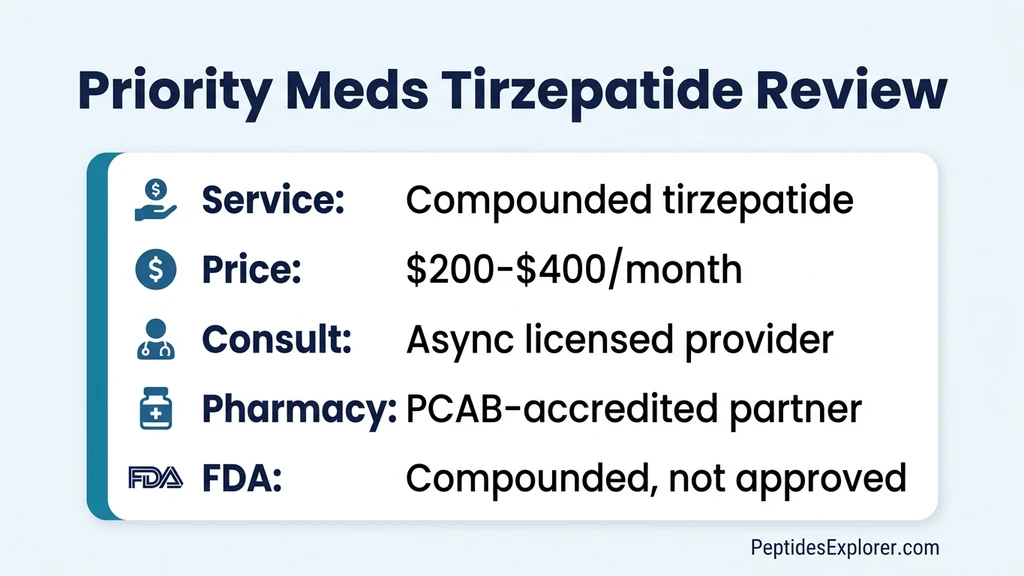
You are evaluating Priority Meds as a telehealth source for compounded tirzepatide and you want to know whether the service is credible before you hand over a credit card. Priority Meds is a US-based telehealth company that connects patients with licensed medical providers and partners with compounding pharmacies to dispense compounded tirzepatide for weight management. Pricing typically falls in the $200 to $400 per month range depending on dose and subscription term, which places it in the same competitive tier as Vitastir, Henry Meds, Ivim Health, and Mochi Health. Before signing up with any provider in this category, verify four things: the partner compounding pharmacy's state licensure and PCAB status, the exact formulation (pure tirzepatide vs tirzepatide blended with B12 or niacinamide), the refund and cancellation policy, and how dose escalations are priced. Compounded tirzepatide is only legal under specific FDA conditions and those conditions have shifted repeatedly between 2024 and 2026. Always confirm current pricing, shipping eligibility, and regulatory status directly on the Priority Meds website before subscribing.
| Quick Reference | Detail |
|---|---|
| Company type | Telehealth-to-compounding-pharmacy model |
| Service | Compounded tirzepatide prescription + shipping |
| Price range | ~$200-400/month (varies by dose and subscription term) |
| Consultation | Asynchronous intake reviewed by a licensed provider |
| Shipping | Cold-chain to most US states (some exclusions) |
| Not available in | States with compounding restrictions (verify at intake) |
| Compared to brand Zepbound | ~60-75% lower cost when insurance does not cover brand |
| FDA status of product | Compounded, not FDA-approved. Legal only under specific conditions. |
The decision to use Priority Meds or any compounded tirzepatide provider depends on three variables: whether your insurance covers brand Zepbound (if yes, default to that), whether the compounding pharmacy is transparent about its licensure and follows USP 797/800 standards, and whether you are comfortable with the regulatory uncertainty surrounding compounded GLP-1s. For the broader framework on evaluating telehealth tirzepatide services, see is compound tirzepatide safe and compound tirzepatide dosage chart.
This article is educational. Verify current pricing, shipping policies, and regulatory status directly with Priority Meds and with your own healthcare provider before starting any medication.
Get your custom peptide protocol:
- Tailored to your body and goals
- Precise dosing and cycle length
- Safe stacking combinations
- Backed by peer-reviewed studies
- Ready in under 2 minutes
What Priority Meds Actually Is
Priority Meds operates in the telehealth-to-compounding-pharmacy model that became widespread during the 2022-2024 GLP-1 shortage. The workflow is nearly identical across every provider in this category:
- 1.You complete an intake questionnaire on the Priority Meds website covering medical history, current medications, BMI, weight goals, and pregnancy/contraindication screening.
- 2.A licensed medical provider in your state reviews the intake asynchronously.
- 3.If clinically appropriate, the provider writes a prescription for compounded tirzepatide.
- 4.A partner compounding pharmacy fills the prescription and ships the medication cold-chain to your address.
- 5.Monthly portal check-ins allow titration adjustments, side effect reporting, and refill requests.
What makes Priority Meds different from filling a Zepbound prescription at your local pharmacy: - Priority Meds dispenses compounded tirzepatide, not FDA-approved Zepbound or Mounjaro. - Pricing is typically lower than brand product at cash-pay rates. - Formulations often include additives such as B12 or niacinamide that are not in brand Zepbound. - Supply chain runs through specific 503A or 503B compounding pharmacies whose quality control varies.
What Priority Meds shares with other telehealth tirzepatide providers such as Vitastir, Citizen Meds, Ivim Health, Henry Meds, Mochi, Sequence, and Form Health: - Asynchronous provider review (not in-person visits) - Subscription-based billing - Cold-chain shipping with ice packs - Portal-based dose titration - Formularies that shift based on what compounding pharmacies can legally produce
What Priority Meds does not do: - Dispense brand-name Zepbound or Mounjaro directly - Accept insurance for compounded tirzepatide (no US insurer covers compounded GLP-1s for weight loss) - Provide in-person exams, labs, or imaging - Replace a primary care physician relationship
If you want to compare Priority Meds against other providers in the same tier, see Vitastir tirzepatide, Citizen Meds tirzepatide, Henry Meds reviews, Ivim Health reviews, and Mochi Health reviews.
The Legitimacy Checklist (Apply to Priority Meds and Every Competitor)
Before committing to any telehealth compounded tirzepatide provider, verify the following items. This checklist applies to Priority Meds and to every other provider in the category. Do not skip steps just because a site looks polished.
1. The prescribing provider is licensed in your specific state. - Ask for the name of the clinician who will review your intake and verify them against your state medical board's public license database. - Red flag: the company will not name the provider, or only references "our network of physicians" without specifics.
2. The compounding pharmacy is state-licensed and accredited. - Compounding pharmacies should be licensed in their home state and registered in the states they ship to. - Look for PCAB (Pharmacy Compounding Accreditation Board) accreditation, 503A state license, or 503B FDA outsourcing facility registration. - Red flag: the company refuses to name the compounding pharmacy, or the pharmacy does not appear in FDA's Registered Outsourcing Facilities list when asked.
3. The formulation is fully disclosed. - Pure tirzepatide reconstituted with bacteriostatic water is the cleanest formulation. - Tirzepatide plus vitamin B12 is common, generally safe, and can usually be sourced separately if you prefer pure tirzepatide. - Tirzepatide plus niacinamide is also common. - Novel additives or "proprietary blends" without disclosed concentrations are a warning sign. - Red flag: the provider will not disclose mg/mL concentration, total vial volume, and any additives on request.
4. Refund and cancellation policies are clear. - Reassuring: month-to-month subscription with the ability to cancel and receive a refund for unshipped doses. - Concerning: multi-month prepay required up front with no refund for unused months, or auto-renewal with no advance notice. - Red flag: the only cancellation path is a phone call with long hold times or an email that goes unanswered.
5. The provider reviews dose escalations before approving them. - Reassuring: to step up from 5 mg to 7.5 mg, you must submit a weight update, report side effects, and receive provider sign-off within 48 hours. - Concerning: automatic dose increases on a fixed calendar regardless of how you are tolerating the medication. - Red flag: dose escalations cost extra and the provider pushes them aggressively.
6. The regulatory basis for compounding is disclosed. - As of 2026, the FDA has moved tirzepatide on and off its shortage list multiple times. When tirzepatide is on the shortage list, 503A compounding is explicitly permitted. When it is off, compounding is only allowed under narrow clinical circumstances such as documented allergies to brand-product excipients. - A legitimate provider will state the current regulatory basis for dispensing compounded tirzepatide. - Red flag: the provider dismisses regulatory questions, claims the product is "FDA-approved," or implies the legal situation is settled when it is not.
For the full regulatory landscape, see FDA peptide crackdown, are peptides legal, and is compound tirzepatide safe.
Priority Meds Pricing in Context
Like every compounded tirzepatide telehealth provider, Priority Meds pricing shifts based on dose tier, subscription length, and occasional promotions. Segment-wide pricing norms are the best reference point if specific Priority Meds numbers are not posted publicly. Always confirm current pricing on the Priority Meds site before purchasing.
Entry dose (2.5-5 mg weekly): Typically $200-$250 per month on month-to-month billing. Often discounted to $150-$200 per month for a 3 or 6 month prepay.
Mid dose (7.5-10 mg weekly): Typically $250-$325 per month. The dose-based price increase reflects the compounding pharmacy's cost per milligram of active ingredient, not a provider markup.
High dose (12.5-15 mg weekly): Typically $300-$400 per month. At these higher doses, some providers switch to concentrated formulations that change the injection volume but not the cost structure significantly.
Comparison to brand-name Zepbound: - Eli Lilly list price: approximately $1,060 per month - Manufacturer savings card (for commercially insured patients whose plan does not cover): approximately $550 per month - LillyDirect self-pay (single-dose vials): approximately $350-$550 per month depending on dose - With full insurance coverage for obesity: $25-$100 monthly copay (uncommon, depends on employer plan)
Comparison to competitor telehealth providers: - Vitastir: roughly $200-$400 per month - Citizen Meds: roughly $230-$380 per month - Henry Meds: roughly $300 per month flat - Ivim Health: roughly $270-$370 per month - Mochi Health: roughly $260-$375 per month - Form Health: roughly $350-$450 per month (includes more clinical touchpoints)
Hidden costs to budget for: - Dose escalation fees: some providers charge a separate consultation fee for titration; verify Priority Meds' policy during intake - Supplies: syringes and alcohol swabs are usually included but confirm - Shipping: typically free on active subscription; one-off orders may incur a $15-$30 fee - Cold-chain summer surcharges: occasionally appear on hot-weather shipments
When Priority Meds makes sense financially: If your insurance covers brand Zepbound at a low copay, default to that. If insurance does not cover and LillyDirect at $350-$550 per month is out of reach, a compounded provider like Priority Meds is a reasonable option provided you have verified the legitimacy checklist. The savings over brand are real, and so is the regulatory exposure.
Use the peptide cost calculator to compare Priority Meds against other options. For detailed cost analysis, see tirzepatide cost with insurance and where to buy tirzepatide.
Red Flags to Watch for With Any Compounded Tirzepatide Provider
These red flags apply to Priority Meds only if you encounter them on the site or during your interactions. They apply universally across the compounded GLP-1 telehealth industry.
Doses higher than the FDA-approved titration ladder. The evidence-based maximum dose for tirzepatide is 15 mg weekly. The SURMOUNT-1 trial that established tirzepatide for chronic weight management capped doses at 5, 10, and 15 mg and produced 20.9% mean body-weight reduction at 15 mg over 72 weeks (Jastreboff et al., 2022). Any provider offering "20 mg mega-dose protocols" or framing 17.5 mg as standard is operating outside clinical evidence.
Before-and-after photos without verification. Marketing photos can be stolen from stock libraries, recycled from other sites, or AI-generated. Verified outcomes come from clinical trials (SURMOUNT-1 through SURMOUNT-5) and real-world registries, not provider websites. SURMOUNT-2 in adults with obesity and type 2 diabetes showed mean weight reductions of 12.8% at 10 mg and 14.7% at 15 mg over 72 weeks (Garvey et al., 2023).
"Proprietary blend" formulations. Every legitimate compounded tirzepatide product discloses active ingredient concentration in mg/mL, vial volume in mL, any additives (B12, niacinamide), lot number, expiration date, and the compounding pharmacy name on the label. A provider that hides this information is a problem.
Pressure-sell tactics and countdown timers. Tirzepatide is a maintenance medication, not a limited-edition product. "Only 7 spots left this month" language is a marketing lever, not a clinical constraint. Legitimate medical services do not use artificial scarcity.
No refund policy for unshipped doses. You should always be able to cancel and receive a refund for medication that has not left the pharmacy. A provider that refuses to refund unshipped doses is keeping money they have not earned.
Vague "US-based pharmacy network" language. "Our US compounding partners" without naming specific pharmacies is not transparency. You should be able to ask and get a name of the specific pharmacy (or short list) filling your orders.
Claims that compounded tirzepatide is FDA-approved. It is not. FDA approves brand products (Zepbound, Mounjaro) as finished dosage forms. Compounded tirzepatide uses the same active pharmaceutical ingredient but the finished product is not FDA-approved. FDA pharmacovigilance review of FAERS reports for compounded GLP-1s has documented dosing errors, inadvertent overdoses, and product quality issues attributed specifically to the regulatory gap between compounded and FDA-approved versions (Hoffman et al., 2025). Any provider that implies otherwise is misleading patients.
No medical provider review in the signup flow. If you can buy tirzepatide by clicking through a purchase form with no intake questionnaire and no provider sign-off, that is not compliant with US prescription law.
Automatic dose increases without clinical review. Reassuring providers require updated weight, side effect reports, and sometimes labs before each step up. Providers that increase doses on a fixed calendar without checking in are outsourcing clinical judgment.
Pharmacy that will not provide a certificate of analysis (COA). Legitimate 503B outsourcing facilities and many 503A compounders can provide COA documentation for their products on request. Refusal to produce documentation is a significant warning sign.
For the full clinical context on tirzepatide safety, see tirzepatide long-term side effects, tirzepatide drug interactions, and can tirzepatide cause anxiety.
How Priority Meds Compares to Alternatives
If Priority Meds is on your shortlist, these are the most common alternatives and the key differentiators.
Priority Meds vs Vitastir: - Similar pricing tier (roughly $200-$400 per month) - Both follow the telehealth-to-compounding-pharmacy model - Formulation options may differ (pure tirzepatide vs tirzepatide + B12 availability) - Verify the specific partner pharmacies for each before choosing - See Vitastir tirzepatide
Priority Meds vs Citizen Meds: - Both target the mid-tier compounded tirzepatide segment - Pricing is typically within $20-$50 per month of each other - Shipping coverage and state availability can differ - See Citizen Meds tirzepatide complete guide
Priority Meds vs Henry Meds: - Henry Meds has longer operating history and larger patient base - Henry Meds pricing is closer to a flat $300 per month regardless of dose - Henry Meds typically partners with one primary compounding pharmacy - Priority Meds may have more flexible dose-based pricing - See Henry Meds reviews
Priority Meds vs Ivim Health: - Ivim is more concierge-style with more frequent provider touchpoints - Ivim runs slightly higher ($300-$450 per month) - Ivim publicly lists its primary pharmacy partners - Priority Meds is typically leaner on clinical support but cheaper - See Ivim Health reviews
Priority Meds vs Mochi Health: - Mochi bundles lifestyle coaching and nutrition resources into the subscription - Mochi pricing sits in a similar band - Mochi is more explicit about long-term maintenance phase transitions - Priority Meds is narrower in scope: medication dispensing, not lifestyle coaching - See Mochi Health reviews
Priority Meds vs LillyDirect (brand Zepbound self-pay): - LillyDirect sells FDA-approved Zepbound at $350-$550 per month for self-pay patients - Product has full FDA stability, sterility, and bioequivalence data - No compounding regulatory exposure - Often competitive in price with Priority Meds at higher dose tiers - This is the default recommendation for uninsured patients who can afford it
Priority Meds vs finding a local compounding pharmacy directly: - A direct relationship with a local PCAB-accredited compounding pharmacy cuts out the telehealth middleman - Typically cheaper per month - Requires you to have an in-person prescriber and to locate a pharmacy that compounds GLP-1s for weight management - More administrative work but more control
The general rule: if insurance covers Zepbound, use it. If not, compare LillyDirect against compounded telehealth providers like Priority Meds, Vitastir, and Citizen Meds using the legitimacy checklist above. For a broader landscape view, see where to buy tirzepatide and is compound tirzepatide safe.
Frequently Asked Questions
Is Priority Meds legit?
Priority Meds operates in the same compliance framework as other mainstream telehealth compounded tirzepatide providers. Whether it is right for you depends on three verifiable items: does the partner compounding pharmacy disclose its state license and PCAB accreditation, does a licensed provider in your state actually review your intake (not a rubber-stamp), and are you comfortable with compounded (non-FDA-approved) medication. The legitimacy checklist in this article applies to Priority Meds and to every competitor. See is compound tirzepatide safe.
How much does Priority Meds tirzepatide cost?
Priority Meds tirzepatide is typically priced in the $200 to $400 per month range based on standard telehealth compounded tirzepatide segment pricing. Exact numbers depend on dose tier and subscription length. Higher doses (12.5-15 mg) cost more than entry doses (2.5-5 mg). Prepaid multi-month plans usually reduce the effective monthly cost. Verify current pricing directly on the Priority Meds site before subscribing. Compare scenarios using the peptide cost calculator.
Is Priority Meds tirzepatide the same as Mounjaro or Zepbound?
No. Mounjaro and Zepbound are Eli Lilly's FDA-approved brand-name tirzepatide products (Mounjaro for type 2 diabetes, Zepbound for obesity). Priority Meds dispenses compounded tirzepatide prepared by a partner compounding pharmacy. The active pharmaceutical ingredient (tirzepatide) can be the same molecule, but the finished product is regulated differently and is not FDA-approved. See compound tirzepatide dosage chart.
Is it legal to get tirzepatide through Priority Meds?
The legality depends on the FDA's current position on tirzepatide shortage status. When tirzepatide is on the FDA drug shortage list, 503A compounding is explicitly permitted. When it is off the list, compounding is restricted to narrow circumstances such as documented allergies to brand-product excipients. This status has shifted multiple times in 2024-2026. A transparent provider will disclose the regulatory basis for dispensing compounded tirzepatide. See are peptides legal and FDA peptide crackdown.
Does Priority Meds ship to every state?
Generally no. Compounded GLP-1 telehealth providers cannot ship to states where their partner pharmacies are not licensed, and some states (including New York, Texas, and California in certain configurations) have stricter rules about compounded GLP-1 shipments. Priority Meds will confirm shipping eligibility during the intake flow. If your state is excluded, see where to buy tirzepatide for alternative options.
What should a Priority Meds tirzepatide vial label show?
The label should clearly show: drug name (tirzepatide), concentration in mg/mL, total volume in mL, any additives (such as B12 or niacinamide), lot number, expiration date, and the compounding pharmacy's name. Refrigerate the vial immediately upon arrival. If any required information is missing or illegible, contact Priority Meds support before using the medication. For reconstitution guidance if your formulation requires it, see compound tirzepatide dosage chart.
Can I switch from Priority Meds to brand Zepbound later?
Yes, and this is increasingly common as insurance coverage for obesity medications expands. If your insurance begins covering Zepbound, or if you decide you prefer the FDA-approved product, you can transition without restarting titration as long as you continue the same milligram dose. Coordinate with your current and new prescribing providers to ensure prescription continuity. See tirzepatide cost with insurance for coverage details.
What do I do if something goes wrong on Priority Meds tirzepatide?
For medical emergencies, contact local emergency services or go to urgent care immediately. For medication-specific concerns, use the Priority Meds medical support line listed in your portal. If you experience severe adverse events (persistent vomiting, severe abdominal pain radiating to the back, signs of pancreatitis, severe allergic reaction), stop the medication and seek in-person care. Report suspected product quality issues to the compounding pharmacy and to the FDA MedWatch program. See is compound tirzepatide safe.
The Bottom Line
Priority Meds is one of several telehealth-to-compounding-pharmacy services offering tirzepatide for weight management in the US market. Its core value proposition is compounded tirzepatide at a lower monthly cost than brand Zepbound, shipped cold-chain after an asynchronous telehealth consultation with a licensed medical provider. Whether Priority Meds specifically is the right choice depends on the same variables that apply to every provider in this category: is the partner compounding pharmacy state-licensed and PCAB-accredited, is the prescribing provider licensed in your state, is the exact formulation disclosed on the label and during intake, and are the cancellation and refund policies clear and reasonable.
Because compounded tirzepatide pricing and regulatory status shift frequently, any specific dollar figure or policy detail in this article or on the Priority Meds website can be out of date within weeks. Verify current pricing, pharmacy licensure, shipping eligibility, and the legal basis for compounding directly with Priority Meds before subscribing. As a general rule, avoid prepaying for more than 1 to 3 months with any new provider until you have seen the medication quality, provider responsiveness, and shipping reliability firsthand.
The practical decision tree for most patients: first, check whether your insurance covers brand Zepbound (if yes, use that, the regulatory and quality story is strongest). If not, compare LillyDirect self-pay (FDA-approved Zepbound at $350-$550 per month) against telehealth compounded providers like Priority Meds, Vitastir, and Citizen Meds. The price gap between compounded ($200-$400) and LillyDirect ($350-$550) is real, but so is the regulatory gap. The legitimacy checklist in this article is the right tool to apply to any provider in the compounded category, including Priority Meds.
For detailed reviews of competing providers, see Vitastir tirzepatide, Citizen Meds tirzepatide complete guide, Henry Meds reviews, Ivim Health reviews, and Mochi Health reviews. For the safety and regulatory framework behind compounded GLP-1s, see is compound tirzepatide safe, tirzepatide cost with insurance, and compound tirzepatide dosage chart.
Related Articles: - Vitastir Tirzepatide - Citizen Meds Tirzepatide Complete Guide - Henry Meds Reviews - Ivim Health Reviews - Mochi Health Reviews - Is Compound Tirzepatide Safe - Where to Buy Tirzepatide - Tirzepatide Cost With Insurance - Compound Tirzepatide Dosage Chart
Related Articles
Vitastir Tirzepatide: Review & What to Know
Vitastir tirzepatide review: telehealth compounded tirzepatide service. Pricing, legitimacy checklist, red flags, and comparison to peers.
Orderly Meds Tirzepatide: Complete Evaluation Guide
Orderly Meds GLP-1 review: legitimacy checklist, pricing, red flags, and how Orderly Meds tirzepatide compares to Henry Meds and brand Zepbound.
Trava Health Review: Pricing & Plans
Trava Health review: pricing, legitimacy, pharmacy partners, real complaints, and how it compares to Henry Meds, Ivim, and brand Zepbound.
Fifty 410 Tirzepatide Review 2026
Fifty 410 tirzepatide review: what the brand is, how compounded tirzepatide sourcing works, what to verify before buying, and 2026 pricing context.