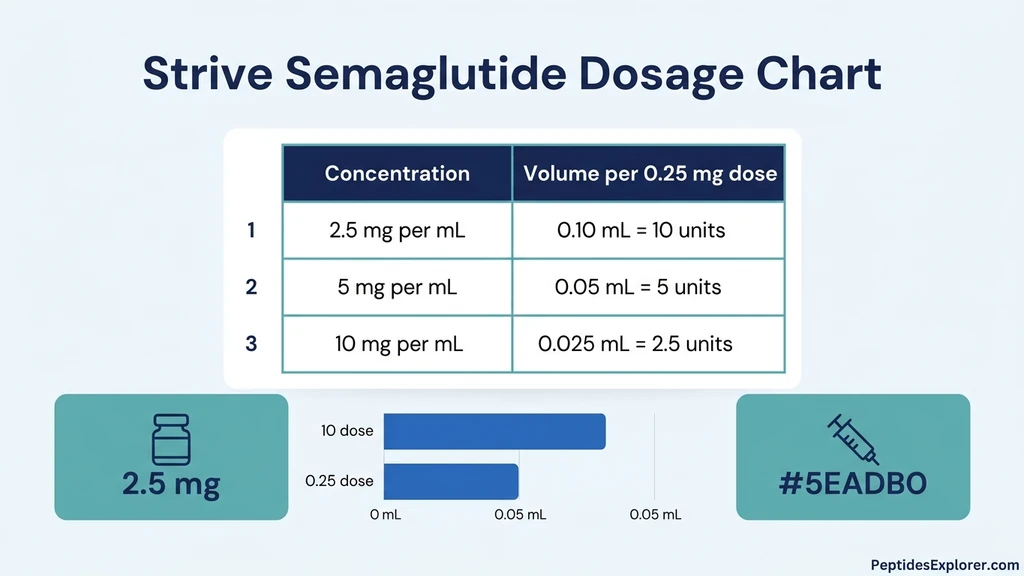
You are searching for the Strive Pharmacy semaglutide dosage chart because you want two things: a review of Strive Pharmacy as a compounding source, and a reliable dose-to-mL conversion table you can pin to the fridge. Strive Pharmacy is a US-based compounding pharmacy that dispenses compounded semaglutide through telehealth partners and direct-prescription workflows. Dosing charts for compounded semaglutide are not brand-specific. The correct mL volume for any given milligram dose depends entirely on the concentration of the vial the pharmacy ships you, which varies across 2.5 mg/mL, 5 mg/mL, and 10 mg/mL formulations. Before memorizing any chart, verify the exact concentration printed on your vial label. The rest of this guide walks through the legitimacy checklist you should apply to any compounding pharmacy including Strive, a mock dosing chart at the three most common concentrations, and the context for how Strive compares to brand Wegovy, LillyDirect, and other telehealth compounded providers.
| Quick Reference | Detail |
|---|---|
| Company type | Compounding pharmacy (503A/503B depending on state) |
| Product | Compounded semaglutide, various concentrations |
| Typical concentrations shipped | 2.5 mg/mL, 5 mg/mL, 10 mg/mL |
| Prescription model | Through telehealth partners or direct physician Rx |
| FDA status of product | Compounded, not FDA-approved |
| Typical price range | ~$150-$350/month depending on dose and partner |
| Compared to brand Wegovy | ~60-85% lower cost if insurance does not cover brand |
| Dosing chart validity | Concentration-specific, not brand-specific |
Compounded semaglutide dosing is a math problem, not a brand problem. The same 0.25 mg starting dose requires 0.1 mL from a 2.5 mg/mL vial, 0.05 mL from a 5 mg/mL vial, and 0.025 mL from a 10 mg/mL vial. Misreading the concentration is the single most common cause of accidental overdose with compounded GLP-1s. For the foundational dose math, see semaglutide dosage chart mL and semaglutide mixing chart.
This is educational content. Verify current pricing, licensure, and the exact concentration on your vial label before drawing any dose.
Get your custom peptide protocol:
- Tailored to your body and goals
- Precise dosing and cycle length
- Safe stacking combinations
- Backed by peer-reviewed studies
- Ready in under 2 minutes
What Strive Pharmacy Actually Is
Strive Pharmacy is a compounding pharmacy, not a telehealth company. Your prescription reaches Strive through one of three routes: a telehealth partner, a direct-to-consumer arm operated with Strive, or your own physician sending a compounded Rx.
What Strive does: - Compounds semaglutide from active pharmaceutical ingredient under state pharmacy licensure - Fills prescriptions from licensed prescribers - Ships cold-chain to US states where licensed - Dispenses common concentrations at 2.5 mg/mL, 5 mg/mL, and 10 mg/mL - May offer formulations with B12, niacinamide, or pure semaglutide in bacteriostatic water
What Strive does not do: - Dispense brand-name Wegovy or Ozempic - Operate as a telehealth clinic on its own (you need a prescription) - Accept insurance for compounded semaglutide - Guarantee availability in every state (licensure is state-by-state)
Why concentration matters more than the brand: Compounded semaglutide is semaglutide. The active molecule is the same whether from Strive or the API Novo Nordisk uses for Wegovy. What changes between pharmacies is formulation: concentration, diluent, and additives. Your dosing chart lives and dies by the concentration printed on the label.
For alternative providers, see Vitastir tirzepatide, Citizen Meds tirzepatide complete guide, and how much is semaglutide.
The Strive Pharmacy Semaglutide Dosing Chart (By Concentration)
Here is the core chart. Read the concentration off your vial label first, then find your target milligram dose on the left, then draw the matching mL volume. Do not apply a chart from a different concentration to your vial. The math will be wrong and the dose will be off by 2x, 4x, or more.
Concentration: 2.5 mg/mL (lower-concentration starter vials)
| Target Dose (mg) | Volume to Draw (mL) | Units on U-100 Syringe |
|---|---|---|
| 0.25 mg | 0.10 mL | 10 units |
| 0.5 mg | 0.20 mL | 20 units |
| 1.0 mg | 0.40 mL | 40 units |
| 1.7 mg | 0.68 mL | 68 units |
| 2.4 mg | 0.96 mL | 96 units |
Concentration: 5 mg/mL (most common mid-range concentration)
| Target Dose (mg) | Volume to Draw (mL) | Units on U-100 Syringe |
|---|---|---|
| 0.25 mg | 0.05 mL | 5 units |
| 0.5 mg | 0.10 mL | 10 units |
| 1.0 mg | 0.20 mL | 20 units |
| 1.7 mg | 0.34 mL | 34 units |
| 2.4 mg | 0.48 mL | 48 units |
Concentration: 10 mg/mL (high-concentration vials for maintenance or high-dose patients)
| Target Dose (mg) | Volume to Draw (mL) | Units on U-100 Syringe |
|---|---|---|
| 0.25 mg | 0.025 mL | 2.5 units |
| 0.5 mg | 0.05 mL | 5 units |
| 1.0 mg | 0.10 mL | 10 units |
| 1.7 mg | 0.17 mL | 17 units |
| 2.4 mg | 0.24 mL | 24 units |
How to read these charts safely:
- 1.Check the label. The concentration is printed in mg/mL.
- 2.Pick the chart that matches your concentration. Ignore the other two.
- 3.Cross-reference with an independent calculator. Use the semaglutide dosage calculator to double-check any dose before injection.
- 4.Use insulin syringes labeled "U-100" or "100 units per mL." A U-100 syringe holds 1 mL total, and each unit equals 0.01 mL. That is why the "units" column above maps 1:1 to 100 x mL.
- 5.At high concentrations (10 mg/mL), the starting doses are very small volumes. 0.025 mL is barely visible in a standard insulin syringe and is where most dosing errors cluster. If your starting dose is that small, ask whether you can receive a lower-concentration vial instead.
For the full standard titration schedule (starting at 0.25 mg and stepping up every 4 weeks), see semaglutide titration schedule and semaglutide dosage chart mL. For microdosing strategies, see how to microdose semaglutide.
The Legitimacy Checklist for Any Compounding Pharmacy
Before trusting Strive or any compounder with injectable GLP-1s, verify the following. This checklist applies to every competitor too.
1. State pharmacy licensure. A compounding pharmacy needs a license in its origin state and a non-resident pharmacy license in your state. Verify on your state Board of Pharmacy website. Red flag: the pharmacy cannot confirm non-resident licensure in your state.
2. PCAB accreditation or 503B registration. PCAB is the voluntary gold standard for 503A compounders. 503B outsourcing facility registration with the FDA is a higher tier with batch-level testing. Red flag: no accreditations and no willingness to discuss quality controls.
3. Formulation disclosed on the label. A legitimate label states drug name, concentration (mg/mL), total volume, additives (B12, niacinamide, or none), lot number, expiration date, and pharmacy name. Red flag: hand-written details or missing lot numbers.
4. A licensed prescriber in your state. Even through a telehealth partner, the prescriber must be licensed where you live. Red flag: the pharmacy fills a prescription from a provider not licensed in your state.
5. Sterility and beyond-use-dating. Compounded semaglutide typically carries a BUD of 28 to 60 days after compounding or first puncture, depending on USP 797 classification. Red flag: no BUD printed or storage guidance refused.
6. Regulatory transparency. As of 2026, compounded semaglutide status has shifted around FDA shortage-list determinations. A legitimate pharmacy explains the current legal basis. Red flag: claims that compounded semaglutide is FDA-approved. It is not.
For regulatory context, see is compound tirzepatide safe (same framework applies to semaglutide) and how much is semaglutide.
Strive Pharmacy Pricing in Context
Strive Pharmacy itself does not set the consumer price in most cases. You pay the telehealth partner, and the telehealth partner pays Strive for fulfillment. That means the price you see depends heavily on which telehealth platform routes your prescription to Strive. General price bands typical for compounded semaglutide dispensed through Strive-class compounders:
Entry dose (0.25-0.5 mg weekly): Typically $150-$225/month. At 5 mg/mL concentration, a single 2.5 mL vial lasts roughly 5 weeks at 0.5 mg weekly, which is the economic unit most pharmacies price around.
Mid dose (1.0 mg weekly): Typically $200-$275/month.
High dose (1.7-2.4 mg weekly): Typically $275-$350/month. At the highest dose, patients often move to 10 mg/mL vials to keep weekly injection volume under 0.25 mL.
Comparison to brand-name Wegovy and Ozempic: - Novo Nordisk Wegovy list price: roughly $1,350/month - With manufacturer savings card (commercial insurance, uncovered): roughly $650/month - Direct-to-patient Wegovy self-pay program: varies, often around $500/month at lower doses - With insurance coverage for obesity (less common): $25-100 copay
Comparison to other compounded semaglutide providers: - Henry Meds: roughly $300/month flat - Ro (Roman): roughly $200-400/month depending on dose - Hims/Hers: roughly $200-400/month - Direct through a local compounding pharmacy: roughly $200-350/month, sometimes lower
Hidden cost considerations: - Consultation or intake fees charged by the telehealth partner before your first vial ships - Dose-change fees (some partners charge, most do not) - Cold-chain shipping surcharges in summer - Multi-month prepay discounts that lock you in before you have seen the product
Value calculation: If insurance covers brand Wegovy at a low copay, that is almost always the best choice (FDA-approved, standardized, full stability data). If it does not cover and self-pay for brand is not sustainable, Strive-class compounded products at $150-$350/month are a reasonable option when the legitimacy checklist above is satisfied.
Use the peptide cost calculator to compare options side by side. For broader cost context, see how much is semaglutide.
Red Flags for Any Compounded Semaglutide Source
These red flags apply to the entire compounded GLP-1 industry, not specifically to Strive:
Doses above the evidence base. The highest FDA-approved maintenance dose for semaglutide in obesity (brand Wegovy) is 2.4 mg weekly. The pivotal STEP-1 trial that established this ceiling produced 14.9% mean body-weight loss at 2.4 mg over 68 weeks (Wilding et al., 2021). Providers selling "5 mg" or "ultra-dose" protocols are operating outside evidence.
Before/after photos with no verification. Real efficacy comes from trials (STEP 1 through STEP 8 for semaglutide), not marketing galleries. STEP-1 enrolled 1,961 adults with overweight or obesity without diabetes and randomized them to 2.4 mg semaglutide vs placebo plus lifestyle intervention, producing the foundational efficacy evidence for semaglutide in chronic weight management (Wilding et al., 2021).
Proprietary blends. A legitimate compounded semaglutide vial discloses concentration, diluent, and additives. "Proprietary peptide matrix" or undisclosed additive lists are a hard no.
Pressure-sell tactics. Semaglutide is a maintenance medication. Limited-time offers and countdown timers are sales manipulation.
No refund for unshipped doses. You should always be able to cancel and get a refund for product that has not left the pharmacy yet.
Vague pharmacy attribution. "Our US-based partner pharmacies" without naming them is not transparency. A legitimate telehealth partner either names Strive specifically or gives you a short list of compounders any given order could come from.
"FDA-approved" claims for compounded semaglutide. The molecule is characterized by the FDA; the specific compounded finished product is not FDA-approved. FDA pharmacovigilance review of FAERS reports for compounded GLP-1s has documented dosing errors, inadvertent overdoses, and product quality issues attributed specifically to the regulatory gap between compounded and brand-name product (Hoffman et al., 2025). Any provider that implies otherwise is misleading you.
No prescriber review. If the signup process does not include review by a prescriber licensed in your state, that is not compliant prescribing.
Doses that auto-escalate. Legitimate providers update dose based on tolerability and weight trajectory. Auto-escalation on a schedule regardless of how you feel is poor clinical practice.
Inconsistent vial labels. If every shipment looks different, if the concentration changes without explanation, or if the lot number is missing, stop using the product and escalate to the pharmacy and your prescriber. For what a correct vial looks like, see semaglutide mixing chart.
How Strive Pharmacy Compares to Alternatives
If you are weighing Strive against other compounding sources, here are the usual alternatives and the differentiators.
Strive vs other compounding pharmacies (Empower, Olympia, Tailor Made, Belmar, Hallandale): - All are 503A/503B compounders operating in the same regulatory envelope - Differentiators are state licensure map, turnaround time, specific formulations offered, and which telehealth partners route to them - None of these compounders are a substitute for FDA-approved brand product on quality; the differentiator is logistics and price
Strive vs brand Wegovy through LillyDirect or Novo Nordisk direct: - LillyDirect does not sell semaglutide (Lilly makes tirzepatide). For brand semaglutide direct, you generally go through your pharmacy with a prescription. - Novo Nordisk has offered direct-to-patient Wegovy programs at reduced prices; availability and terms shift. - Brand is FDA-approved, stability-tested, and fully standardized. The trade-off is price.
Strive vs Vitastir and Henry Meds (telehealth brands): - Vitastir and Henry Meds are telehealth platforms, not pharmacies. They may route to Strive or to other compounders. - The experience (intake, portal, subscription) comes from the telehealth side. - See Vitastir tirzepatide for the telehealth-side evaluation framework.
Strive vs Citizen Meds: - Citizen Meds is a telehealth platform with its own pharmacy relationships. - Similar price band and compounding regulatory posture. - See Citizen Meds tirzepatide complete guide for a comparable review framework.
Strive vs a direct local compounding pharmacy: - You can walk into a PCAB-accredited local compounding pharmacy with a prescription from your own physician and often get comparable or lower prices. - Requires an in-person physician who is comfortable writing compounded GLP-1 prescriptions. - Cuts out the telehealth subscription fee entirely.
The rule of thumb: for most patients, if insurance covers brand semaglutide use it. If not, compare telehealth compounded options (with Strive on the pharmacy side) against a direct local compounder with your own prescriber. Both are valid; the local route is cheaper if you have a willing prescriber, while telehealth-to-Strive is easier if you do not. For compounded tirzepatide parallels, see compound tirzepatide dosage chart.
Frequently Asked Questions
Is Strive Pharmacy legit?
Strive Pharmacy is a US-based compounding pharmacy operating in the same 503A/503B framework as most compounders dispensing semaglutide. Its legitimacy depends on the same factors as any compounder: verified state licensure in both the origin and destination state, PCAB accreditation or 503B registration where applicable, clear vial labeling including concentration and lot number, and a prescribing provider licensed in your state. Apply the legitimacy checklist in this article to any source before purchase. For a similar compound GLP-1 evaluation, see Vitastir tirzepatide.
Why does the Strive Pharmacy semaglutide dosage chart change based on concentration?
Because compounded semaglutide can be dispensed at 2.5 mg/mL, 5 mg/mL, 10 mg/mL or other concentrations, the volume you draw for a given milligram dose changes proportionally. A 0.25 mg dose is 0.10 mL at 2.5 mg/mL, 0.05 mL at 5 mg/mL, and 0.025 mL at 10 mg/mL. The milligram dose is the medical instruction; the mL volume is a concentration-dependent translation. Always read the concentration off your vial label before using any chart. For the underlying math, see semaglutide mixing chart.
What concentration does Strive Pharmacy ship semaglutide at?
Strive, like most compounders, dispenses multiple concentrations depending on the prescriber's order and the patient's dose. Common concentrations are 2.5 mg/mL, 5 mg/mL, and 10 mg/mL. Higher concentrations are typical at maintenance doses to keep injection volume small; lower concentrations are typical at starter doses to make volume measurement easier. The concentration is printed on the vial label. If the label is unreadable or missing, do not inject; contact the pharmacy. See semaglutide dosage chart mL for dosing math at each concentration.
How much does Strive Pharmacy semaglutide cost?
Typically $150 to $350 per month, depending on dose level and which telehealth partner routes your prescription. Entry doses (0.25-0.5 mg weekly) are on the lower end; maintenance doses (1.7-2.4 mg weekly) are on the higher end. Strive is the fulfillment pharmacy, not the consumer billing entity in most cases. Verify total cost including any telehealth consultation or intake fees. Use the peptide cost calculator to compare.
Is Strive Pharmacy semaglutide the same as Wegovy or Ozempic?
No. Wegovy and Ozempic are Novo Nordisk's FDA-approved brand-name semaglutide products. Strive dispenses compounded semaglutide made by compounding pharmacies using the raw semaglutide active ingredient. The active molecule is semaglutide in all three, but the finished product is regulated differently. Compounded semaglutide is not FDA-approved. For the full standard titration schedule that applies to any semaglutide, see semaglutide titration schedule.
Is it legal to get semaglutide through Strive Pharmacy?
The legality depends on FDA's current position on semaglutide shortage status. When semaglutide is on the FDA shortage list, 503A compounding is explicitly allowed. When it is off the list, compounding is restricted to specific circumstances (such as documented allergies to brand product components or specific dose needs not available in brand form). The situation has shifted multiple times in 2024-2026. A legitimate pharmacy and prescriber will disclose the current legal basis. For broader compound GLP-1 regulatory context, see is compound tirzepatide safe.
Does Strive Pharmacy ship to every state?
No. Compounding pharmacies need a non-resident pharmacy license to ship into any state where they do not physically operate. Licensure is state by state and changes over time. Your telehealth partner or Strive's intake process should confirm whether they ship to your state before you pay. Some states (notably California, Texas, and New York) have stricter rules for compounded GLP-1s that may limit what can be shipped in. See how to microdose semaglutide for situations where lower-volume doses may affect your state's compliance requirements.
What should I check on a Strive Pharmacy semaglutide vial when it arrives?
Check, in order: drug name (semaglutide), concentration (mg/mL printed clearly), total volume (mL), any additives (commonly B12 or niacinamide, or none), lot number, beyond-use-date (BUD), and the compounding pharmacy name (Strive Pharmacy or the specific Strive branch). Refrigerate immediately on arrival. If the vial is cloudy, has particulates, or shows any label irregularity, do not use it; contact the pharmacy. For a step-by-step handling and mixing guide, see semaglutide mixing chart.
Can I use a dosing chart from a different compounding pharmacy with my Strive vial?
Only if the concentrations match. A 5 mg/mL chart is a 5 mg/mL chart regardless of whether Strive, Empower, or any other compounder shipped the vial. What you cannot do is apply a 2.5 mg/mL chart to a 5 mg/mL vial; that error doubles your dose. Always confirm the concentration on your specific vial label before using any chart. For independent verification, use the semaglutide dosage calculator.
The Bottom Line
Strive Pharmacy is a compounding pharmacy that sits on the fulfillment side of the compounded semaglutide ecosystem. Its general value proposition is compounded semaglutide at a lower monthly cost than brand Wegovy, shipped to most US states through telehealth partners or direct prescriptions. Strive's legitimacy depends on the same factors that apply to every compounder in this category: is the pharmacy licensed in both its origin state and your state, is it PCAB-accredited or 503B-registered, does every vial arrive with a complete label (concentration, volume, additives, lot number, BUD, and pharmacy name), and is the prescribing provider licensed in your state.
Because compounded semaglutide pricing and regulatory status shift frequently, any specific number in this article can be out of date within weeks. Verify current pricing, licensure, and legal status directly with Strive and the telehealth partner or prescriber before subscribing. Do not prepay for more than 1 to 3 months until you have seen the product and vial labeling firsthand.
The dosing chart in this article is concentration-specific. That is the most important single thing to take away. A milligram dose is a medical instruction; a milliliter volume is a translation that depends entirely on the concentration of the specific vial you hold in your hand. Reading the concentration off the label before drawing any dose is non-negotiable. For double-checking the math, use the semaglutide dosage calculator or cross-reference semaglutide dosage chart mL and semaglutide mixing chart.
For most patients, the decision tree is: first check whether insurance covers brand Wegovy or Ozempic (if yes, use that). If not, compare manufacturer self-pay programs against compounded telehealth options (Strive on the pharmacy side at $150-$350/month). The price difference is real; so is the regulatory gap. The legitimacy checklist in this article applies to Strive and to every compounded semaglutide source.
For related reading, see Vitastir tirzepatide for the telehealth-side evaluation framework, Citizen Meds tirzepatide complete guide for a parallel review, semaglutide titration schedule for the standard dose ramp, is compound tirzepatide safe for the regulatory context (same framework applies to semaglutide), how much is semaglutide for full cost comparisons, and how to microdose semaglutide for low-dose protocols.
Related Articles: - Semaglutide Dosage Chart mL - Semaglutide Mixing Chart - Semaglutide Titration Schedule - Vitastir Tirzepatide - Is Compound Tirzepatide Safe - Compound Tirzepatide Dosage Chart - How Much Is Semaglutide - How to Microdose Semaglutide
Related Articles
ElixaMD Reviews (2026): Is It Legit?
ElixaMD reviews 2026: $99/mo GLP-1 telehealth with a 4.3 Trustpilot from 22 reviews, a domain registered in 2025, and refund complaints. Verdict inside.
NextGen Peptides Review (2026): Legit or Not?
NextGen Peptides review 2026: 4.7 Trustpilot, 131-batch COA library, US-only shipping. Why ngpeptide.com is not the scam-flagged NextGenPeps lookalike.
Ro Weight Loss Cost: 2026 Pricing
Ro weight loss cost in 2026: $145-149/mo membership ($39-45 first month) plus $149-349/mo medication cash, or a copay under $50 with insurance.
Prime Peptides Review (2026)
Prime Peptides review 2026: Janoshik-tested vendor with a 2024 FDA warning letter and batch purity swings. Verdict, scorecard, and how to verify your vial.