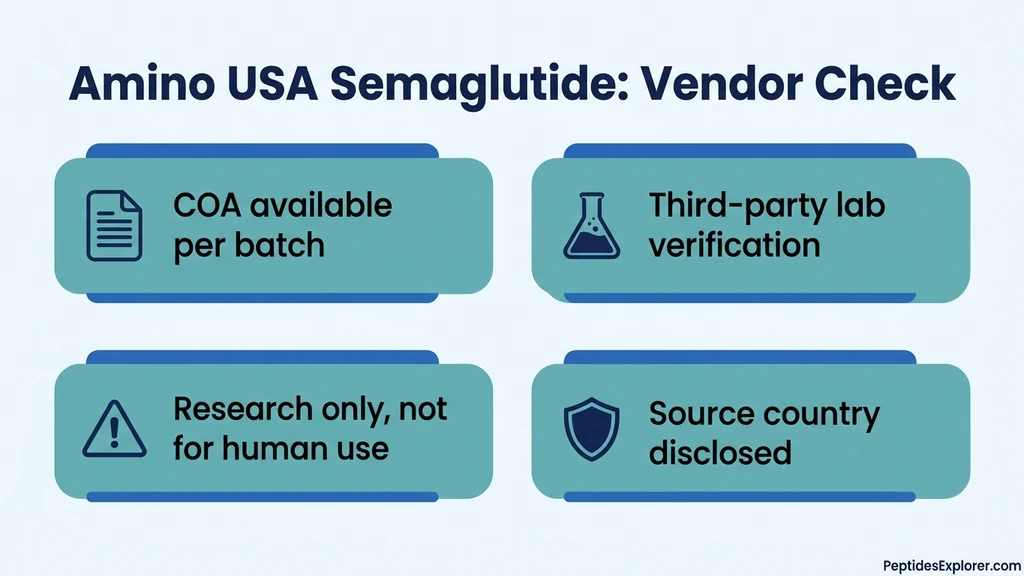
You are looking at the Amino USA website, scrolling past photos of vials and price tables, and you want to know whether the company actually ships clean semaglutide before you place an order. Amino USA is a research peptide vendor (not a compounding pharmacy and not a telehealth clinic). Their semaglutide is sold "for research use only" with the standard "not for human consumption" disclaimer. To evaluate them, you need four data points: do they publish third-party Certificates of Analysis (COAs) by lot, is there a verifiable US business address, can you identify the source country of the active pharmaceutical ingredient, and what is their refund policy on damaged or off-spec product. Without those four answers, the price on the screen is meaningless.
| Quick Reference | Detail |
|---|---|
| Company type | Research chemical vendor (not a pharmacy) |
| Product framing | "For laboratory research use only" |
| FDA status | Not FDA-approved; not legally for human use |
| Common products | Semaglutide, tirzepatide, BPC-157, GHK-Cu, retatrutide |
| What to verify | Per-lot COA, business address, API source, refund policy |
| Pricing band | Mid-tier research peptide pricing |
| Acceptable payment | Verify before buying (credit card vs crypto changes refund recourse) |
| Compared to brand Wegovy | Lower price, no FDA backing, no clinical oversight |
Brand-name semaglutide (Ozempic, Wegovy, Rybelsus) is FDA-approved and backed by the STEP and SUSTAIN trials. The STEP-1 trial showed mean weight reductions of 14.9% over 68 weeks at 2.4 mg weekly (Wilding et al., 2021). Research-grade semaglutide from a vendor like Amino USA uses the same active molecule but bypasses every quality control step that produces those clinical results. For the broader regulatory picture, see are peptides legal and our peptide safety guide.
This is educational content about how to evaluate a research peptide vendor. Nothing here is medical advice or an endorsement of using research chemicals on yourself. If you are seeking semaglutide for weight loss, work with a licensed prescriber and consider a regulated pathway like LillyDirect, an insurance-covered prescription, or a vetted telehealth provider such as Henry Meds or Mochi Health.
Get your custom peptide protocol:
- Tailored to your body and goals
- Precise dosing and cycle length
- Safe stacking combinations
- Backed by peer-reviewed studies
- Ready in under 2 minutes
What Amino USA Actually Is (And Is Not)
Amino USA sits in the same category as Polaris Peptides, Transcend Peptides, and dozens of other research chemical suppliers that proliferated after the 2022 GLP-1 shortage. The business model is straightforward: import or commission lyophilized peptide powders, fill vials, list them on a website with a "research use only" disclaimer, and ship to a credit card or crypto-paying customer.
What Amino USA is not:
- 1.A compounding pharmacy. Compounding pharmacies operate under FDA 503A or 503B registration, employ licensed pharmacists, follow USP 797 sterility standards, and are inspected by state boards of pharmacy. Research vendors do none of those things.
- 2.A telehealth provider. There is no medical consult, no prescribing physician, no aftercare. The website does not collect medical history because the product is not intended for human use.
- 3.An FDA-approved drug source. The FDA has only approved semaglutide as Ozempic, Wegovy, and Rybelsus from Novo Nordisk. Compare that with Henry Meds, Ivim Health, or Mochi Health, which use 503A compounding pharmacies under prescription oversight.
What Amino USA likely is, based on the standard research vendor template:
- A US-registered LLC (verify in the corresponding state's business filings)
- A reseller of bulk peptide powder synthesized in China, India, or domestic CMOs
- A small operation with limited staff, often without an in-house chemist
- A direct-to-consumer storefront that depends on the legal fiction that buyers are "researchers"
This matters because semaglutide was discovered and developed through a multi-decade program at Novo Nordisk that produced one of the most carefully studied weight loss molecules in modern medicine (Lau et al., 2015). The STEP-1 trial that established its weight loss efficacy enrolled 1,961 patients across 16 countries with continuous safety monitoring (Wilding et al., 2021). A research vial from any vendor including Amino USA bypasses that infrastructure entirely.
The molecule may be identical. The quality assurance is not. For broader vendor comparisons, see Polaris Peptides reviews and Transcend Peptides reviews.
The Four-Question Vendor Test (Apply to Amino USA and Anyone Else)
Before you spend money with any research peptide vendor, run these four checks. They take fifteen minutes. They are the difference between a clean lyophilized powder and a vial of unknown content with the right label.
Question 1: Is there a per-lot Certificate of Analysis you can read?
A Certificate of Analysis (COA) is a third-party lab report showing identity, purity, mass spec confirmation, and (ideally) endotoxin content for a specific batch. The gold standard:
- Report from a named, independent lab (not a "tested in our facility" claim)
- Lot number on the COA matches the lot number on your vial
- HPLC purity above 98%
- Mass spectrometry confirming the molecular weight of semaglutide (4113.6 g/mol)
- Endotoxin level reported in EU/mg
Red flag: a generic "purity certificate" with no lot number, dated months before your batch shipped, signed by someone you cannot find. Acceptable: a current PDF tied to your specific lot, viewable on the product page or on request.
Question 2: Can you verify the US business address?
Pull the address from the Amino USA website footer or terms page. Cross-reference with:
- Secretary of State business registration in the listed state
- Google Maps street view to confirm a real building (not a UPS Store mailbox)
- WHOIS data on the domain (note: many use privacy proxies, which is normal but limits verification)
A research vendor that ships from a physical fulfillment center in the US has more accountability than one operating purely through an offshore proxy.
Question 3: Where is the active pharmaceutical ingredient (API) made?
Most research-grade semaglutide originates from one of three sources:
- Chinese CMOs (contract manufacturing organizations) like Hangzhou Dayangchem, Jiangsu Aoduo, or smaller players. Quality varies enormously.
- Indian CMOs, less common for GLP-1 peptides
- Smaller US or European peptide synthesis labs (rare for this molecule due to cost)
A reputable research vendor will tell you the source if asked through customer support. A vendor that refuses, or claims it is "proprietary," is hiding something. Knowing the API source lets you cross-reference with independent testing data on Reddit's research peptide subreddits or testing services like Janoshik Analytics or Finnrick Analytics.
Question 4: What is the refund policy on damaged or contaminated product?
A clean policy reads roughly: "If your shipment arrives damaged, photograph it before opening, contact support within 48 hours, and we will replace or refund." A bad policy reads: "All sales final. No refunds." A predatory policy makes you ship the damaged vial back at your expense for a partial refund.
Pay attention to the payment method too. Credit card purchases give you chargeback rights through Visa or Mastercard. Crypto payments (often discounted 5 to 10%) give you no recourse. The discount exists because the vendor wants to avoid chargebacks. That is a structural signal.
For more on evaluating vendors broadly, see where to buy peptides 2026 and our peptide safety guide.
What Amino USA Likely Sells (Product Range)
Research peptide vendors carry overlapping catalogs because they are mostly buying from the same handful of upstream suppliers. Based on the standard mix, expect Amino USA to list:
GLP-1 family: - Semaglutide (typically 5 mg or 10 mg vials) - Tirzepatide (typically 10 mg, 15 mg, or 30 mg vials) - Retatrutide (typically 10 mg) - Survodutide, mazdutide, cagrilintide on some catalogs
Healing and recovery: - BPC-157 (5 mg or 10 mg) - TB-500 / Thymosin Beta-4 (5 mg) - GHK-Cu (50 mg or 100 mg) - KPV (5 mg or 10 mg)
Growth hormone family: - CJC-1295 with or without DAC - Ipamorelin - Sermorelin - Tesamorelin
Sexual health and skin: - PT-141 (Bremelanotide) - Melanotan II
The semaglutide listing usually shows up at $20 to $40 for a 5 mg vial, or $40 to $80 for 10 mg. Tirzepatide runs roughly $50 to $90 for 10 mg, $200 to $300 for 30 mg. These are typical research-vendor prices and do not reflect product quality directly. A cheap vial can be clean; an expensive vial can be junk. Price is not a proxy for purity.
Compare these to legitimate compounded options at telehealth providers: Mochi Health charges $99 per month for compounded semaglutide and includes a prescribing physician. Ivim Health and Henry Meds operate similarly. The price gap reflects regulatory and clinical infrastructure, not just markup.
For dosing math once you have product, use the semaglutide dosage calculator and the reconstitution calculator. For the standard semaglutide titration ladder, see our semaglutide dosage chart and semaglutide titration schedule.
Red Flags to Watch For on Any Research Peptide Site
Apply these red flags to Amino USA and to every research peptide vendor you consider. They are vendor-agnostic.
No COAs anywhere on the site. A real research supplier will at least claim COAs are available on request. A site with zero quality documentation is not serious about quality.
COAs that are years old or unsigned. A 2022 COA on a 2026 batch is meaningless. Lot-specific testing is the only meaningful purity proof.
Generic stock photos of vials. Vendors that use the same vial photo as five other sites are not running their own fill operation. They are dropshipping.
No physical US address in the footer. A PO Box or generic city name without a street address means there is nothing to inspect and nowhere to serve papers.
Crypto-only or crypto-strongly-preferred payment. Discounts of 10% or more for crypto signal a desire to avoid credit card chargeback rights. That is not necessarily fraud, but it shifts all risk to you.
Claims of "pharmaceutical grade" without testing data. "Pharmaceutical grade" has a real regulatory meaning under USP standards. A research vendor cannot legally sell "pharmaceutical grade" finished product without compounding pharmacy registration. The phrase on a research site is marketing.
Implied human use language. Phrases like "for your wellness journey" or before-and-after weight loss photos on a research vendor's site are a regulatory tell. The FDA can and does pursue vendors that step over the research-use-only line. A site that does this is either reckless or about to disappear.
No batch numbering on vials. Without a lot number, you cannot trace a problem back to a specific production run. This is basic supply chain hygiene that real labs follow.
"Pharmacy" in the name without a state pharmacy license. If "Amino USA Pharmacy" or similar appears anywhere, verify state board of pharmacy registration. Calling yourself a pharmacy when you are not is a serious violation.
Aggressive launch sales and rotating discount codes. Legitimate suppliers compete on quality and consistency. The vendors that lean hardest on $50-off coupons and 24-hour flash sales are usually the ones with the highest churn.
For the regulatory backdrop on why these signals matter, see FDA peptide crackdown 2026, are peptides legal, and is compound tirzepatide safe.
Amino USA vs the Alternatives
The right comparison depends on what you actually want. If the goal is "I want to lose weight on semaglutide," a research vendor like Amino USA is the wrong tool, regardless of how clean the product is. The right tool is a prescriber.
Amino USA vs LillyDirect or Wegovy through insurance: Wegovy through insurance with a manufacturer savings card runs $25 to $100 per month at the pharmacy counter. The product is FDA-approved, manufactured by Novo Nordisk under cGMP standards, and supported by the STEP trial program (Wilding et al., 2021). If insurance covers it, no research vendor competes on a quality-adjusted basis.
Amino USA vs telehealth compounded providers (Henry Meds, Mochi, Ivim): Compounded semaglutide through a telehealth provider runs $99 to $300 per month and includes a prescribing physician, a 503A compounding pharmacy, and aftercare. The product is still not FDA-approved (compounded drugs never are), but the regulatory floor is meaningfully higher than a research vendor's. See Mochi Health reviews, Henry Meds reviews, and Ivim Health reviews for detailed comparisons.
Amino USA vs other research vendors (Polaris, Transcend, Marek): Among research vendors, the differentiator is testing transparency. Vendors that publish per-lot COAs from named third-party labs (like the Finnrick or Janoshik testing many subreddits track) sit in the top tier. Vendors that publish nothing sit at the bottom. See Polaris Peptides reviews, Transcend Peptides reviews, and Marek Health reviews for tested comparisons.
Amino USA vs grey-market international pharmacies: Some buyers consider importing brand-name Ozempic from international pharmacies (Canadian, UK, Indian). This is also legally complicated and often produces counterfeits. The brand-name product through those channels is not necessarily safer than a research vendor with strong COAs.
The honest summary: if you have a prescription pathway available, use it. If you do not and you are a researcher with documented research use, choose a research vendor based on COA transparency and consistent third-party testing data. Amino USA fits or fails that test based on what they actually publish.
For the broader source-of-supply discussion, see where to buy semaglutide and where to buy peptides 2026.
Questions to Email Amino USA Before Ordering
If you cannot find the answers on their website, write to customer support and ask directly. The quality of the response is a quality signal in itself. A serious vendor answers in plain language within 48 hours. A weak vendor either ignores you or sends a templated non-answer.
The five email questions:
- 1."Can you send me the third-party Certificate of Analysis for the current semaglutide lot you would ship me today? I want to see the lab name, lot number, HPLC purity percentage, and mass spec confirmation."
- 1."Where is the semaglutide active pharmaceutical ingredient synthesized? I am asking for the country of origin and, if possible, the contract manufacturer name."
- 1."What is your physical fulfillment address, and is there a phone number where I can reach a person during business hours?"
- 1."If a vial arrives broken or the COA does not match the listed purity, what is your replacement and refund policy? Do I need to return the damaged vial?"
- 1."Are you registered as a pharmacy or compounding pharmacy with any state board? If so, which one?"
The acceptable answers respectively:
- 1.A direct PDF or link to a current, lot-specific COA. Anything vaguer is a red flag.
- 2.A specific country (most likely China). "Proprietary" is not an acceptable answer.
- 3.A real US street address and a phone or chat support that connects to a human within one business day.
- 4.A clear policy in writing. Replacement on damage with photo evidence, refund on contamination per COA mismatch.
- 5.Honesty. If the answer is no, that is fine. If the answer is yes, verify with the named state board.
A vendor that handles all five questions cleanly is in the top quartile of the research peptide market. A vendor that ducks even one of them is not worth your money. For storage and handling once your vial arrives, see how to store peptides and how long do reconstituted peptides last. For reconstitution math, see how to reconstitute peptides.
When Research Vendors Become a Bad Idea
Some situations make research-vendor semaglutide a worse choice than usual, even if the COA looks clean.
You have type 2 diabetes. Semaglutide affects blood glucose and insulin sensitivity. Without medical monitoring, hypoglycemia from semaglutide stacked with sulfonylureas or insulin can land you in the ER. A telehealth or in-person prescriber is essential.
You have a history of pancreatitis or gallbladder disease. Semaglutide increases gallbladder events and has post-marketing reports of pancreatitis. A licensed prescriber screens for these risks; a research vendor does not.
You are pregnant, planning pregnancy, or breastfeeding. Semaglutide is contraindicated in pregnancy. Research-vendor purchases circumvent the screening that prevents this exposure.
You take multiple chronic medications. GLP-1 drugs slow gastric emptying, which changes the absorption kinetics of oral medications including levothyroxine, oral contraceptives, and certain antibiotics. A pharmacist review catches these interactions.
You have a personal or family history of medullary thyroid carcinoma or MEN-2. Semaglutide carries a black box warning for thyroid C-cell tumors based on rodent data. This is an absolute contraindication.
You are under 18. Pediatric semaglutide use is approved only for adolescent obesity and only under specialist care.
You cannot reliably store and reconstitute the vial. Semaglutide degrades with heat, light, and improper reconstitution. If you do not have a working refrigerator, a steady supply of bacteriostatic water, and the discipline to follow a reconstitution protocol, the active ingredient breaks down and you are injecting degraded peptide.
In any of these scenarios, the answer is not "buy from a different research vendor." The answer is "use a prescription pathway." For more on side effects and contraindications, see semaglutide side effects, tirzepatide long-term side effects, and semaglutide contraindications.
Frequently Asked Questions
Is Amino USA legit?
Amino USA operates in the same regulatory category as most research peptide vendors. Whether they are reliable for you depends on whether they publish per-lot Certificates of Analysis from named third-party labs, whether they have a verifiable US business address, whether they disclose the source country of their semaglutide API, and whether they have a clear refund policy. Apply the four-question test in this article. See Polaris Peptides reviews for a tested-vendor comparison.
Is Amino USA semaglutide the same as Ozempic or Wegovy?
The active molecule (semaglutide) is the same in concept. The finished product is not. Ozempic and Wegovy are FDA-approved Novo Nordisk products manufactured under cGMP standards with full clinical trial backing (Wilding et al., 2021). Research-vendor semaglutide is sold for laboratory use only, has no FDA approval, no clinical oversight, and quality varies by source. See our semaglutide dosage chart for clinical reference doses.
How much does Amino USA semaglutide cost?
Research-vendor semaglutide typically prices at $20 to $40 for a 5 mg vial and $40 to $80 for 10 mg. Verify the current Amino USA pricing on their site because research peptide pricing shifts monthly. Compare against compounded semaglutide at telehealth providers like Mochi Health ($99/month including a prescribing physician) using our peptide cost calculator.
Can I legally buy semaglutide from Amino USA?
Buying research chemicals labeled "for laboratory use only" sits in a legal grey zone. The vendor frames it as a research transaction, which is permitted. Using research chemicals on yourself is not a recognized medical pathway, and the FDA has the authority to act against vendors that cross the research line into implied human use. For the regulatory backdrop, see are peptides legal and FDA peptide crackdown 2026.
Does Amino USA provide Certificates of Analysis?
You need to verify this directly with Amino USA. A reliable research vendor publishes per-lot COAs from a named, independent lab (not in-house testing claims). Ask for the COA tied to the specific lot they would ship you. If they cannot produce one within 48 hours of an email request, that is a quality signal. See where to buy peptides 2026 for vendor evaluation criteria.
What is the difference between research-grade and compounded semaglutide?
Research-grade semaglutide is sold by chemical vendors with no medical or pharmacy oversight, labeled for laboratory use only, no prescriber involved. Compounded semaglutide comes from a 503A or 503B pharmacy under a prescription, prepared by a licensed pharmacist, with sterility standards and pharmacist liability. The molecule is similar; the safety floor is meaningfully different. See Henry Meds reviews and Mochi Health reviews for compounded options.
What should I do if my Amino USA vial arrives damaged?
Photograph the package and the vial before opening, save the shipping label, and email customer support within 24 to 48 hours with the photos and your order number. A reasonable vendor will offer replacement or refund on photo evidence. If the vendor refuses or stops responding, dispute the charge with your credit card issuer. This is one reason crypto payments are riskier than cards for research peptide purchases. For storage, see how to store peptides.
How do I dose research-grade semaglutide if I am using it for a research purpose?
Research dosing protocols mirror clinical dosing as a reference point. Standard human-equivalent semaglutide titration starts at 0.25 mg weekly, escalates every 4 weeks to 0.5 mg, 1 mg, 1.7 mg, then 2.4 mg. Use the semaglutide dosage calculator and the reconstitution calculator to convert mg dose to syringe units based on your vial concentration. See semaglutide titration schedule for the full ladder.
The Bottom Line
Amino USA, like every research peptide vendor, lives or dies on the answers to four questions: do they publish per-lot Certificates of Analysis, do they have a verifiable US business address, can they tell you where the semaglutide API is synthesized, and do they have a clear refund policy that survives a damaged shipment. If you can pull all four answers out of their website or out of customer support within 48 hours, they belong in the upper tier of research vendors. If even one answer is missing, look elsewhere.
The deeper point is that research-vendor semaglutide and prescription semaglutide are different products in everything except the molecule. Brand-name Wegovy is backed by the STEP-1 trial that enrolled nearly 2,000 patients across 16 countries with continuous safety monitoring (Wilding et al., 2021). The Novo Nordisk discovery and development program ran for more than a decade and produced one of the most carefully studied weight loss molecules in modern medicine (Lau et al., 2015). A research vial bypasses every step of that infrastructure. The price reflects the absence.
If your goal is weight loss, the right pathway is a prescription. Insurance-covered Wegovy or Zepbound is the cleanest option. LillyDirect self-pay sits next. Telehealth compounded options like Mochi Health, Henry Meds, or Ivim Health cost more than research vendors but include a prescribing physician and a 503A compounding pharmacy. Use the peptide cost calculator to compare.
For broader vendor reviews and the regulatory landscape, see Polaris Peptides reviews, Transcend Peptides reviews, are peptides legal, FDA peptide crackdown 2026, and our peptide safety guide.
Related Articles: - Polaris Peptides Reviews - Transcend Peptides Reviews - Mochi Health Reviews - Henry Meds Reviews - Where to Buy Semaglutide - Are Peptides Legal - Peptide Safety Guide
Related Articles
Ameano Peptides Reviews: Vendor Quality Audit
Ameano peptides reviews: research vendor audit covering COA verification, lab testing, source purity, shipping, and how to verify vendor legitimacy.
Polaris Peptides Review 2026: 97 Samples Tested
Polaris Peptides reviewed: 97 samples tested by Finnrick. Tirzepatide A-rated (8.8/10), retatrutide D-rated. Pricing, COAs, alternatives compared.
NextGen Peptides Review (2026): Legit or Not?
NextGen Peptides review 2026: 4.7 Trustpilot, 131-batch COA library, US-only shipping. Why ngpeptide.com is not the scam-flagged NextGenPeps lookalike.
Red Rock Pharmacy Tirzepatide: Honest Review
Red rock pharmacy tirzepatide review: 503A compounding pharmacy in Las Vegas. Pricing, telehealth partners, legitimacy checklist, and red flags.