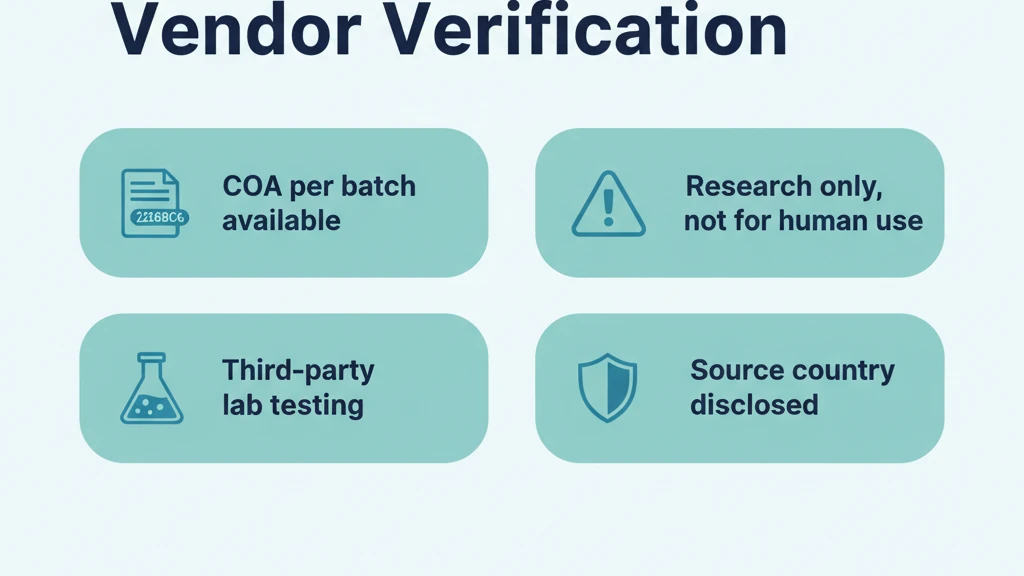
You are 14 tabs deep into research peptide vendor comparisons. Ameano keeps showing up in Reddit threads and your cart is half-full, but you cannot find a single Certificate of Analysis on their site to confirm what is actually in the vials. Ameano Peptides is a US-based research peptide vendor selling lab-grade BPC-157, GHK-Cu, semaglutide, tirzepatide, and other research compounds at competitive per-vial pricing. Unlike telehealth providers such as Henry Meds or Vitastir, Ameano sells "for research use only" products that are not prescribed and not legal for human use under FDA guidance. Vendor legitimacy in this category rests on five pillars: published Certificates of Analysis from independent labs, third-party HPLC and mass spectrometry testing, USP-grade source raw material disclosure, transparent business registration, and consistent customer reports of accurate purity and labeling. Ameano has a mixed footprint on the standard pillars and should be evaluated against competitors using the framework below. Verify current COA availability and lab partner credentials directly on the vendor site before any purchase.
| Quick Reference | Detail |
|---|---|
| Vendor type | Research peptide vendor (not telehealth) |
| Legal status | "For research use only," not for human consumption |
| Product range | BPC-157, GHK-Cu, semaglutide, tirzepatide, and other peptides |
| Typical pricing | Competitive mid-tier per vial |
| COA availability | Should be verified per product |
| Lab testing | Third-party HPLC and mass spectrometry expected |
| Source grade claim | USP-grade or research-grade per vendor |
| Comparison category | Same as Pure Rawz, Limitless Life, Amino Asylum |
Research peptides are sold under the legal fiction that buyers are running laboratory experiments. FDA does not approve research peptides for human use. Anyone considering this category should read are peptides legal and research peptides safety first. For the prescription telehealth alternative, see Vitastir tirzepatide, Henry Meds reviews, and Ivim Health reviews.
This is educational content. Vendor quality, business status, and product purity change constantly. Verify COAs and lab partners directly with the vendor before any transaction.
Get your custom peptide protocol:
- Tailored to your body and goals
- Precise dosing and cycle length
- Safe stacking combinations
- Backed by peer-reviewed studies
- Ready in under 2 minutes
What Ameano Peptides Actually Sells
Ameano operates in the research peptide vendor category. That category sells synthesized peptides labeled "for research use only" through a website checkout. The buyer is presumed to be a laboratory researcher conducting in vitro or animal experiments. FDA does not regulate this market the same way it regulates pharmaceutical products.
The product catalog typically spans:
- Healing peptides like BPC-157 and TB-500
- Cosmetic and skin peptides like GHK-Cu and copper peptides
- Growth peptides like CJC-1295, ipamorelin, and tesamorelin
- GLP-1 receptor agonists like semaglutide, tirzepatide, and retatrutide
- Nootropic peptides like selank and semax
- Sexual function peptides like PT-141
Vials typically arrive as lyophilized white powder that requires reconstitution with bacteriostatic water before any potential use. Sizes commonly run 5 mg, 10 mg, and sometimes higher for certain compounds.
Ameano falls into the same operational category as Pure Rawz, Limitless Life, Amino Asylum, Pep Sciences, and similar US research peptide vendors. The legal disclaimers are identical. The purity claims are similar. The differentiation between vendors comes down to actual lab data, customer service, shipping reliability, and consistency between batches.
What Ameano is not:
- A licensed pharmacy
- A telehealth provider
- A prescriber of any kind
- An FDA-approved source for human use products
The fundamental research peptide trade-off has not changed in years. Per-mg pricing is dramatically lower than telehealth ($30 to $80 per vial versus $250 to $400 per month subscription). Quality control is your responsibility, not a regulator's. The legal status is murky and shifting under the FDA peptide crackdown.
The pharmacology of the peptides themselves is well documented. BPC-157 has demonstrated tissue healing effects across multiple animal models (Sikiric et al., 2018) with mechanistic work showing accelerated tendon and ligament healing in rats (Sikiric et al., 2011). GHK-Cu has shown wound healing and skin regeneration properties in human and animal studies (Pickart, 2008). The peptides work. Whether the vial in front of you contains what the label says is the open question with any research vendor.
The Research Vendor Legitimacy Checklist
Vendor reviews in this category are different from telehealth reviews. You are not evaluating a doctor or a prescription. You are evaluating whether a chemical supplier delivers what they claim, on time, with verifiable lab data. Apply this 7-point checklist to Ameano and to every competitor.
1. Certificate of Analysis (COA) availability. A COA is a lab document showing the actual purity, identity, and contaminant profile of a specific batch of product. Legitimate vendors publish per-batch COAs on the product page or make them available on request. The COA must:
- Identify the specific batch or lot number
- Show purity percentage from HPLC analysis (target above 98 percent)
- Confirm peptide identity via mass spectrometry
- Document any impurities, residual solvents, or endotoxin levels
A vendor that cannot produce a COA for the specific batch you received fails the first checkpoint.
2. Independent third-party lab testing. The COA must come from an independent laboratory, not the vendor's in-house testing. Common reputable labs that test research peptides include Janoshik Analytical, Jano Lab, Auxilium Biotechnologies, and similar specialty labs. The lab name and contact should be on the COA.
3. HPLC and mass spectrometry data. HPLC (High Performance Liquid Chromatography) measures purity. Mass spectrometry confirms the peptide is the molecule it claims to be. Both are standard. A COA showing only HPLC without mass spec confirmation is incomplete.
4. USP-grade or research-grade source raw material. The starting material matters. Vendors should disclose whether their peptides are synthesized from USP-grade reagents, source country, and any GMP certification on the synthesis side. Vague language like "premium quality" without specifics is a yellow flag.
5. Business registration transparency. A legitimate US research peptide vendor has a registered business entity, a verifiable physical address, and a working customer service line. Anonymous Cash App-only operations with PO box addresses are red flags.
6. Consistent labeling and packaging. Real research peptides arrive in tamper-evident vials with complete labels: peptide name, milligram content, lot number, expiration date, and storage instructions. Hand-written labels or generic vials with no batch information indicate a downstream operation pulling from unknown sources.
7. Customer pattern over time. A single bad review does not condemn a vendor. A consistent pattern of complaints across Reddit, Trustpilot, and dedicated peptide forums (over months, not days) reveals the truth. Look for patterns in shipping, batch consistency, dosage accuracy claims, and customer service responsiveness.
For the broader safety framework, see research peptides safety, are peptides legal, and how to verify peptide quality.
How Ameano Peptides Performs on the Checklist
Apply each of the seven pillars to Ameano based on publicly verifiable signals.
COA availability. Ameano publishes lab certificates for at least some products. Verify before purchase that the specific peptide and batch you are buying has a current COA available. Vendors sometimes test only flagship products and use generic language for the rest.
Independent third-party lab. Confirm the COA names a real, contactable independent lab. Janoshik Analytical is the most common third-party testing reference in the research peptide space. A COA citing an obscure lab with no online footprint is weaker than one from a well-known testing house.
HPLC and mass spec data. Both measurements should appear on the COA. HPLC alone is incomplete. A purity number without an identity confirmation could describe a 99 percent pure but wrong molecule.
Source raw material. Most research peptide vendors source from a small number of overseas manufacturers (China, India). The vendor's job is to verify each lot before resale. Ask Ameano support directly: "What is the source manufacturer, and what is your incoming inspection process?" The quality of the answer reveals the quality of the operation.
Business registration. Search for Ameano's registered business entity in the state of operation. A legitimate Delaware LLC or California LLC with a registered agent is the minimum bar. An anonymous storefront with no corporate paper trail is a warning sign.
Labeling and packaging. Customer reports describe vials, labels, and shipping presentation that should be consistent. Read recent Reddit threads in r/Peptides or similar communities to see current customer experience.
Customer pattern. Search "Ameano peptides reddit" and "Ameano peptides reviews" filtered to the last 6 months. Filter out the obvious shill accounts (one-post history, all positive). Look for technical complaints (failed COA verification, vials arriving with wrong amount, slow shipping) versus subjective complaints (the peptide did not work as expected, which is not a vendor problem).
The honest summary based on the framework: Ameano sits in the standard mid-tier of US research peptide vendors. Not the obvious gold standard. Not an obvious scam. The same legitimacy verification you would apply to any vendor in this category applies here. If COAs verify, lab partner is real, and customer pattern over months is consistent, the vendor is operating to the standard of the category. None of which makes the underlying activity FDA-compliant for human use.
For comparable vendor evaluations, see Pure Rawz reviews, Limitless Life reviews, and where to buy research peptides.
What Concrete Verification Looks Like in Practice
Vendor verification is not abstract. It is a concrete sequence you can run in 30 minutes before any purchase.
Step one: pick the product and find the published COA. Open the Ameano product page for the peptide you want. Find the COA download or image. If there is no COA at all, stop. Do not buy.
Step two: verify the lot number on the COA matches a real testing event. A COA should reference a specific batch number, the date of testing, and the testing lab. Generic COAs that look photocopied across products are red flags. Real COAs are batch-specific.
Step three: contact the testing lab. Janoshik Analytical and similar labs will confirm if a vendor is a real client. Email the lab with the COA number and ask if it is authentic. This step alone eliminates a large fraction of fake COAs in circulation.
Step four: confirm the peptide identity on the COA. Look at the mass spectrometry section. The molecular weight reported should match the peptide. BPC-157 has a molecular weight of 1419.5. GHK-Cu has a molecular weight of 402.9 (peptide alone) or 466.4 (with copper). Tirzepatide is 4813.5. Mismatched molecular weight means the vial does not contain what the label claims.
Step five: check the purity number. Anything below 95 percent purity is unacceptable for any peptide. Above 98 percent is standard. Above 99 percent is excellent. A COA showing 88 percent purity should be a hard pass.
Step six: read the impurity profile. Look for residual solvent levels (especially TFA, trifluoroacetic acid), endotoxin levels, and bacterial counts. High TFA can cause irritation. High endotoxin causes inflammatory reactions. These numbers matter even for research handling.
Concrete error scenario one. Buyer purchases an Ameano BPC-157 vial without checking the COA. Receives the vial, reconstitutes, and notices unusual color. Sends a sample to an independent lab for confirmation. Lab reports the contents are 92 percent purity with elevated TFA. Result: the buyer paid for a product that fails standard quality benchmarks. Fix: verify the COA before purchase, not after.
Concrete error scenario two. Buyer assumes "5 mg vial" means 5 mg of pure peptide. Vial actually contains 5 mg of crude product with 10 percent impurity. Real peptide content is 4.5 mg. Subjective effect is reduced. Buyer concludes BPC-157 does not work. Fix: account for purity percentage when calculating effective dose using the peptide reconstitution calculator.
Concrete error scenario three. Buyer uses a non-COA vendor's GLP-1 vial assuming research peptide tirzepatide is identical to telehealth tirzepatide. The vial is actually contaminated with bacterial endotoxin from poor synthesis hygiene. Reconstitution and use causes severe inflammatory reaction. Fix: research peptides without COA verification carry contamination risk that prescription compounded products do not. See is compound tirzepatide safe for the prescription path.
For the full reconstitution math, see how to reconstitute peptide, BPC-157 dosage by body weight, and reconstituting GHK-Cu 50mg.
Pricing and What It Tells You
Research peptide pricing is a signal. Too cheap is a red flag. Too expensive without justification is also a red flag. Ameano's pricing and the broader category benchmarks:
Typical research peptide pricing (per vial, all vendors):
- BPC-157 5 mg: $25 to $50
- TB-500 5 mg: $35 to $65
- GHK-Cu 50 mg: $35 to $70
- Semaglutide 5 mg: $80 to $150
- Tirzepatide 10 mg: $150 to $300
- CJC-1295 with DAC 5 mg: $40 to $75
- Ipamorelin 5 mg: $30 to $60
- PT-141 10 mg: $50 to $100
Ameano sits within these ranges for most products. Pricing significantly below the floor (BPC-157 at $10 per vial, tirzepatide at $40) usually indicates either underweight vials, low purity, or counterfeit fill. Pricing significantly above the ceiling without independent third-party data to justify it usually indicates overhead-padding rather than premium quality.
Hidden cost considerations across vendors:
- Bacteriostatic water sold separately ($5 to $15 per bottle)
- Insulin syringes not included (need to buy separately, $20 to $40 per box)
- Shipping (usually $10 to $20)
- Cold-chain shipping for stability-sensitive peptides (rarely offered, usually patient burden to use immediately)
Per-mg comparison to telehealth:
A 10 mg tirzepatide research vial at $200 from a vendor like Ameano is $20 per mg. A telehealth subscription at $300 per month for 10 mg per week (40 mg per month) is $7.50 per mg. Telehealth is actually cheaper per milligram once you account for the prescriber, the COA-equivalent quality assurance, and the clinical support.
The cost story flips at the highest doses. A patient on 15 mg weekly through telehealth at $400 per month is paying around $6.67 per mg. A research vendor charges similar pricing without any of the prescriber overhead. The economics favor research peptides only if the buyer is comfortable absorbing all of the quality verification work.
For real per-vial cost comparison, use the peptide cost calculator and compare against tirzepatide cost with insurance and how much is semaglutide.
Common Complaints in the Research Vendor Space
Ameano-specific complaints overlap heavily with the entire research peptide vendor category. The pattern that shows up across vendors:
Slow or inconsistent shipping. Reports of orders arriving 3 to 10 days after promised. Sometimes due to carrier delays, sometimes due to vendor processing backlogs. Expect timing variation.
Underweight vials. Customer weighs the lyophilized powder and finds it short of the labeled content. This is a serious quality issue when documented with a calibrated scale. Single reports may be batch error; repeated reports suggest systematic underfill.
Wrong product shipped. Order tirzepatide, receive semaglutide. More common with low-overhead vendors that share fulfillment.
COA does not match received vial. Vendor publishes COA for batch A, ships batch B with no COA. Or COA references a peptide identity that the vial appearance does not match.
Customer service silence after purchase. Pre-sale responsiveness is good, post-sale resolution is slow or nonexistent. This is the most common research vendor complaint.
Payment processing changes mid-order. Vendors get cut off by Stripe or PayPal and switch to crypto or wire transfer. This is industry-wide turbulence under regulatory pressure, not vendor-specific malice. But it makes refunds essentially impossible.
Peptide does not produce expected effect. Could be vendor quality (low purity, wrong molecule). Could be patient biology. Cannot be diagnosed without independent lab testing of the actual vial.
Storage damage during transit. Heat-sensitive peptides arriving warm in summer. Shipping in insulated packaging matters; many research vendors ship in standard envelopes.
For Ameano specifically, search "Ameano peptides reviews reddit" filtered to recent months and look for the specific patterns above. Cross-reference with Trustpilot and any peptide forum threads. A pattern of unresolved complaints is more telling than any single review.
For what to do after a quality issue, see how to verify peptide quality, peptide storage guide, and can I return research peptides.
Who Ameano Peptides Fits and Who Should Avoid
The research peptide category is not a fit for everyone, regardless of which vendor wins your evaluation. Apply this filter honestly.
Poor fit for research peptide vendors generally:
- Anyone who needs FDA-approved product (use brand or telehealth instead)
- Anyone unwilling to verify COAs and do basic lab data interpretation
- Anyone uncomfortable with the legal ambiguity of "research use only" purchases
- Anyone with a medical condition that requires prescriber oversight (most weight-loss patients fit here)
- Anyone who would buy and inject without independent quality verification
- Pregnant or breastfeeding individuals
- Patients on medications with potential peptide interactions (use the peptide interaction checker)
Better fit for research peptide vendors generally:
- Patients with prescriber oversight outside the standard telehealth model
- Researchers and clinicians sourcing for actual laboratory work
- Long-time users with established protocols and consistent vendor relationships
- Patients who can interpret a COA and verify lab partners independently
Better fit for telehealth instead of research vendors:
If you are weighing Ameano for tirzepatide or semaglutide, the prescription path is almost always the better choice for human use. See Vitastir tirzepatide, Henry Meds reviews, Ivim Health reviews, Mochi Health reviews, Marek Health reviews, and Citizen Meds tirzepatide. The underlying product through telehealth is compounded by licensed pharmacies with USP 797 sterile compounding standards, which research vendors do not match.
For peptides not commonly available through telehealth (BPC-157, TB-500, GHK-Cu, CJC-1295, ipamorelin, PT-141), research vendors remain the primary supply route. Apply the legitimacy checklist rigorously and prefer vendors with the longest track records. See BPC-157 dosage by body weight, BPC-157 vs TB-500, and GHK-Cu benefits.
Frequently Asked Questions
Is Ameano Peptides legit?
Ameano sits in the standard mid-tier of US research peptide vendors. Whether the specific vial you receive meets quality standards depends on COA verification, lab partner authenticity, and batch consistency. Apply the 7-point legitimacy checklist in this article and the framework in research peptides safety before any purchase. Research peptides are not FDA-approved for human use regardless of vendor.
Does Ameano Peptides provide a COA?
Confirm directly on the product page or by emailing support before purchase. A legitimate research peptide vendor publishes per-batch Certificates of Analysis from independent labs (Janoshik Analytical, similar). The COA should show HPLC purity above 98 percent and mass spectrometry confirming peptide identity. No COA, no purchase. See how to verify peptide quality.
How does Ameano Peptides compare to Pure Rawz or Limitless Life?
All three operate in the same US research peptide vendor category with similar pricing, similar legal disclaimers, and similar quality verification requirements. Differentiation comes down to actual COA practice, customer service responsiveness, and shipping reliability. Pure Rawz has a longer track record. Limitless Life is comparable in scale. Verify each independently using the legitimacy checklist.
Is Ameano Peptides safe for human use?
Research peptides are not FDA-approved for human use, regardless of vendor. The label says "for research use only" and that disclaimer carries weight. Risks include unknown impurity profiles, incorrect identity, contamination, and dosing errors. For weight-loss peptides specifically, the safer path is prescription compounded product from telehealth providers like Vitastir tirzepatide or Henry Meds reviews.
How much does Ameano Peptides charge for tirzepatide?
Research vendor tirzepatide typically lands at $150 to $300 per 10 mg vial across vendors in this category, including Ameano. Per-milligram cost is comparable to or higher than telehealth subscriptions once you account for prescriber overhead and quality assurance. Use the peptide cost calculator to compare actual annual cost. For prescription path, see tirzepatide cost with insurance.
What if my Ameano peptide vial looks wrong?
Stop, photograph the vial and label, and contact vendor support immediately. Lyophilized peptides should appear as white powder or fluffy white cake. Yellow tint, melted appearance, visible particles, or loose powder coating the vial walls indicate quality issues. Do not reconstitute. Request a replacement and a fresh COA. Document the batch number for any future complaint pattern. See peptide storage guide.
Can I get a refund from Ameano Peptides if the COA does not verify?
Refund policy varies by vendor and by payment method. Credit card purchases offer chargeback protection if the product materially differs from what was advertised (failed COA verification qualifies). Crypto and wire payments offer essentially no recourse. Document the discrepancy with the testing lab in writing before disputing the charge. See can I return research peptides.
Is Ameano Peptides legal in the US?
Selling peptides labeled "for research use only" exists in a legal gray zone that has narrowed significantly under FDA enforcement actions in 2024-2026. Vendor legality is separate from buyer legality. Buying for personal human use violates FDA guidance even when the seller is operating within their disclosed limits. See are peptides legal and FDA peptide crackdown for the current regulatory picture.
The Bottom Line
Ameano Peptides is a US-based research peptide vendor selling lab-grade BPC-157, GHK-Cu, semaglutide, tirzepatide, and other compounds in the same operational category as Pure Rawz, Limitless Life, and similar mid-tier vendors. The fundamental questions for evaluating any vendor in this category are unchanged. Does the vendor publish per-batch Certificates of Analysis from real independent labs. Does the COA show HPLC purity above 98 percent and mass spectrometry confirmation of peptide identity. Does the customer pattern over months show consistent quality and responsive service.
Vendor quality is not the same as vendor legality. Research peptides are not FDA-approved for human use regardless of which vendor supplies them. The "for research use only" label is not legal cover for personal injection. FDA enforcement against peptide vendors and buyers has tightened in the 2024-2026 window. Patients seeking GLP-1 medications for weight loss should default to the prescription telehealth path, which provides licensed prescriber oversight and pharmacy-grade compounding.
For peptides outside the GLP-1 family (BPC-157, TB-500, GHK-Cu, CJC-1295, ipamorelin, PT-141), research vendors remain the primary supply route in practice. Apply the 7-point legitimacy checklist rigorously and prefer vendors with the longest track records of consistent COA practice. Verify the testing lab independently, confirm purity and identity, and never assume that what is on the label is what is in the vial.
Use the peptide cost calculator to compare research vendor pricing against telehealth alternatives. For the full safety framework, see research peptides safety, are peptides legal, and how to verify peptide quality.
Related Articles: - Research Peptides Safety - Are Peptides Legal - BPC-157 Dosage by Body Weight - GHK-Cu Benefits - How to Verify Peptide Quality - Pure Rawz Reviews - Where to Buy Research Peptides
Related Articles
Amino USA Semaglutide Review: Vendor Check
Amino USA semaglutide review: research-only vendor checklist. COA availability, lab testing, source country, pharmacy registration, and red flags.
Red Rock Pharmacy Tirzepatide: Honest Review
Red rock pharmacy tirzepatide review: 503A compounding pharmacy in Las Vegas. Pricing, telehealth partners, legitimacy checklist, and red flags.
Polaris Peptides Review 2026: 97 Samples Tested
Polaris Peptides reviewed: 97 samples tested by Finnrick. Tirzepatide A-rated (8.8/10), retatrutide D-rated. Pricing, COAs, alternatives compared.
Humanin Peptide: Benefits, Dosing, Safety
Humanin is a 24-amino-acid mitochondrial peptide studied for neuroprotection since 2001. What the research shows, reported protocols, and the safety gaps.