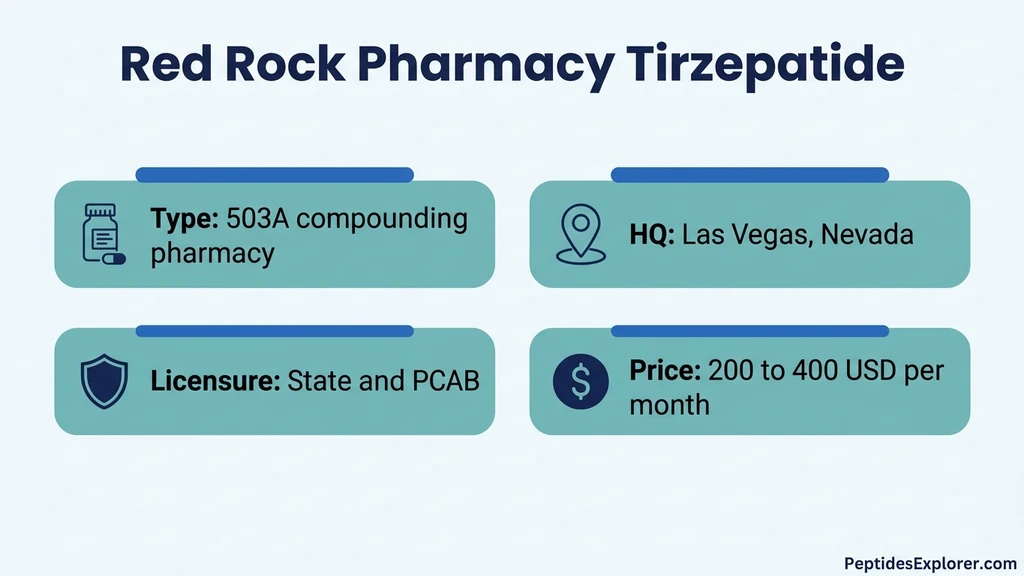
You are sitting at your kitchen table with the laptop open, staring at the Red Rock Pharmacy intake form your telehealth provider just sent you. You want to know whether the vial that arrives next week is going to come from a legitimate compounder or a fly-by-night operation. Red Rock Pharmacy is a 503A compounding pharmacy based in Las Vegas, Nevada, with a sister location in Arizona, that supplies compounded tirzepatide and semaglutide to telehealth weight-loss platforms across most US states. The pharmacy holds active state licensure in Nevada (NV Pharmacy License #PH02538) and ships through licensed prescribers, not direct to consumer. Compounded tirzepatide via Red Rock typically lands at $250 to $400 per vial depending on the telehealth partner and dose, well below brand Zepbound list price. The product is pharmacy-compounded, not FDA-approved, and the legal basis depends on FDA's current tirzepatide shortage status. Verify your telehealth provider's licensure in your state and Red Rock's current PCAB accreditation status before subscribing.
| Quick Reference | Detail |
|---|---|
| Pharmacy type | 503A compounding pharmacy |
| Locations | Las Vegas, NV and Arizona |
| Services | Compounded tirzepatide, semaglutide, hormone therapies |
| Dispensing model | Through licensed telehealth prescribers, not direct |
| Typical patient cost | $250 to $400 per month (varies by partner and dose) |
| State licensure | Active Nevada Board of Pharmacy registration |
| Out-of-state shipping | Licensed in most US states; verify yours |
| FDA status of product | Compounded, not FDA-approved finished product |
Red Rock occupies the same regulatory category as Strive Pharmacy, Empower Pharmacy, and the compounders behind Vitastir, Henry Meds, and Ivim Health. The legitimacy framework is the same across all of them. For the broader regulatory picture, see is compound tirzepatide safe and FDA peptide crackdown.
This is educational content. Pricing, licensure, and FDA shortage status change month to month. Verify everything directly with the pharmacy and your prescriber before starting any medication.
Get your custom peptide protocol:
- Tailored to your body and goals
- Precise dosing and cycle length
- Safe stacking combinations
- Backed by peer-reviewed studies
- Ready in under 2 minutes
What Red Rock Pharmacy Actually Is
Red Rock Pharmacy is a 503A compounding pharmacy. That single fact does most of the work in explaining what they can and cannot do. A 503A facility compounds individual prescriptions for individual patients based on a valid prescription from a licensed prescriber. They are not a manufacturer like Eli Lilly. They are not a 503B outsourcing facility that ships to clinics in bulk.
The pharmacy is headquartered in Las Vegas with a second location in Arizona. The Nevada State Board of Pharmacy lists Red Rock as actively licensed, and Arizona has its own state board record. State licensure is the entry-level credential. Above that sits PCAB accreditation, which audits sterile compounding standards under USP 797 and USP 800.
Here is how Red Rock fits into the patient experience:
- 1.You sign up with a telehealth provider (the brand-facing company)
- 2.A licensed prescriber in your state reviews your intake
- 3.The prescriber writes a tirzepatide prescription and sends it to Red Rock
- 4.Red Rock compounds your specific vial
- 5.The vial ships cold-chain to your home
You never interact directly with Red Rock as a patient. The pharmacy is the back-end fulfillment layer. This is the same architecture used by Empower Pharmacy, Strive, and Hallandale Pharmacy.
What Red Rock dispenses through partner platforms typically includes:
- Tirzepatide compounded with bacteriostatic water, sometimes plus B12 or niacinamide
- Semaglutide in similar formulations
- Testosterone cypionate and other hormone therapies
- Various peptide therapies depending on prescription
The active ingredient in compounded tirzepatide is the same molecule as Eli Lilly's Mounjaro and Zepbound. The finished product, however, is regulated under different FDA rules. SURMOUNT-1 demonstrated mean weight reductions of 15.0%, 19.5%, and 20.9% at the 5, 10, and 15 mg doses over 72 weeks using the brand product (Jastreboff et al., 2022). Compounded versions assume the same pharmacology. They do not have their own clinical trials. Pharmacokinetic studies confirm tirzepatide's predictable concentration-dependent dose response (Bastin et al., 2023), which is why concentration on the vial label matters more than brand name.
For the full picture on dose math at different concentrations, see compound tirzepatide dosage chart and tirzepatide units conversion.
Pricing Through Red Rock Partner Platforms
Red Rock does not sell directly to patients. Pricing depends on which telehealth platform routes your prescription through them. General price bands seen across the industry for Red Rock-fulfilled tirzepatide:
Entry dose (2.5 to 5 mg weekly): Typically $250 to $300 per month. Prepaid quarterly plans often drop the monthly price to $200 to $250.
Mid dose (7.5 to 10 mg weekly): Typically $300 to $375 per month. The step-up reflects the actual milligram cost from the pharmacy, not pure markup.
High dose (12.5 to 15 mg weekly): Typically $350 to $425 per month. At this level the pharmacy may switch to higher-concentration vials that change the volume you draw without changing the dose.
For comparison, your other options at the same dose:
- Brand Zepbound list price: $1,060 per month
- Lilly savings card for commercial-insured patients without coverage: around $550 per month
- LillyDirect self-pay: $349 to $549 per month for FDA-approved Zepbound
- Henry Meds reviews: around $300 per month flat
- Ivim Health reviews: $297 to $375 per month
- Mochi Health reviews: $260 to $375 per month
- Vitastir tirzepatide: $200 to $400 per month
- Citizen Meds tirzepatide: comparable mid-tier pricing
The pricing pattern is consistent across the industry. Compounded tirzepatide from any 503A pharmacy lands roughly 60 to 80 percent below brand list price. The variation between platforms reflects the telehealth provider's overhead, not the pharmacy's cost.
Hidden cost items to confirm before subscribing:
- Dose escalation fees. Some platforms charge $25 to $75 per dose change. Others include it.
- Shipping. Usually included on monthly subscriptions, sometimes $15 to $30 for one-off refills.
- Cold-chain surcharges in summer. Occasionally appear during heat waves.
- Cancellation refund policy. Critical to read before prepaying multiple months.
Use the peptide cost calculator to compare actual annual cost across providers. For a deeper look at brand versus compounded pricing, see tirzepatide cost with insurance and how much is semaglutide.
The Legitimacy Checklist for Red Rock (and Any Compounder)
Compounding pharmacies are not all created equal. The Las Vegas Review-Journal and Nevada Board of Pharmacy have records on every licensed pharmacy in the state. Apply this checklist to Red Rock and to any compounder behind your prescription.
1. Active state pharmacy license. Red Rock holds a Nevada Board of Pharmacy license. Verify it is current at nvbop.gov by searching the pharmacy name. The license must list "compounding" as a permitted activity.
2. PCAB accreditation status. PCAB (Pharmacy Compounding Accreditation Board, run by ACHC) audits sterile compounding to USP 797 standards. Not every legitimate pharmacy holds PCAB, but accreditation is a strong positive signal. Red Rock's current PCAB status should be verifiable on the ACHC search tool.
3. USP 797 and USP 800 compliance. USP 797 covers sterile compounding. USP 800 covers handling of hazardous drugs. A compounder of injectable peptides must comply with USP 797 at minimum. Ask your telehealth provider directly: "Is Red Rock USP 797 compliant?" The answer should be yes with no hesitation.
4. State licensure where you live. A Nevada-licensed pharmacy can ship interstate only if it is also registered with the destination state's board of pharmacy. Red Rock holds non-resident licenses in many states. Verify yours by asking the platform or searching your state board.
5. Adverse event reporting practice. Legitimate compounders track and report adverse events to FDA MedWatch. A pharmacovigilance analysis of FAERS data found compounded GLP-1 products had elevated reporting odds ratios for abdominal pain, suicidality, and cholecystitis compared to FDA-approved products (Hoffman et al., 2025). Some of that signal reflects reporting bias, but a serious compounder participates in the reporting system.
6. Recall history. Search FDA's recall database for "Red Rock Pharmacy." A clean record is good. A history of recalls is not necessarily disqualifying if the pharmacy responded transparently, but it deserves attention.
7. Disclosed formulation on the vial. When the vial arrives, the label must show: drug name, total milligrams, concentration in mg/mL, total volume, lot number, expiration date, beyond-use date, and the compounding pharmacy name. Missing information on the label is a red flag regardless of pharmacy reputation.
8. Prescriber transparency. A licensed prescriber in your state must be the one writing the order. Ask for the specific provider's name and verify their license on your state's medical board site.
For the broader compounded GLP-1 landscape, see is compound tirzepatide safe, are peptides legal, and FDA peptide crackdown.
What You Actually Receive from Red Rock
Patients who receive Red Rock-compounded tirzepatide describe a fairly consistent unboxing experience. The package arrives in an insulated cooler with ice packs, ships overnight or 2-day, and contains:
- One or more multi-dose vials of compounded tirzepatide
- Insulin syringes (typically U-100, 1 mL or 0.5 mL)
- Alcohol prep pads
- A sharps disposal container or pouch
- Printed dosing instructions from the prescribing platform
The vial label commonly reads something like: "Tirzepatide 10 mg/mL, Total Volume 2 mL, Total Drug 20 mg, with B12 1 mg/mL." Concentration matters more than total volume. A 10 mg/mL vial means 25 units on a U-100 syringe equals 2.5 mg.
If your label says tirzepatide 5 mg/mL instead, the same 2.5 mg dose now requires 50 units of volume. Drawing 25 units from a 5 mg/mL vial gives you 1.25 mg, half your prescribed dose. Use the peptide reconstitution calculator before your first injection to confirm your math.
Concrete error scenario one. Patient receives Red Rock tirzepatide 5 mg/mL but assumes the standard 10 mg/mL math from a forum post. Patient draws 25 units expecting 2.5 mg. Actual delivered dose is 1.25 mg. Over 8 weeks this patient will see negligible appetite suppression and conclude tirzepatide does not work. Fix: read the vial label every time and confirm concentration before drawing.
Concrete error scenario two. Patient receives Red Rock tirzepatide 10 mg/mL with B12 added. Patient panics about the orange tint and calls support. The orange color is normal for B12-containing formulations and does not indicate contamination. Fix: ask the platform what additives are in your specific formulation before the vial arrives.
Concrete error scenario three. Patient stores the vial at room temperature for two weeks instead of refrigerating. Tirzepatide degradation accelerates above 8 degrees Celsius. The peptide may lose 10 to 30 percent of potency over that period. Fix: refrigerate immediately on arrival and never leave at room temperature for more than 21 days per Lilly's stability data.
For the full vial-handling protocol, see how to reconstitute tirzepatide, how long does tirzepatide last in the fridge, and tirzepatide injection technique.
Complaints and What They Actually Mean
Red Rock has a public footprint of complaints, mostly through the platforms that use them rather than directly. The pattern is similar to every high-volume compounder serving the GLP-1 telehealth market. Common categories:
Shipping delays. Reported sporadically across platforms using Red Rock. Cause is usually carrier-side, not pharmacy-side, but the patient experience is the same. Mitigation: order refills 7 days before you run out, never the day you take your last dose.
Vial appearance variation. Patients sometimes report cloudy solution, particles, or color changes between batches. Some variation is normal for compounded products with additives. Anything visibly cloudy with floating particles is not. Stop use and contact the platform immediately if you see anything that looks wrong.
Customer service routing. Because Red Rock fulfills through telehealth partners, patients often cannot contact the pharmacy directly. All issues route through the platform. This is industry standard for 503A telehealth fulfillment, not a Red Rock-specific failure.
Dose strength inconsistency. Patients occasionally report subjectively different effects from different batches. Without independent lab testing on the specific vials, this is anecdotal. A serious pharmacy will provide a Certificate of Analysis (COA) on request.
Prescription transfer friction. Switching from Red Rock to another pharmacy mid-cycle is sometimes complicated by the telehealth platform's exclusivity arrangements, not by Red Rock policies. If you need to switch, your prescriber writes a new prescription to the new pharmacy.
The honest summary: Red Rock has the standard complaint profile of a high-volume 503A compounder. Nothing in the public record suggests systemic quality failure. Nothing in the public record proves they are uniformly excellent either. Treat them like any other compounder. Verify the vial label, store correctly, and report adverse events to both the platform and FDA MedWatch.
For more on what to watch for after starting, see tirzepatide long-term side effects, tirzepatide drug interactions, and can tirzepatide cause anxiety.
Who Red Rock Pharmacy Tirzepatide Fits
Red Rock-compounded tirzepatide makes sense for a specific patient profile. Apply this filter honestly.
Good fit:
- Insurance does not cover brand Zepbound and self-pay at $549 per month from LillyDirect is not sustainable
- You have a clear weight-loss indication (BMI over 30, or BMI over 27 with comorbidities)
- You are comfortable with compounded products and understand they lack FDA finished-product approval
- You can read a vial label and do basic unit math, or you commit to using the peptide reconstitution calculator every time
- You have a reliable refrigerator and can avoid leaving vials at room temperature
- You can tolerate some variability between batches and follow up promptly if anything looks off
Poor fit:
- Your insurance covers Zepbound at a low copay (use the brand product)
- You have a history of pancreatitis, severe gallbladder disease, or medullary thyroid carcinoma
- You are pregnant, planning pregnancy within 2 months, or breastfeeding
- You cannot tolerate any GI side effects (compounded versus brand will not change this; the side effects are pharmacological)
- You want a doctor relationship that includes in-person visits and lab review (compounded telehealth is not built for this)
- You are uncomfortable with regulatory uncertainty (compounded GLP-1 status shifts frequently)
Worth a second look:
- BMI between 25 and 27 with no comorbidities. Off-label use exists but the risk-benefit ratio is weaker.
- Maintenance phase patients who have already lost target weight. STEP-1 data suggest semaglutide produces 14.9 percent mean weight loss at 68 weeks (Wilding et al., 2021) but maintenance protocols are evolving.
- Patients who have failed previous GLP-1 medications due to side effects. The same molecule will not behave differently because it came from Red Rock instead of Lilly.
For decision-tree help, see how to choose a peptide provider, where to buy tirzepatide, and semaglutide vs tirzepatide.
Red Rock vs Other Compounders
If you are weighing Red Rock against the other 503A compounders supplying telehealth GLP-1, here is the honest comparison.
Red Rock vs Empower Pharmacy: Empower is one of the largest compounders in the country, supplies many telehealth platforms, and has a longer published track record. Red Rock is smaller and more regional. Both hold state licensure. Quality should be evaluated platform by platform.
Red Rock vs Strive Pharmacy: Strive (Strive Pharmacy semaglutide dosage chart) is another high-volume compounder serving telehealth. Comparable scale and patient experience. Pricing through partner platforms is similar.
Red Rock vs Hallandale Pharmacy: Hallandale is Florida-based, supplies multiple platforms, and has had a generally clean public record. Red Rock and Hallandale are roughly interchangeable from a patient quality perspective.
Red Rock vs the platform you would actually choose: The pharmacy is a back-end. The patient experience is set by the platform. Compare Vitastir tirzepatide, Henry Meds reviews, Ivim Health reviews, Mochi Health reviews, Marek Health reviews, Citizen Meds tirzepatide, and Ellie MD GLP-1 reviews on customer service, dose flexibility, and refund policy. The pharmacy that fills your order is largely platform-driven.
Red Rock vs going direct to brand: Always the cleanest path if cost allows. Eli Lilly's Zepbound is FDA-approved with full stability data and standardized concentration. LillyDirect self-pay at $349 to $549 is increasingly the recommendation for patients without insurance.
The decision tree most patients should follow: insurance covers Zepbound, take it. Insurance does not cover but you can afford LillyDirect self-pay, take that. Cost is still the limit, then a Red Rock-supplied compounded version through a vetted telehealth platform fills the gap. Apply the legitimacy checklist before subscribing.
Frequently Asked Questions
Is Red Rock Pharmacy legit?
Red Rock holds active Nevada Board of Pharmacy licensure as a 503A compounding pharmacy and supplies multiple telehealth platforms. Legitimate in the regulatory sense. Whether the specific vial you receive meets quality standards depends on batch, storage during shipping, and the platform that routed your prescription. Apply the 8-point legitimacy checklist in this article and the framework in is compound tirzepatide safe.
How much does Red Rock Pharmacy tirzepatide cost?
Patients pay $250 to $400 per month depending on the telehealth platform and dose level. Red Rock does not sell directly to patients, so the price reflects platform overhead plus the pharmacy's compounding cost. Compare actual annual cost using the peptide cost calculator. For brand pricing context, see tirzepatide cost with insurance.
Which telehealth providers use Red Rock Pharmacy?
Red Rock has fulfillment relationships with multiple telehealth weight-loss platforms. Specific partnerships shift frequently as platforms add or rotate compounding partners. Ask your platform directly which pharmacy fills your prescription. For comparable platforms reviewed individually, see Vitastir tirzepatide, Henry Meds reviews, and Ivim Health reviews.
Is Red Rock tirzepatide the same as Mounjaro?
The active molecule is the same tirzepatide compound. The finished product is regulated differently. Mounjaro is Eli Lilly's FDA-approved brand product with full stability and clinical trial data. Red Rock-compounded tirzepatide is a pharmacy-compounded version legal under specific FDA conditions. The pharmacology should be equivalent at matched doses. Concentration math may differ; see compound tirzepatide dosage chart.
Does Red Rock ship to my state?
Red Rock holds non-resident pharmacy licenses in many but not all US states. Shipping availability is determined at intake by your telehealth platform. Some states (notably California, New York, and Texas) have stricter compounded GLP-1 rules that change which formulations can be shipped in. Verify with the platform during sign-up before paying anything.
What concentration is Red Rock tirzepatide?
Red Rock formulations vary by prescription. Common concentrations are 5 mg/mL and 10 mg/mL, sometimes with B12 or niacinamide added. Read the vial label every time and confirm concentration before drawing your dose. The same milligram dose requires different unit volumes depending on concentration. Use the peptide reconstitution calculator to verify.
What if my Red Rock vial looks cloudy or has particles?
Stop use immediately and contact your telehealth platform. Compounded tirzepatide should be clear (or slightly tinted if B12 is added) with no visible particles. Cloudy solution or floating debris can indicate contamination, degradation, or precipitation from improper storage. Take a photo, do not inject, and request a replacement. Report to FDA MedWatch if contamination is suspected. See tirzepatide long-term side effects for what to watch for after exposure.
Can I switch from Red Rock to brand Zepbound later?
Yes. Patients commonly transition from compounded to brand Zepbound when insurance coverage opens up or when they prefer FDA-approved product. Continue the same milligram dose without restarting titration. Coordinate with your prescriber to write a new prescription for brand product through your retail pharmacy or LillyDirect. See semaglutide to tirzepatide switching for related transition protocols.
The Bottom Line
Red Rock Pharmacy is a Las Vegas-based 503A compounding pharmacy that supplies compounded tirzepatide and semaglutide to telehealth weight-loss platforms. The pharmacy holds active Nevada state licensure and operates within the same regulatory framework as Empower, Strive, Hallandale, and the other high-volume compounders fulfilling GLP-1 telehealth orders. Patient-facing pricing through partner platforms typically lands at $250 to $400 per month, well below brand Zepbound but above zero risk.
Legitimacy in this category is not binary. The pharmacy can hold every required license and still ship a vial that arrives warm, mislabeled, or off-spec. The platform can have great customer service and still partner with a compounder mid-rotation. Your protection is the 8-point legitimacy checklist applied every time you subscribe, every time a vial arrives, and every time you draw a dose.
For most patients the decision tree is unchanged by which compounder is in the back. If insurance covers Zepbound, take the brand product. If not, LillyDirect self-pay is the safest path at $349 to $549 per month for FDA-approved product. If cost remains the limit, a Red Rock-supplied compounded version through a vetted telehealth platform fills the gap. Verify the legitimacy checklist before subscribing and read the vial label before every injection.
Run the peptide cost calculator to compare your real annual cost against brand pricing. For the full safety framework, see is compound tirzepatide safe, FDA peptide crackdown, and compound tirzepatide dosage chart.
Related Articles: - Is Compound Tirzepatide Safe - Vitastir Tirzepatide Review - Henry Meds Reviews - Ivim Health Reviews - Mochi Health Reviews - Citizen Meds Tirzepatide Guide - Compound Tirzepatide Dosage Chart
Related Articles
Fifty 410 Tirzepatide Review 2026
Fifty 410 tirzepatide review: what the brand is, how compounded tirzepatide sourcing works, what to verify before buying, and 2026 pricing context.
Vitastir Tirzepatide: Review & What to Know
Vitastir tirzepatide review: telehealth compounded tirzepatide service. Pricing, legitimacy checklist, red flags, and comparison to peers.
Olympia Tirzepatide Dosage Chart Guide
Olympia Pharmacy tirzepatide dosage chart by concentration. mg-to-units conversion at 5, 10, and 20 mg/mL, legitimacy checks, and how to read your vial.
Direct Meds Pricing: Review & Comparison
Direct Meds pricing review for compounded tirzepatide and semaglutide. Tier breakdown, what is included, and how Direct Meds compares to other telehealth.