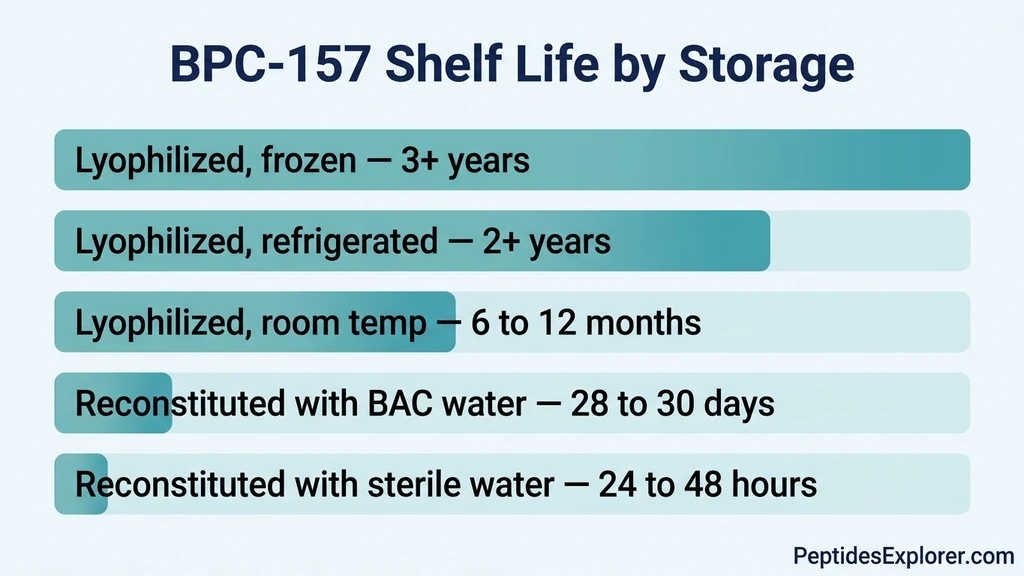
You reconstituted a BPC-157 vial six weeks ago and it has been sitting in the back of the fridge since. Is it still good? Can you inject it? Or did it quietly turn into an expensive waste of saline last Tuesday? Yes, BPC-157 expires. Unreconstituted (lyophilized) vials keep for 2+ years if stored cool, dark, and dry. Reconstituted BPC-157 with bacteriostatic water lasts 28 to 30 days refrigerated. Reconstituted with sterile water, you have 24 to 48 hours before it is no longer reliable. If the solution is cloudy, yellow-brown, or has visible particles, discard it.
| Storage Condition | Shelf Life | Action |
|---|---|---|
| Lyophilized vial, room temperature (dry, dark) | 6 to 12 months | Use or refrigerate |
| Lyophilized vial, refrigerated (2 to 8 degrees C) | 2+ years | Use within labeled expiry |
| Lyophilized vial, frozen (-20 degrees C) | 3+ years | Thaw once, do not refreeze |
| Reconstituted with bacteriostatic water, refrigerated | 28 to 30 days | Discard at day 30 |
| Reconstituted with sterile water, refrigerated | 24 to 48 hours | Discard at 48 hours |
| Reconstituted, room temperature | 24 hours max | Refrigerate immediately or discard |
| Reconstituted, cloudy or yellow-brown | Already degraded | Discard, do not inject |
BPC-157 is a synthetic pentadecapeptide, and like every peptide, it decays with heat, light, oxidation, and time. The decay is mostly invisible at first. By the time you can see it, the peptide has already lost significant bioactivity. This guide covers how long each storage state actually lasts, how to tell if a vial has gone bad, and what to do when you are not sure. For the full storage protocol across all peptides, see our peptide storage guide.
This is educational content. Consult a healthcare provider before starting any peptide.
Get your custom peptide protocol:
- Tailored to your body and goals
- Precise dosing and cycle length
- Safe stacking combinations
- Backed by peer-reviewed studies
- Ready in under 2 minutes
Unreconstituted BPC-157: 2+ Years If You Store It Right
Lyophilized (freeze-dried) BPC-157 is the most stable form of the peptide. The manufacturing process removes essentially all water, leaving a dry powder that resists hydrolysis, the chemical reaction that breaks peptide bonds in the presence of water. BPC-157 itself shows unusual stability: it remains intact in human gastric juice for more than 24 hours, due in part to its high proline content (5 of 15 residues) which provides structural rigidity (Sikiric et al., 2011). This is why lyophilized vials ship with 2-year expiration dates and often retain potency beyond that.
The four enemies of lyophilized BPC-157:
- Heat. Every 10 degrees Celsius above room temperature roughly doubles the degradation rate. A vial left in a hot car (45 degrees C) for a summer afternoon is not ruined, but it has lost more shelf life than a week in a climate-controlled room.
- Light. UV and visible light break peptide bonds directly. Keep vials in their original box or in an opaque container. Clear glass fridge shelves are fine as long as the kitchen light is not constantly on.
- Humidity. Moisture that sneaks into a lyophilized vial starts the hydrolysis clock early. The rubber stopper is designed to prevent this, but repeated puncturing or storage in a humid bathroom accelerates moisture ingress.
- Oxidation. Methionine and tryptophan residues are oxidation targets. BPC-157 does not contain methionine in its sequence, but tryptophan is present and oxidizes slowly. A sealed vial is protected; an opened vial less so.
Practical storage recommendation: Refrigerate unreconstituted vials at 2 to 8 degrees Celsius in their original packaging. This buys you the full 2+ year shelf life. Room temperature storage in a dark cupboard works for 6 to 12 months if your climate is moderate. If you ordered a large supply and will not use it within a year, freezing the unreconstituted vials at -20 degrees C extends shelf life to 3+ years.
One-time freezing is fine. Freeze-thaw cycles are not. Each cycle introduces micro-crystals that can physically disrupt the peptide structure. If you freeze, plan to thaw once (slowly, in the refrigerator overnight) and keep the vial refrigerated thereafter.
For the full peptide storage hierarchy across other compounds, see how to store peptides.
Reconstituted BPC-157: 28 to 30 Days (With Bacteriostatic Water)
Once you add water to a lyophilized vial, the clock starts. How fast it ticks depends entirely on which water you used.
Bacteriostatic water (BAC water), refrigerated: 28 to 30 days is the conservative, well-tested window. BAC water contains 0.9% benzyl alcohol, which suppresses bacterial growth and slows some peptide degradation pathways. Aqueous peptide stability is dominated by hydrolysis, deamidation, oxidation, and aggregation, with pH optimization and refrigeration being the most effective stabilization strategies (Boczar & Michalska, 2023). Real-world stability data from peptide research groups suggests BPC-157 in BAC water at 2 to 8 degrees C retains greater than 90% potency at day 30 and often beyond. Most providers cap the recommendation at 28 days for safety margin.
Sterile water, refrigerated: 24 to 48 hours maximum. Sterile water has no preservative. Even in the refrigerator, bacterial contamination from repeated vial punctures becomes a real risk within a day. Use sterile water only if you will finish the vial in one or two sittings. For a month-long supply, bacteriostatic water is standard. See bacteriostatic water vs sterile water for the full comparison.
Bacteriostatic water, room temperature: 24 to 72 hours. The bacteriostat buys you some grace time if the vial is accidentally left out, but heat accelerates peptide hydrolysis. If you leave a BAC-reconstituted vial on the counter for a weekend, it is not automatically ruined, but potency has dropped. If you leave it out for a week, discard.
What about freezing reconstituted BPC-157? Generally not recommended. Reconstituted peptide solutions do not freeze uniformly. Ice crystals can denature the peptide, and freeze-thaw cycles (even one) cause measurable potency loss. If you are going to store BPC-157 for more than 30 days, do it in lyophilized form and reconstitute only the amount you will use in the next month.
Volume affects stability marginally. A 5 mg vial reconstituted to 2 mL of solution is slightly more stable than the same peptide reconstituted to 5 mL, because higher concentration buffers against small degradation losses. This is a second-order effect. Stick to your dosing plan; do not over-concentrate solely for storage reasons.
For the reconstitution step-by-step with volume ratios, see how long reconstituted peptides last and use the peptide reconstitution calculator.
How to Tell If BPC-157 Has Expired or Degraded
Early-stage peptide degradation is invisible. You will not see a fresh vial at day 1 and a 50%-degraded vial at day 45 look any different. The visible signs of BPC-157 degradation only appear in late-stage, heavily degraded solutions.
Visible signs of degraded BPC-157:
- Cloudy solution. A fresh reconstituted BPC-157 vial is crystal clear. Cloudiness indicates bacterial contamination, peptide aggregation, or both. Do not inject.
- Yellow or yellow-brown color. Fresh BPC-157 solution is colorless or very faintly off-white. A yellow-brown tint indicates oxidation products. Discard.
- Visible particles or floaters. Any specks, flakes, or suspended debris means contamination or precipitated peptide. Discard.
- Clumping at the bottom of the vial. If peptide has clumped out of solution, gentle swirling should redissolve fresh peptide. If clumps persist, degradation is advanced. Discard.
- Unexpected smell through the stopper. Fresh BPC-157 solution is odorless. Any off-smell (sour, sulfurous, ammonia) signals bacterial growth. Discard immediately.
Invisible degradation is the bigger risk. A vial can be 30% degraded and look completely normal. This is why the 28 to 30 day cap on reconstituted BPC-157 exists. By the time you can see a problem, you are well past the point of full potency.
Effect-based signs you may have a degraded vial:
- Sudden loss of therapeutic effect. If BPC-157 was working for you at week 2 and seems useless at week 5 of the same vial, vial degradation is a likely cause.
- Injection site changes. More redness, stinging, or irritation than usual from a vial that was tolerated before can signal degradation products or bacterial contamination.
- No effect on a brand-new vial. If a fresh vial produces none of the expected response, storage conditions during shipping (heat exposure, delayed delivery) may have compromised it before you received it.
For the symptom profile to distinguish vial issues from true peptide side effects, see BPC-157 capsules side effects.
Can You Test BPC-157 Potency at Home?
Short answer: not really. Peptide potency testing is an analytical chemistry problem, not a kitchen-chemistry one. But there are options.
Third-party mass spectrometry testing: Some research-use labs will run a sample of your reconstituted peptide through mass spec to confirm molecular weight and purity. Cost is typically $100 to $200 per sample. This is the gold standard for verifying a vial is still the peptide you think it is. Worth it if you have committed to a 3-month protocol and want to confirm mid-cycle potency. Not worth it for a casual user.
HPLC (high-performance liquid chromatography) testing: More quantitative than mass spec, less accessible. A handful of peptide QA labs offer HPLC at $150 to $300 per sample. This is what pharmaceutical manufacturers use for release testing. For most end users, this is overkill.
At-home visual inspection: Free, imperfect, but catches obvious degradation. Hold the vial up to a bright light. Look for clarity, color, particles, and clumps. Compare against a fresh vial if you have one. This catches late-stage degradation but misses early potency loss.
Effect-based self-assessment: Track your response to the peptide over the course of a vial. If effect falls off sharply mid-vial, that is a signal (not proof) that the vial is degrading faster than expected.
What does not work: pH strips (BPC-157 pH does not change much with degradation), smell (most degradation is odorless until very late), and "it looks clear so it is fine" (clarity is necessary but not sufficient).
The economic argument against heavy testing: A 5 mg BPC-157 vial typically costs $30 to $60. A mass spec test costs $100 to $200. If you suspect a vial is degraded, the cheaper play is to discard it and reconstitute a fresh one. Reserve testing for batches you are worried about (hot shipping, old stock, supplier change) or for users running longer protocols where vial integrity matters more.
For dosing protocols that determine how fast you will go through a vial, see BPC-157 dosage by body weight and BPC-157 benefits.
Is Expired or Degraded BPC-157 Dangerous?
The two risks from a degraded vial are different and worth separating.
Risk 1: Loss of potency. By far the most common outcome. A degraded peptide is still a peptide, just fewer intact active molecules per milliliter. You inject a "full" dose and get a partial therapeutic effect, or none. No safety problem. Just wasted protocol time and money.
Risk 2: Bacterial contamination. The real safety concern. A reconstituted vial that sat unrefrigerated, was punctured repeatedly with non-sterile syringes, or was reconstituted with non-sterile water can grow bacteria. Injecting bacterially contaminated solution causes infection at the injection site, abscesses, or in worst cases systemic infection. This is rare but serious.
Risk 3 (theoretical): Degradation products. When peptides break down, they produce smaller peptide fragments and free amino acids. These fragments are not generally toxic at the microgram levels present in a degraded vial, but they are also not inert. The body clears them through normal peptidase pathways. The theoretical risk of immunogenic responses to degradation products is low for BPC-157 specifically because it is a short 15-amino-acid peptide with well-characterized breakdown products.
The practical rule: If in doubt, discard. BPC-157 is not expensive enough to make gambling on potentially contaminated product a rational decision. A fresh 5 mg vial costs less than a copay on an ER visit for an injection site abscess. Discard anything cloudy, discolored, or past the 30-day reconstituted window.
When to definitely discard:
- Any visible cloudiness, color change, or particles
- Reconstituted with BAC water and past 30 days
- Reconstituted with sterile water and past 48 hours
- Left unrefrigerated for more than 24 hours (reconstituted vials)
- Unreconstituted vial past labeled expiration by more than 6 months
- Any vial with a compromised stopper or broken seal
- Any vial from a shipment that arrived hot or delayed
For the broader safety framework on peptide storage, see how long reconstituted peptides last and does bacteriostatic water need to be refrigerated.
How to Dispose of Expired BPC-157 Safely
Do not just toss an expired vial in the trash, especially if it is reconstituted. Proper disposal protects you, pets, and anyone who handles your garbage.
Sharps container for needles and reconstituted vials. Any vial with liquid in it is technically a biohazard once it has been punctured. Drop the whole vial (or the contents transferred to a sharps container) along with used needles. Most pharmacies accept filled sharps containers for disposal; some local health departments run free drop-off programs.
Pharmacy take-back for lyophilized vials. Many pharmacies participate in medication take-back programs that accept expired injectable medications. Call ahead to confirm they accept peptides.
DEA take-back events. The US Drug Enforcement Administration runs National Prescription Drug Take-Back Days twice a year. BPC-157 is not a controlled substance, but take-back events accept non-controlled injectables as well.
Home disposal (last resort). If no take-back option is available, mix the liquid peptide contents with an absorbent non-consumable material (coffee grounds, cat litter, sawdust) in a sealed bag and dispose in household trash. Do not pour down drains; peptides in wastewater are a low environmental concern but general policy discourages drain disposal of pharmaceuticals.
Do not flush. Some medications have FDA flush lists; peptides are not on them. Flushing BPC-157 is not environmentally catastrophic, but there is no reason to do it.
Do not donate or share expired peptides. Even to friends, even for "just trying it." An expired vial given to another person is both potentially ineffective and potentially contaminated. Giving away injectable medications is also illegal in most jurisdictions outside of a prescribing relationship.
For the full safety and handling protocol, see the peptide storage guide.
Frequently Asked Questions
Does BPC-157 expire?
Yes. Unreconstituted (lyophilized) BPC-157 vials last 2+ years refrigerated if kept dry and dark. Reconstituted with bacteriostatic water, BPC-157 is good for 28 to 30 days refrigerated. Reconstituted with sterile water, only 24 to 48 hours. See our peptide storage guide for the full protocol.
How long does reconstituted BPC-157 last in the fridge?
28 to 30 days is the conservative, standard recommendation when reconstituted with bacteriostatic water and stored at 2 to 8 degrees Celsius. Real-world stability often exceeds this, but 30 days is the safe cap. With plain sterile water, only 24 to 48 hours. For broader context, see how long reconstituted peptides last.
Can I use BPC-157 past its expiration date?
Lyophilized vials often retain potency 6 to 12 months past labeled expiration if stored correctly, but potency is not guaranteed. Reconstituted vials past 30 days should be discarded. If the solution is cloudy, discolored, or has particles, discard regardless of date. See BPC-157 benefits for the effective dose assumptions that depend on full potency.
What does expired BPC-157 look like?
Fresh BPC-157 solution is colorless and crystal clear. Expired or degraded BPC-157 may appear cloudy, yellow or yellow-brown, have visible particles, or show clumping at the bottom of the vial. Any off-smell through the stopper also indicates contamination. For reconstitution done right, use our peptide reconstitution calculator.
Can I freeze BPC-157 to make it last longer?
Yes for unreconstituted lyophilized vials (extends shelf life to 3+ years at -20 degrees C), but only freeze once and thaw slowly in the refrigerator. No for reconstituted solutions. Freezing causes ice-crystal damage and potency loss. For long-term storage, keep peptide in lyophilized form and reconstitute only monthly amounts. See how to store peptides.
Is it dangerous to inject expired BPC-157?
The main risk is reduced effectiveness from potency loss, which is not dangerous but wastes the protocol. The real safety risk is bacterial contamination in reconstituted vials past 30 days or left unrefrigerated, which can cause injection site infection. If in doubt, discard. See BPC-157 capsules side effects for the normal side effect profile to rule out vial problems.
How can I test if my BPC-157 is still good?
Visual inspection catches late-stage degradation (cloudiness, color change, particles). For quantitative testing, third-party mass spec runs $100 to $200 per sample and confirms molecular weight and purity. For most users, if visual signs and therapeutic response look normal, the vial is fine within the 30-day window. Past 30 days, discard rather than test. For reconstitution accuracy, use the peptide reconstitution calculator.
Does bacteriostatic water itself expire and affect BPC-157 shelf life?
Yes. Bacteriostatic water vials are typically good for 28 days after first puncture (the benzyl alcohol preservative loses effectiveness over time in a punctured vial). Unopened BAC water has a 2 to 3 year shelf life. Using expired BAC water shortens the effective shelf life of your reconstituted BPC-157. See does bacteriostatic water need to be refrigerated and bacteriostatic water vs sterile water for the full water protocol.
The Bottom Line
BPC-157 does expire, and the timeline depends almost entirely on how you store it. Lyophilized vials refrigerated in their original packaging last 2+ years. The moment you add bacteriostatic water, you have 28 to 30 days. Plain sterile water cuts that to 24 to 48 hours. Room-temperature storage of reconstituted vials is never a good idea past 24 hours.
The practical rules: refrigerate everything that is not actively in your hand, discard any cloudy or discolored solution, and do not try to stretch reconstituted vials past 30 days. BPC-157 is not expensive enough that gambling on questionable vials is worth it. When in doubt, reconstitute fresh.
For the full storage protocol across all peptides, see how to store peptides. For reconstitution mechanics, use the peptide reconstitution calculator. For BPC-157 dosing that determines how fast you will go through a vial, see BPC-157 dosage by body weight and BPC-157 benefits.
Related Articles: - How to Store Peptides - How Long Do Reconstituted Peptides Last - How Long Does GHK-Cu Last - BPC-157 Benefits - BPC-157 Dosage by Body Weight - BPC-157 Capsules Side Effects - Bacteriostatic Water vs Sterile Water - Does Bacteriostatic Water Need to Be Refrigerated
Related Articles
How Long Does HGH Last in the Fridge?
Unreconstituted HGH lasts 2+ years at 2-8C. Reconstituted with bacteriostatic water: 14-21 days; sterile water: 24 hours. Never freeze. Full shelf life rules.
Where to Inject BPC-157 for Elbow Pain: Sites
Where to inject BPC-157 for tennis elbow and golfer's elbow: 1-2 cm from the epicondyle, the ulnar nerve no-go zone, two-site rotation, 4-8 week timeline.
BPC-157 on an Empty Stomach or With Food?
BPC-157 empty stomach or with food: injections ignore meals, oral survives gastric juice either way. Dilution math, what the rat studies did, coffee, NSAIDs.
Best Peptides for Arthritis: What Evidence Shows
Best peptides for arthritis ranked by evidence: semaglutide knee OA trial, collagen RCTs, BPC-157, TB-500, KPV, thymosin alpha-1. By type, route and red flags.