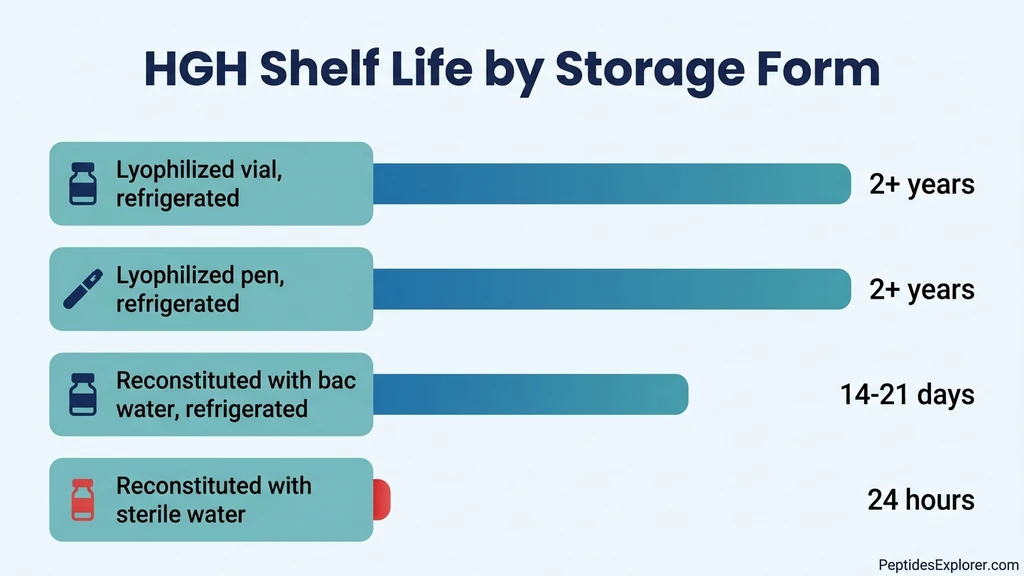
You pulled an HGH pen out of the fridge, noticed the solution looks a little off, and now you are trying to remember when you reconstituted it. Or maybe you just got a shipment of lyophilized somatropin and you want to know whether it is safe for the next two years or the next two weeks. HGH is not a simple peptide. It is a full 191-amino-acid protein, which means it is dramatically more temperature-sensitive than shorter peptides like BPC-157 or GHK-Cu. Unreconstituted lyophilized HGH lasts 2+ years refrigerated at 2 to 8 degrees Celsius. Reconstituted with bacteriostatic water, it keeps 14 to 21 days in the fridge. Reconstituted with plain sterile water, 24 hours maximum. Never freeze it. Never leave it above 25 degrees Celsius for more than a few hours. Get any of those rules wrong and the protein unfolds, loses bioactivity, and becomes useless (and in rare cases, immunogenic).
| Form | Storage Condition | Shelf Life |
|---|---|---|
| Unreconstituted lyophilized vial | 2 to 8 C (fridge) | 2+ years (check expiration) |
| Unreconstituted pen cartridge | 2 to 8 C (fridge) | 2+ years (check expiration) |
| Reconstituted with bacteriostatic water | 2 to 8 C (fridge) | 14 to 21 days |
| Reconstituted with sterile water | 2 to 8 C (fridge) | 24 hours |
| Reconstituted vial at room temperature | Below 25 C | 24 to 48 hours max |
| Pen injector after first use (most brands) | 2 to 8 C | 28 days |
| Frozen HGH | Any temperature below 0 C | Destroyed. Do not use. |
| HGH above 25 C for 24+ hours | Warm room, car, transit | Likely degraded. Discard. |
The refrigerator is not optional for HGH. It is the single variable that determines whether your vial is therapeutic or garbage. For the full cold-chain framework across all peptides, see how to store peptides. For reconstituted stability specifics, see how long do reconstituted peptides last.
This is educational content. Consult a healthcare provider before starting any peptide or protein therapy.
Get your custom peptide protocol:
- Tailored to your body and goals
- Precise dosing and cycle length
- Safe stacking combinations
- Backed by peer-reviewed studies
- Ready in under 2 minutes
Unreconstituted HGH: 2+ Years Refrigerated
Lyophilized (freeze-dried) HGH is a white powder sealed under vacuum or inert gas inside a glass vial or pen cartridge. In this dry state, the protein is remarkably stable. As long as it stays cold, dry, and in the dark, manufacturer shelf life is typically 24 to 36 months from the date of manufacture. Excipient studies on lyophilized rhGH show that sugar and polyol stabilizers (mannitol, sucrose, trehalose) protect the protein's secondary structure and limit aggregation in the dry state by satisfying water-binding sites and stabilizing the amorphous matrix around the protein (Costantino et al., 1998).
Brand HGH shelf life by product: - Humatrope (Eli Lilly): 24 months refrigerated at 2 to 8 C before reconstitution. - Genotropin (Pfizer): 36 months refrigerated for the GoQuick pen; 24 months for the MiniQuick. - Saizen (Merck Serono): 36 months refrigerated for the click.easy cartridge. - Norditropin (Novo Nordisk): 24 months refrigerated before first use. - Omnitrope (Sandoz): 24 to 30 months refrigerated depending on presentation. - Research-grade somatropin (lyophilized vial): 24 months is the conservative label, though peptide integrity often exceeds that if the cold chain has never been broken.
The date printed on the box is the expiration date under ideal storage. If you have kept the vial at 2 to 8 C the entire time (no fridge failures, no transit exposures, no freezer accidents), the manufacturer stands behind the labeled shelf life. If the product has spent significant time above 8 C or below 0 C, treat that date as meaningless and judge the protein by physical inspection.
What "2 to 8 C" actually means: Not the freezer. Not the door shelf where temperatures swing. The middle of a working refrigerator, ideally on the main shelf. Fridge door compartments cycle between 4 C and 12 C every time the door opens, which is acceptable for short-term storage but not ideal. The back of the main shelf is most stable.
For the complete peptide cold-chain protocol and how HGH compares to smaller peptides, see how to store peptides.
Reconstituted HGH with Bacteriostatic Water: 14 to 21 Days
Once you add diluent to the lyophilized powder, the clock starts. HGH in solution is substantially less stable than the dry powder because hydrated protein chains can unfold, aggregate, oxidize, and break down much faster than desiccated ones.
Bacteriostatic water (0.9 percent benzyl alcohol preservative): The standard diluent for research-grade HGH and for brand HGH when the pharmacist supplies a separate diluent. Refrigerated at 2 to 8 C, reconstituted HGH in bacteriostatic water maintains clinical potency for 14 to 21 days.
Why 14 to 21 days and not longer: HGH is a 22 kDa protein, not a small peptide. Benzyl alcohol preserves against bacterial growth but does not stop slow protein degradation (deamidation, oxidation, aggregation) that happens over weeks in solution. Most endocrinologists cite 14 days as the conservative limit. Some manufacturer-specific data extends this to 21 or 28 days when the vial is stored unopened and refrigerated. Stability work on reconstituted somatropin at 1.0 and 3.33 mg/mL stored in polypropylene syringes confirmed maintained purity and potency for up to 28 days at 2-8 degrees C, with greater turbidity in alternative copolymer containers (Ray & Chen, 1998).
Why this is shorter than smaller peptides: Short peptides like GHK-Cu (3 amino acids) or BPC-157 (15 amino acids) stay stable in solution for 28 to 60 days because they have few bonds that can degrade. HGH has 191 amino acids and complex secondary structure (a four-helix bundle stabilized by two disulfide bridges). Any disruption of that fold inactivates the hormone. See bacteriostatic water vs sterile water for the diluent breakdown.
Pen-injector specifics: Once you puncture a cartridge with a pen needle, most manufacturers rate the in-use shelf life at 28 days at 2 to 8 C. Humatrope pens, Genotropin GoQuick, and Saizen click.easy all publish 28-day in-use stability. Norditropin FlexPro extends in-use stability to 21 days with a slightly different formulation.
What about room temperature in-use? Norditropin FlexPro is unique in that once in use, it can sit at or below 25 C for 21 days (useful for travel). Most other brand pens require refrigeration continuously. Check the leaflet for your specific product.
For the complete reconstitution protocol including syringe sizing and volume math, use the peptide reconstitution calculator.
Reconstituted HGH with Sterile Water: 24 Hours
Sterile water for injection has no preservative. It is pure USP water in a sealed vial. For one-shot reconstitutions where you will administer the full dose immediately, it is fine. For multi-dose use over days or weeks, it is inappropriate for HGH.
The 24-hour rule: If you reconstituted HGH with sterile water (not bacteriostatic water), you have 24 hours refrigerated to use the solution. After 24 hours, bacterial growth risk rises sharply even in the fridge. Discard.
Why bacteriostatic water is the default for HGH: HGH protocols typically involve 1 to 6 IU daily for 6+ weeks. Nobody reconstitutes a 10 mg vial of HGH to use in a single day. Bacteriostatic water lets you draw 20 to 30 doses from the same vial over the course of 2 to 3 weeks. Sterile water forces you into a one-and-done model that wastes 95 percent of the product.
When sterile water is used for HGH: Clinical settings where the full vial is administered in a single session (rare for HGH), or patients with benzyl alcohol sensitivity (very uncommon, but documented).
A note on specific brands: Some pre-filled HGH pens ship with a cartridge-specific diluent that is neither standard bacteriostatic water nor sterile water. Genotropin MiniQuick, for example, comes pre-filled with a proprietary diluent. Always use the diluent supplied with your product if one is provided. Do not substitute bacteriostatic water unless the product leaflet says you can.
See does bacteriostatic water need to be refrigerated for the diluent storage rules that also apply to HGH reconstitution.
Why You Can Never Freeze HGH
Freezing is the single most destructive thing you can do to HGH. A peptide like GHK-Cu or BPC-157 can tolerate freezing in lyophilized form because its structure is simple. HGH cannot. Once it freezes, its three-dimensional fold is disrupted and the hormone is inactivated.
What happens when HGH freezes: - Ice crystals form inside the vial and physically disrupt the protein's four-helix bundle. - The disulfide bridges that hold the structure together can break. - Upon thawing, the protein refolds incorrectly or aggregates into non-functional clumps. Controlled freezing studies of recombinant hGH demonstrated that insoluble particulate aggregation increases sharply with cooling rate, with pH 7.4 formulations producing markedly more light-scattering particulates than pH 7.8 formulations after freeze-thaw (Eckhardt, Oeswein & Bewley, 1991). - Bioactivity drops from 100 percent to near zero.
Visual signs of freeze damage: After thawing, you may see cloudiness, haze, flaky particles, or a grainy texture. The solution will not return to perfectly clear. Sometimes frozen HGH looks normal but has lost 50 to 100 percent of its potency (invisible damage), which is why the "never freeze" rule is absolute regardless of what the vial looks like afterward.
Common accidental freezing scenarios to avoid: - Top shelf of a refrigerator against the back wall (often sub-zero in cheaper fridges). - Transit in winter without insulated packaging. - Overzealous ice-pack shipping where the product sat against frozen packs for 48+ hours. - A fridge set to 0 to 1 C by accident (aim for 4 C).
If you suspect your HGH was frozen: Do not use it. There is no reliable way to confirm bioactivity without a bioassay. The cost of a new vial is less than the cost of a 6-week cycle with inactive product. Discard.
This protein fragility is why HGH differs from smaller peptides. For a peptide like tirzepatide, freezing is also not recommended but some formulations tolerate it briefly. For HGH, the rule is absolute. See how long does tirzepatide last in the fridge for the comparable GLP-1 rules.
Temperature Sensitivity: The 25 C Ceiling
HGH degrades rapidly above 25 C (77 F). This is the number most storage failures cluster around. It is not a dramatic temperature. It is roughly the temperature of a warm living room, a car interior on a mild day, or a package sitting on a doorstep in spring.
Time-temperature degradation approximation: - At 2 to 8 C (fridge): minimal degradation over weeks. - At 15 to 25 C (cool room): measurable degradation within days. - At 25 to 30 C (warm room): significant degradation within 24 to 48 hours. - At 30 to 40 C (summer car, warm transit): rapid degradation within hours. - Above 40 C: denaturation within minutes to hours.
In-use travel scenarios: A reconstituted vial or pen that you take out of the fridge for a 15-minute injection is fine. Leaving it on the counter for an hour is fine. Leaving it in a bag at room temperature all day is the boundary. Leaving it in a car trunk in summer destroys it.
Cold-chain shipping considerations: Most research peptide suppliers ship HGH with ice packs on 2 to 3 day transit. The product leaves the warehouse at 2 to 8 C and should arrive within the same window. If your shipment arrives with ice packs still frozen solid or barely thawed, it is almost certainly in spec. If ice packs arrived at room temperature and the package sat on a doorstep in July, discard and reorder.
Checking lyophilized vial integrity after shipping: Open the box, confirm vials are not broken, check for loose caps or visible moisture inside the vial (indicates a seal breach), and confirm the powder is still a dry, uniform cake or fluffy powder. A collapsed or melted-looking cake suggests thermal exposure.
For how bacteriostatic water behaves under similar stress, see how long does bacteriostatic water last.
How to Tell if HGH Has Gone Bad
HGH physical inspection is more informative than for small peptides because HGH is a full protein that shows degradation visually more readily. Always inspect before injecting.
A properly reconstituted HGH solution should be: - Completely clear and colorless (or very faintly straw-colored in some brand formulations). - Free of visible particles. - Free of cloudiness or haze. - Liquid with a consistency indistinguishable from water.
Warning signs that indicate degradation: - Cloudiness or haze: Protein aggregation. Discard. - Yellowing or amber color: Oxidation. Discard. - Visible particles, flakes, or strings: Protein denaturation and aggregation. Discard. - Foam or bubbles that do not settle: Shaking-induced aggregation (HGH should be gently swirled, never shaken). If foam clears in 5 minutes, solution may still be fine. If particles remain, discard. - Any change from the baseline appearance when you first reconstituted: Trust your eyes. If it looks different than day 1, do not use it.
A note on brand pen cartridges: Clear pens let you inspect the cartridge directly. Some pens hide the cartridge behind an opaque window. If you cannot see the solution, rely strictly on the expiration or in-use timeline and do not push past it.
Temperature-log sanity check: If your fridge has been above 25 C for more than a few hours (power failure, door left open, moved homes), even if the product still looks clear, bioactivity may have dropped. A working HGH cycle that produces no results despite proper dosing often traces back to one temperature excursion weeks earlier.
For a broader breakdown of what a degraded peptide looks like across product types, see how long do reconstituted peptides last.
Brand HGH vs Research Somatropin: Storage Differences
Brand HGH (Humatrope, Genotropin, Saizen, Norditropin, Omnitrope) and research-grade somatropin follow the same physical storage rules but come with different documentation.
Brand HGH advantages: - Manufacturer-tested stability data (often 28 days in-use for pens). - Specific diluent supplied with the product. - Reliable cold-chain shipping from certified distributors. - Published temperature excursion tolerances (often 2 to 8 C ideal, up to 25 C briefly tolerated).
Research-grade somatropin considerations: - Shipping cold chain is supplier-dependent. Verify ice packs arrive cold. - Reconstitution with your own bacteriostatic water (not supplied). - No manufacturer-published in-use stability past "conservative 14 days refrigerated." - Lyophilized powder quality varies by supplier. Good suppliers produce a fluffy, white, uniform cake. Poor lyophilization shows up as collapsed or melted-looking powder.
Storage rules that apply to both: - 2 to 8 C refrigeration for unreconstituted product. - 14 to 21 days for reconstituted with bacteriostatic water. - 24 hours for reconstituted with sterile water. - Never freeze. - Never expose to temperatures above 25 C for extended periods.
The practical difference: Brand HGH comes with regulatory infrastructure behind its claims. Research somatropin does not. If a brand pen is still clear at day 20 post-reconstitution, the manufacturer has usually validated that stability. If a research vial is still clear at day 20, you are making an educated judgment based on general protein behavior.
For how HGH-related peptides (MK-677, ipamorelin, tesamorelin) compare in storage requirements, see tesamorelin vs ipamorelin.
Practical Storage Setup: Do This, Not That
The textbook answer is boring: refrigerate between 2 and 8 C, protected from light, in the original packaging, never frozen. The practical answer gets more specific.
What works in the real world: - Store unreconstituted HGH in the back of the main fridge shelf (most stable temperature). - Keep the outer box on. It protects against light and incidental temperature swings. - Store reconstituted vials upright in the same spot. - Label reconstituted vials with the reconstitution date. A Sharpie on the box works. - If you travel, use an insulated cooler bag with a gel pack (not ice, which can freeze the vial). Aim for 4 to 8 C, not below.
What to avoid: - Fridge door shelves (temperature swings every time the door opens). - Near the freezer compartment or against the back wall if your fridge runs cold. - In direct contact with ice packs during transit. - In a bathroom "medicine cabinet" (not refrigerated, often humid). - In a warm garage fridge that drops to freezing in winter.
Power outage protocol: An unopened fridge holds 2 to 8 C for about 4 hours with the door closed. If the outage is longer, transfer HGH to a cooler with ice packs (spaced so vials are not in direct contact with the ice). Monitor with a thermometer. After 24 hours of uncertain temperature, assume the product is questionable and budget for replacement.
Long-term storage (months before use): Unreconstituted HGH can stay refrigerated for the full manufacturer shelf life if the cold chain is unbroken. Some users freeze lyophilized vials for multi-year storage, but this is not manufacturer-approved and introduces freeze-thaw risk even for the dry powder. Fridge storage for the labeled shelf life is the safe path.
For the complete peptide storage framework, see how to store peptides.
Frequently Asked Questions
How long does unreconstituted HGH last in the fridge?
2+ years for most brand and research-grade lyophilized HGH, refrigerated at 2 to 8 C in the original container. Check the printed expiration date, which is manufacturer-validated stability under ideal cold-chain conditions. See how to store peptides for the full cold-chain framework.
How long does reconstituted HGH last in the fridge?
14 to 21 days when reconstituted with bacteriostatic water and refrigerated at 2 to 8 C. Some pen injectors publish 28 days in-use stability (Humatrope, Genotropin GoQuick, Saizen click.easy). With plain sterile water, only 24 hours. Never freeze. See how long do reconstituted peptides last.
Can I freeze HGH to make it last longer?
No. Freezing destroys HGH by disrupting the four-helix bundle and breaking disulfide bridges. Frozen HGH loses bioactivity whether or not it looks normal after thawing. The fridge at 2 to 8 C is the only correct storage for both unreconstituted and reconstituted HGH. For comparison with other peptides, see how long does GHK-Cu last.
What happens if my HGH was left out at room temperature?
A few hours at room temperature for a reconstituted vial is usually fine. A full day at 20 to 25 C is the boundary. Above 25 C or for 24+ hours, assume degradation and discard. HGH is far more heat-sensitive than small peptides because the full protein denatures quickly. For diluent-specific rules, see does bacteriostatic water need to be refrigerated.
How can I tell if my HGH has gone bad?
A properly reconstituted HGH solution is clear, colorless, and particle-free. Signs of degradation: cloudiness, yellowing, visible particles, flakes, or persistent foam. If any of these appear, discard the vial. Unlike small peptides, HGH is a full protein and shows visual degradation more readily. See how long do reconstituted peptides last for the broader peptide degradation rules.
Is research-grade somatropin stored the same as brand HGH?
Yes, the physical storage rules are identical: 2 to 8 C refrigeration, no freezing, no temperatures above 25 C, 14 to 21 days reconstituted with bacteriostatic water. The difference is regulatory: brand HGH comes with manufacturer-validated in-use stability data; research somatropin relies on general protein behavior. Inspect cold-chain packaging carefully on arrival. See bacteriostatic water vs sterile water for diluent selection.
How long does an HGH pen last after first use?
Most brand HGH pens publish 28 days in-use shelf life refrigerated at 2 to 8 C (Humatrope, Genotropin GoQuick, Saizen click.easy). Norditropin FlexPro is 21 days and uniquely allows up to 25 C storage during that window. Always check your product leaflet; generic cross-brand rules do not apply. Use the peptide reconstitution calculator for dose volume planning.
Can I travel with HGH?
Yes, with insulated packaging and gel packs (not ice in direct contact with vials). Aim for 4 to 8 C during transit. For pens, Norditropin FlexPro is the most travel-flexible because it tolerates up to 25 C for 21 days in use. For vials or other pen brands, treat the fridge as mandatory and plan around it. For the complete cold-chain shipping framework, see how to store peptides.
Does HGH expire faster than other peptides?
Yes. Small peptides like GHK-Cu (3 amino acids) or BPC-157 (15 amino acids) stay stable reconstituted for 28 to 60 days refrigerated. HGH (191 amino acids with complex 3D structure) degrades in 14 to 21 days because any disruption of the protein fold inactivates it. This is why HGH storage rules are stricter. See tesamorelin vs ipamorelin for GH-related peptide storage comparisons.
The Bottom Line
HGH storage rules are stricter than small-peptide storage because HGH is a full 191-amino-acid protein with a precise three-dimensional fold. Disrupt that fold and the hormone stops working. The refrigerator at 2 to 8 C is non-negotiable for both unreconstituted and reconstituted product.
The short version of the rules: unreconstituted lyophilized HGH lasts 2+ years refrigerated (check the expiration date). Reconstituted with bacteriostatic water, 14 to 21 days refrigerated (28 days for most brand pens in use). Reconstituted with plain sterile water, 24 hours maximum. Never freeze. Never expose to temperatures above 25 C for extended periods. Inspect every dose: clear, colorless, particle-free is healthy; cloudy, yellow, flaky is not.
Brand HGH (Humatrope, Genotropin, Saizen, Norditropin, Omnitrope) comes with manufacturer-validated stability data and product-specific diluent. Research-grade somatropin follows the same physical rules but relies on general protein behavior rather than regulatory validation. Both require an unbroken cold chain from warehouse to injection.
For the peptide-agnostic storage framework and cold-chain setup, see how to store peptides. For reconstituted stability across all peptide classes, see how long do reconstituted peptides last. For diluent selection, see bacteriostatic water vs sterile water. For reconstitution math, use the peptide reconstitution calculator.
Related Articles: - How to Store Peptides - How Long Do Reconstituted Peptides Last - How Long Does GHK-Cu Last - How Long Does Tirzepatide Last in the Fridge - How Long Does Bacteriostatic Water Last - Bacteriostatic Water vs Sterile Water - Does Bacteriostatic Water Need to Be Refrigerated - Tesamorelin vs Ipamorelin
Related Articles
Does BPC-157 Expire? Shelf Life and Storage
Does BPC-157 expire? Yes. Unreconstituted vials last 2+ years; reconstituted lasts 28-30 days refrigerated. Degradation signs and disposal.
Semaglutide Refrigeration Guide
Yes, semaglutide must be refrigerated at 2-8°C before first use. Ozempic pens last 56 days at room temp after opening. Compounded vials: 28 days.
How Long Does Bac Water Last?
Unopened bacteriostatic water lasts until manufacturer expiry (2-3 years). After puncture, it lasts 28 days refrigerated at 2-8°C per USP 797.
Does Semaglutide Expire? Storage
Semaglutide expires: Ozempic pens last until the label date (typically 2 years), compounded vials 6 months, reconstituted vials 28 days refrigerated.