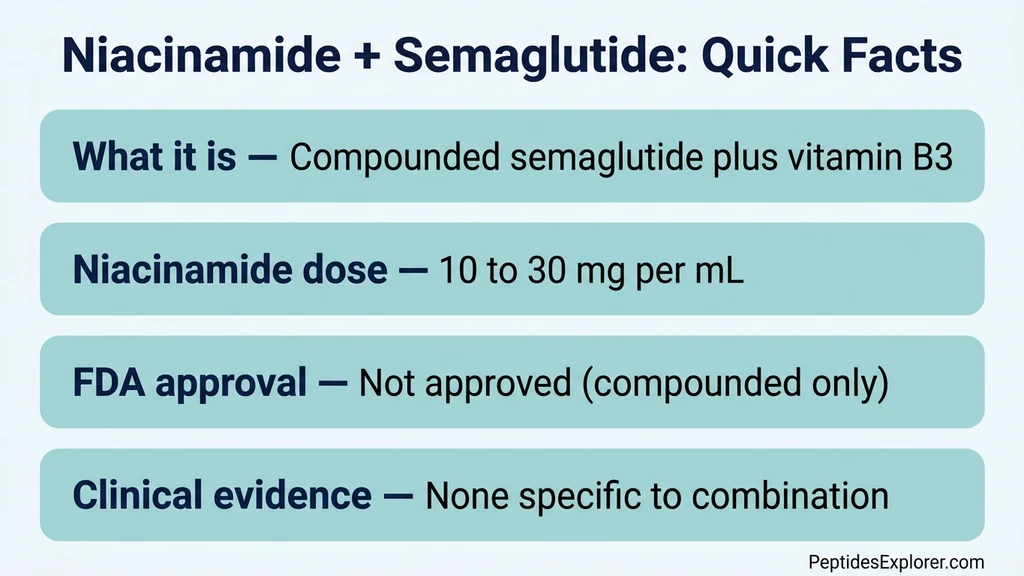
Your compounded semaglutide label says "with niacinamide" and you want to know what that vitamin is doing in your GLP-1 vial, whether it is safe, and whether you should prefer a plain formulation instead. Niacinamide (the amide form of vitamin B3, also called nicotinamide) is added by some compounding pharmacies to semaglutide injections at supplemental doses, typically 10 to 30 mg per mL. The stated rationale is threefold: peptide stability in solution, anti-inflammatory adjunct effect, and a small amount of vitamin supplementation during rapid weight loss. The honest answer is that the human clinical evidence for niacinamide improving semaglutide outcomes is essentially zero. What exists is in-vitro stability data and extrapolation from B vitamin physiology. Niacinamide at these doses is broadly safe (unlike niacin, it does not cause flushing), and the combination is not FDA-approved because no compounded semaglutide is FDA-approved. Before injecting any compounded product, verify the exact niacinamide concentration, the semaglutide concentration, and the bacteriostatic water ratio on the label. This is a commercial compounding choice, not a clinically validated protocol. Always discuss compounded formulations with the prescribing provider before using.
| Quick Reference | Detail |
|---|---|
| What it is | Compounded semaglutide + supplemental vitamin B3 (nicotinamide) |
| Typical niacinamide dose | 10 to 30 mg per mL (weekly delivered dose usually 5-15 mg) |
| Stated reasons | Peptide stability, anti-inflammatory support, vitamin supplementation |
| Human clinical evidence | None specific to GLP-1 + niacinamide combination |
| FDA approval status | Not approved. Compounding-pharmacy product only. |
| Safety profile | Generally safe at supplemental doses; not niacin, no flush |
| Alternative combination | Semaglutide + B12 (more common, addresses B12 absorption) |
| When to avoid | Liver disease, thrombocytopenia, pregnancy without MD approval |
The core decision: if you are offered compounded semaglutide with niacinamide, you should understand that the vitamin is a formulation choice made by the pharmacy, not a clinical enhancement proven to change outcomes. For our framework on the more common B12 variant, see compound semaglutide with B12. For mixing specifics, see semaglutide mixing chart.
This is educational content, not medical advice. Compounded medications carry unique regulatory and quality considerations. Consult your prescribing provider before starting any compounded semaglutide product.
Get your custom peptide protocol:
- Tailored to your body and goals
- Precise dosing and cycle length
- Safe stacking combinations
- Backed by peer-reviewed studies
- Ready in under 2 minutes
What Niacinamide Actually Is
Niacinamide, also known as nicotinamide, is the amide form of vitamin B3. It is water-soluble, serves as a precursor to NAD+ and NADP+ (cofactors in energy metabolism and DNA repair), and is available over the counter.
Niacinamide is NOT the same as niacin (nicotinic acid). Both are forms of vitamin B3 but behave differently:
- Niacin (nicotinic acid) causes the classic "niacin flush" at doses above 30-50 mg because it releases histamine and activates GPR109A. Used clinically at high doses for dyslipidemia.
- Niacinamide (nicotinamide) does NOT cause flushing, does NOT meaningfully affect blood lipids, and is used in dermatology and general B3 supplementation.
When a compounded semaglutide product says "niacinamide" or "nicotinamide," it is the flush-free form. Every compounding pharmacy formulation uses this form.
Supplemental dose context: - RDA: 14-16 mg daily - Typical OTC supplement: 100-500 mg daily - Dose in compounded semaglutide: 10-30 mg per mL, meaning a weekly 0.25 mL injection delivers 2.5-7.5 mg
The amount of niacinamide you receive from a weekly compounded semaglutide injection is small. It will not meaningfully affect your vitamin B3 status, which is part of why its clinical benefit in these formulations is questionable.
Why Compounding Pharmacies Add Niacinamide to Semaglutide
There are three stated rationales. They have different levels of evidence.
Rationale 1: Peptide stability in solution.
Semaglutide is a 31-amino-acid peptide susceptible to degradation through oxidation, aggregation, deamidation, and hydrolysis. Niacinamide has been studied as a stabilizing agent in pharmaceutical literature through proposed mechanisms like mild antioxidant activity, reduced aggregation via hydrogen bonding, and pH buffering. The evidence here is in-vitro and formulation-science based. No published human studies show niacinamide-containing semaglutide produces better clinical outcomes than pure semaglutide.
Rationale 2: Anti-inflammatory adjunct.
Niacinamide has documented anti-inflammatory effects in dermatology and modest systemic effects at higher oral doses, acting through inhibition of NF-kB signaling and modulation of PARP-1 and SIRT1 activity (Niren, 2006). Some compounding pharmacies extrapolate this: rapid weight loss produces transient metabolic inflammation, and niacinamide might buffer it. The extrapolation is weak. The dose in a weekly injection (a few milligrams) is far below the doses (500-1500 mg daily orally) that show measurable anti-inflammatory effects. This rationale is largely marketing.
Rationale 3: Vitamin supplementation during weight loss.
Semaglutide reduces food intake substantially, and patients eating 1000-1500 kcal daily may become deficient in B vitamins. Adding a B vitamin is pitched as "insurance." This rationale is more valid for B12 than niacinamide. GLP-1 therapy may reduce B12 absorption through slower gastric emptying and altered stomach acid. Niacinamide deficiency from semaglutide-induced food restriction is extremely uncommon because B3 is abundant in protein foods and is not affected by GLP-1 absorption mechanisms.
The honest summary: Most compounding pharmacies add niacinamide for a mix of theoretical stability benefits and marketing differentiation. It is not harmful but also not a proven clinical benefit. For vitamin support, oral multivitamins or targeted B12 are better approaches than relying on a few milligrams of niacinamide in a weekly injection. For the more evidence-supported variant, see compound semaglutide with B12.
How It Compares to Semaglutide + B12
The most common compounded semaglutide additive is cyanocobalamin (vitamin B12), not niacinamide. Understanding the difference helps you evaluate the formulation you are being offered.
Semaglutide + B12: - B12 concentration in compounded product: typically 1000 mcg per mL - Clinical rationale: GLP-1 therapy reduces gastric acid and slows gastric emptying, which impairs dietary B12 absorption. Longer-term users of semaglutide have measurably lower B12 levels. The B12 deficiency mechanism is well established with metformin (also used for type 2 diabetes), where calcium-dependent intrinsic factor binding is disrupted (Bauman et al., 2000). - Evidence strength: moderate. B12 deficiency during GLP-1 therapy is documented. Whether injected B12 at these doses prevents deficiency is mechanistically plausible. - Safety: B12 has no meaningful toxicity. Excess is excreted renally. - Side effect profile: generally well tolerated. Some patients notice a pink tinge to the solution (cyanocobalamin is pink/red).
Semaglutide + niacinamide: - Niacinamide concentration: typically 10-30 mg per mL - Clinical rationale: stability, anti-inflammatory effect, vitamin B3 support - Evidence strength: low for clinical benefit. Some formulation-science data for stability. - Safety: generally safe at these doses. Not niacin, no flushing. - Side effect profile: generally unnoticeable at the low delivered dose.
Semaglutide + both (less common): - Some pharmacies combine both additives - The rationale is cumulative: stability + B12 absorption support + B3 backup - No added clinical evidence beyond the individual components
Pure semaglutide (no additives): - Gold standard for predictability - What brand Wegovy and Ozempic contain (along with their own excipients) - Easiest to compare across studies and dose titration
Which should you prefer?
If you are choosing between compounded formulations: 1. Plain semaglutide if you want the cleanest comparison to brand product outcomes. 2. Semaglutide + B12 if you have documented or suspected B12 deficiency risk, or if you plan to stay on semaglutide for more than 6 months. 3. Semaglutide + niacinamide only if your pharmacy exclusively offers this formulation and the other options are not available. 4. Semaglutide + both if your provider believes you need the combined vitamin support, with the caveat that this is additive risk of allergic reactions to any single component.
For the tirzepatide equivalent of this decision, see compound tirzepatide dosage chart and is compound tirzepatide safe.
Safety and Drug Interactions
At the doses present in compounded semaglutide (a few milligrams per weekly injection), niacinamide has a very favorable safety profile. Most people will not experience any niacinamide-attributable effect.
Niacinamide-specific concerns:
- Liver enzymes: very high oral doses (above 3 grams daily) have been associated with elevated liver enzymes. Injected amounts in compounded semaglutide are approximately 1/100th of that dose, so not a practical concern. Patients with pre-existing liver disease should inform their provider.
- Thrombocytopenia: rare reports at high doses. Compounded dose is far below the range of concern; patients with hematological conditions should discuss with their provider.
- Pregnancy and lactation: niacinamide at supplemental doses is safe. However, semaglutide itself is NOT recommended in pregnancy, so the combined product is contraindicated regardless of the vitamin.
- Drug interactions: carbamazepine and primidone may be slightly affected; at the doses in compounded semaglutide, interactions are not clinically significant.
Semaglutide-specific safety (applies to all formulations): The semaglutide component drives the major side effect profile: - GI: nausea, vomiting, constipation, diarrhea (common) - Gallbladder: risk of gallstones during rapid weight loss - Pancreatitis: rare but serious; discontinue and evaluate if severe abdominal pain - Thyroid C-cell tumors: contraindicated in personal/family history of MTC or MEN2 - Hypoglycemia: primarily with concurrent insulin or sulfonylurea use - Retinopathy: rapid A1c reduction can transiently worsen diabetic retinopathy
For the full side effect profile, see does semaglutide cause nausea and does semaglutide cause hair loss.
Storage: refrigerate at 2-8 degrees Celsius, protect from light, do not freeze, discard if cloudy or particulate. Niacinamide does not change handling requirements.
Warning signs to stop and contact your provider: severe abdominal pain, persistent vomiting, rash or breathing difficulty after injection, visual changes, unusual fatigue or jaundice.
For titration safety, see semaglutide titration schedule. For expected timelines, see how long does semaglutide take to work.
How to Read a Compounded Semaglutide + Niacinamide Label
Every compounded injection should have a clear label. If yours does not, contact the compounding pharmacy before using.
Required label elements:
- 1.Drug name ("Semaglutide" or "Semaglutide with niacinamide")
- 2.Semaglutide concentration in mg/mL (commonly 2.5 mg/mL or 5 mg/mL)
- 3.Niacinamide concentration in mg/mL (commonly 10-30 mg/mL)
- 4.Total volume in mL (commonly 2-5 mL)
- 5.Lot number and expiration/beyond-use date
- 6.Compounding pharmacy name and license
- 7.Storage instructions ("Refrigerate 2-8°C, protect from light")
- 8.Prescription fill number
Calculating your dose: If your label reads "Semaglutide 5 mg/mL with niacinamide 20 mg/mL" and your prescription is 0.5 mg semaglutide weekly: - Semaglutide: 0.5 mg / 5 mg per mL = 0.1 mL injection volume - Niacinamide delivered: 20 mg/mL × 0.1 mL = 2 mg per week (less than a fifth of a supplement tablet)
Use the semaglutide dosage calculator for a step-by-step calculation.
Labeling red flags:
- Vague "peptide blend" or "proprietary GLP-1 complex": a legitimate compounded product names every active ingredient with its exact concentration.
- Missing pharmacy name: every compounded product should trace to a named licensed pharmacy.
- No beyond-use date: compounded semaglutide has a finite stability window (commonly 28-56 days refrigerated).
- Inconsistent concentrations across refills: concentration changes without a new prescription mean your mL dose will change and you could under- or overdose.
Most compounded semaglutide arrives pre-reconstituted. Some ships as lyophilized powder requiring bacteriostatic water reconstitution. See semaglutide mixing chart for reconstitution math. For the parallel sourcing framework, see where to buy tirzepatide.
Frequently Asked Questions
Is niacinamide in compounded semaglutide safe?
At the doses typically used in compounded semaglutide (10-30 mg per mL, delivering a few milligrams per weekly injection), niacinamide is broadly safe for most adults. It does not cause the flushing associated with niacin. The main concerns are for patients with significant liver disease, hematological disorders, or known vitamin B3 sensitivity. Always confirm the formulation with your prescribing provider before the first dose. See is compound tirzepatide safe for the parallel framework.
Does niacinamide make semaglutide work better?
There is no published human clinical evidence that niacinamide improves weight loss outcomes, tolerability, or any other measurable endpoint when added to semaglutide. The rationales (stability, anti-inflammatory support, vitamin supplementation) are mostly theoretical or extrapolated from unrelated contexts. If you are considering a compounded formulation specifically to improve outcomes, the evidence does not support choosing niacinamide-containing over plain semaglutide. See how long does semaglutide take to work.
Why do some compounding pharmacies add niacinamide instead of B12?
Different pharmacies make different formulation choices. B12 (cyanocobalamin) is more common because it addresses a documented issue (reduced B12 absorption during GLP-1 therapy). Niacinamide is less common and is typically justified with stability or anti-inflammatory claims. Some pharmacies offer both together. If you prefer one over the other, ask the prescribing provider whether the pharmacy can fill your prescription differently. See compound semaglutide with B12.
Will niacinamide in my semaglutide cause flushing?
No. Niacinamide (nicotinamide) is the flush-free form of vitamin B3. Flushing is caused by niacin (nicotinic acid), which is a different molecule. The amounts used in compounded semaglutide are also small (a few milligrams per weekly dose), well below any threshold that would cause symptoms even with the flush-causing form. If you experience flushing after a semaglutide injection, the cause is almost certainly not niacinamide. See does semaglutide cause nausea for other reactions to check.
Is compounded semaglutide with niacinamide FDA-approved?
No. No compounded semaglutide is FDA-approved. FDA approves the active pharmaceutical ingredient manufacturing process and specific brand products (Ozempic, Wegovy, Rybelsus). Compounded products are made by licensed compounding pharmacies under 503A or 503B rules, which is a different regulatory category. Adding niacinamide does not change that. The legal status of compounding semaglutide depends on FDA shortage list determinations that have shifted multiple times in 2024-2026. See semaglutide titration schedule.
Can I switch from semaglutide with niacinamide to plain semaglutide?
Yes, with one caveat. The semaglutide dose in milligrams is what drives clinical effect, so switching formulations with the same mg dose should be clinically equivalent. The caveat is concentration: if you switch from a 5 mg/mL compounded product to a 2 mg/mL brand product, your injection volume changes substantially. Always recalculate your injection volume with the new concentration and ideally confirm with your provider before the first dose of the new formulation. See semaglutide mixing chart.
Does niacinamide in my semaglutide affect my other medications?
At the dose delivered per weekly injection (a few milligrams), niacinamide does not cause clinically significant drug interactions. The semaglutide itself can affect absorption of other oral medications (because it slows gastric emptying), but that is not caused by the niacinamide component. If you take carbamazepine, primidone, or are on high-dose oral niacinamide supplements, mention the combined exposure to your provider. See compound tirzepatide dosage chart for related drug interaction frameworks.
How long is compounded semaglutide with niacinamide good for after opening?
Most compounded semaglutide products have a beyond-use date of 28 to 56 days under refrigeration (2-8 degrees Celsius), which is set by the pharmacy based on their internal stability testing. Once opened, use within the specified period and discard any remaining solution. Do not freeze. Protect from light. The presence of niacinamide does not meaningfully change the stability window. Check your specific label for the exact beyond-use date. See where to buy tirzepatide for broader compounded-product quality considerations.
The Bottom Line
Niacinamide and semaglutide together is a compounded formulation choice made by some pharmacies, not a clinically validated protocol. The vitamin B3 is added at supplemental doses (10-30 mg per mL, delivering a few milligrams per weekly injection) for a mix of stability, theoretical anti-inflammatory, and vitamin supplementation rationales. The human evidence that this combination outperforms plain semaglutide or semaglutide with B12 is essentially zero. The combination is generally safe because niacinamide at these doses has a benign profile and is not the flush-causing form of vitamin B3.
The practical advice: if your compounded semaglutide comes with niacinamide, that is fine. You do not need to switch formulations just to avoid it. If you are choosing between options, semaglutide with B12 has more mechanistic justification (GLP-1 therapy impairs B12 absorption over time). Plain semaglutide is the cleanest comparison to trial data. Before any dose, verify the label: semaglutide concentration in mg/mL, niacinamide concentration in mg/mL, beyond-use date, lot number, and pharmacy name. Calculate your injection volume against the specific concentration on the label, not a generic protocol.
Compounded semaglutide remains a regulatory gray area. The FDA position on shortage-based compounding has changed multiple times in 2024-2026. Any legitimate provider will be transparent about the current legal basis for the product. Any vague answer about regulation is a red flag regardless of which additives are in the vial.
For the more common B12 variant and mixing math, see compound semaglutide with B12 and semaglutide mixing chart. For the parallel tirzepatide framework, see is compound tirzepatide safe and compound tirzepatide dosage chart. For the semaglutide side effect profile, see does semaglutide cause nausea and does semaglutide cause hair loss.
Related Articles: - Semaglutide Mixing Chart - Is Compound Tirzepatide Safe - Compound Tirzepatide Dosage Chart - Semaglutide Titration Schedule - How Long Does Semaglutide Take to Work - Where to Buy Tirzepatide
Related Articles
How Often to Inject Peptides: Frequency Guide
How often to inject peptides: daily for BPC-157 and ipamorelin, weekly for semaglutide and CJC-1295 DAC. Frequency table by half-life, cycling, missed doses.
Kisspeptin Dosage: Every Human Study Dose Explained
Kisspeptin dosage from human trials: KP-10 at 0.01-3 mcg/kg, KP-54 at 3.2-12.8 nmol/kg. Doses for men and women, mcg conversions, and why they desensitize.
Ipamorelin Dosage: Protocols, Timing & Units
Ipamorelin dosage: 200-300 mcg subcutaneous, 1-3x daily, bedtime fasted. Charts by goal and weight, saturation dose, reconstitution units, safety data.
Epitalon Dosage: Khavinson Protocol, Cycles & Unit Math
Epitalon dosage: 5-10 mg/day subcutaneous for 10-20 days, 1-2 courses per year. Khavinson protocol, reconstitution units for 10-50 mg vials, evidence review.