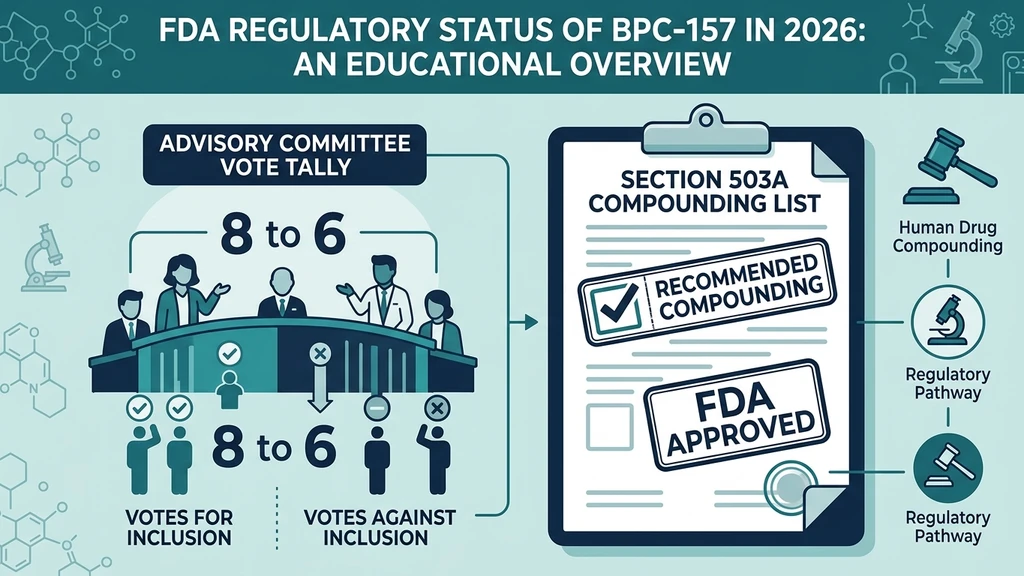
You searched "BPC-157 FDA approval" because a headline told you the FDA just moved on the peptide, and you want to know what actually changed. Here is the straight answer. BPC-157 is not FDA-approved. On July 23, 2026, an FDA advisory committee voted 8-6, with one abstention, to *recommend* adding BPC-157 to the list of substances that compounding pharmacies are allowed to prepare (ABC News, July 23, 2026). A recommendation to allow compounding is not a drug approval, and the vote is not binding on the FDA.
| Quick Reference | Details |
|---|---|
| FDA-approved as a drug? | No |
| What happened July 23, 2026? | Advisory panel voted 8-6 to recommend it for the 503A compounding list |
| Is the vote binding? | No. The FDA makes the final decision |
| Legal to compound right now? | Not yet added to the Category 1 list |
| Prescription required if approved for compounding? | Yes |
| Phase III clinical trials completed | Zero |
| Primary evidence base | Animal (rodent) studies |
This distinction is the whole story, and most coverage blurs it. "Recommended for compounding" and "FDA-approved" are two different things separated by years of clinical trials that have never been run for BPC-157. This guide explains exactly what the committee voted on, what it means for your access, what did not change, and where the safety data actually stands.
Get your custom peptide protocol:
- Tailored to your body and goals
- Precise dosing and cycle length
- Safe stacking combinations
- Backed by peer-reviewed studies
- Ready in under 2 minutes
What the FDA Committee Actually Voted On
On July 23, 2026, the FDA's Pharmacy Compounding Advisory Committee (PCAC) met to consider whether BPC-157 should be added to the Section 503A Bulks List. That list names the bulk drug substances a licensed compounding pharmacy is permitted to use when filling a prescription. BPC-157 was the first of seven peptides the committee reviewed across its July 23-24 meeting (FDA, PCAC meeting notice, July 2026).
The committee voted 8-6 in favor, with one member abstaining (ABC News, July 23, 2026). That is a recommendation, and nothing more. The FDA is not obligated to follow its advisory committees, and the agency issues a separate final determination after weighing the vote, public comment, and its own scientific review.
Read the question the panel answered carefully. It was not "does BPC-157 work?" and it was not "is BPC-157 safe enough to approve as a drug?" It was narrower: should pharmacies be allowed to compound it for patients who have a prescription. A yes vote clears a regulatory hurdle for access. It does not certify the peptide the way a new drug approval would.
The Other Six Peptides on the Docket
BPC-157 shared the July 23-24 agenda with six other peptides, including KPV, TB-500, and MOTS-c, along with epitalon and emideltide. The committee did not wave everything through. At least one compound in the group was rejected, which tells you the panel was drawing distinctions rather than rubber-stamping peptides as a class (STAT, July 23, 2026).
That matters for how you read the BPC-157 result. A split 8-6 vote with a rejection elsewhere on the same docket is a genuinely contested outcome, not a formality. For the wider regulatory picture across all of these compounds, see our FDA peptide crackdown 2026 analysis and our are peptides legal guide.
Who Voted Yes, and the Conflict-of-Interest Question
HHS Secretary Robert F. Kennedy Jr. supported the outcome, consistent with his broader push to widen access to compounded peptides. ABC News also reported that a majority of the panelists who voted yes had ties to the peptide industry (ABC News, July 23, 2026).
This is worth holding in view. It does not make the recommendation wrong, but a narrow vote carried partly by members with industry connections is exactly the kind of result the FDA scrutinizes before it acts. It is one more reason a recommendation and a final decision are not the same event.
Recommended for Compounding Is Not FDA-Approved
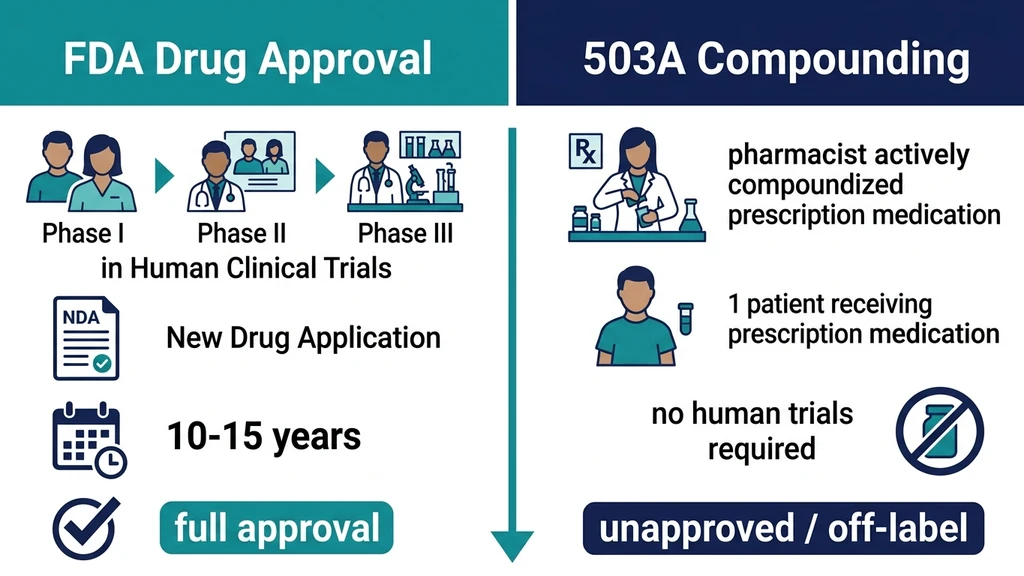
The single most important thing to understand is what "FDA-approved" actually means, because the July vote did not deliver it. FDA drug approval is granted through a New Drug Application (NDA) after a compound clears preclinical work and Phase I, II, and III human trials. That process typically spans 10 to 15 years and costs $1 to 2 billion. BPC-157 has never entered it. No IND application has been filed, and no Phase III trial has been completed.
Being added to the 503A Bulks List, if the FDA ultimately agrees, is a different and much narrower status. It means a licensed pharmacist can legally prepare BPC-157 for an individual patient who holds a valid prescription. The peptide would still be an unapproved, investigational compound with no USP or NF monograph. Physicians who prescribe it would be doing so off-label, for uses the FDA has never reviewed.
What FDA Drug Approval Requires
The approval pipeline is a fixed sequence, and each stage exists to answer a specific question:
| Stage | Question It Answers | Typical Duration |
|---|---|---|
| Preclinical | Is it safe enough to test in humans? | 1-3 years |
| IND application | May we begin human testing? | ~1 month review |
| Phase I | Is it safe in healthy volunteers? | 1-2 years |
| Phase II | Does it work, and at what dose? | 2-3 years |
| Phase III | Does it work in large populations? | 3-4 years |
| NDA review | Does the full data package support approval? | 6-12 months |
BPC-157 sits entirely outside this pipeline. The compounding pathway was designed precisely for substances that have not gone through it, so that patients and physicians can access customized preparations that are not available as approved drugs. Access and approval are separate legal ideas, and conflating them is the most common mistake in peptide coverage. For how this same distinction plays out with a related compound, see our is GHK-Cu FDA-approved explainer.
Why the Wording Matters for You
If BPC-157 lands on the Category 1 list, a marketer may tell you it is "FDA-cleared" or "FDA-recognized." Neither phrase means approved. The committee members who voted no said so directly. They worried that adding BPC-157 to the compounding list would create the false impression that it had been evaluated with the same rigor as an FDA-approved drug (ABC News, July 23, 2026).
That is the exact confusion this article exists to prevent. When you evaluate a supplier or a clinic, treat "compounding is allowed" and "the drug is approved" as two separate facts, and ask which one they are actually claiming.
How BPC-157 Got Here: The 2023 Restriction and the April 2026 Reset
The July 2026 vote did not come out of nowhere. It is the latest step in a three-year regulatory arc that first restricted BPC-157, then reopened the question.
In late 2023, the FDA placed BPC-157 and a group of other popular peptides into Category 2 of the 503A framework: bulk substances the agency flagged as presenting significant safety risks or lacking sufficient data. Category 2 effectively barred compounding pharmacies from preparing them (FDA, bulk drug substances that may present significant safety risks).
In April 2026, the FDA removed BPC-157 from Category 2. That step was largely procedural. It followed withdrawn nominations and the start of a fresh 503A review cycle, and it set up the July PCAC meeting. Removal from Category 2 did not approve BPC-157, and it did not move the peptide to Category 1. It simply cleared the way for the committee to reconsider it.
The Three Buckets, Kept Straight
The 503A system is easier to follow if you hold three states apart:
- Category 1: eligible for compounding with a prescription. This is the status the July vote recommends for BPC-157, pending the FDA's final call.
- Category 2: flagged for significant safety or data concerns, and effectively off-limits to compounders. This is where BPC-157 sat from late 2023 until April 2026.
- Unlisted or under review: neither cleared nor barred, awaiting evaluation. This is roughly where BPC-157 has been since April 2026.
None of these three is the same as FDA drug approval, which is a separate track entirely. For the full timeline of which peptides moved and when, see our FDA peptide crackdown 2026 breakdown.
Is BPC-157 Legal Right Now?
The honest answer is that BPC-157 sits in a gray zone, and the July vote has not yet changed that. As of this writing, the FDA has not issued a final decision adding BPC-157 to the Category 1 list. Until it does, compounding pharmacies are not clearly authorized to prepare it, and BPC-157 has been available mainly through research-chemical suppliers and the gray market (ABC News, July 23, 2026).
If the FDA accepts the recommendation, the picture becomes cleaner. Licensed 503A pharmacies would be able to compound BPC-157 for patients with a valid prescription, and 503B outsourcing facilities could prepare larger batches. A prescriber-patient relationship would be required, and the product would remain an off-label, unapproved therapy rather than an approved drug.
No date has been announced for the FDA's final determination. Advisory committee recommendations can take months to translate into agency action, and the FDA can decline to follow the vote. Anyone selling BPC-157 today as "newly legal because the FDA approved it" is misreading the state of play.
The Research-Chemical Route and Its Risks
Most BPC-157 sold today is labeled "for research purposes only." That market is legal to buy from for laboratory use, but it is not legal to self-administer, and the products carry no pharmaceutical quality guarantees. Purity, sterility, and endotoxin control vary widely between suppliers.
This is where the access question becomes a safety question. A compounded prescription from a licensed pharmacy carries quality controls that a research vial from an unregulated vendor does not. If you are weighing sources, our where to buy peptides in 2026 guide covers how to evaluate suppliers, and our BPC-157 side effects guide covers what the safety literature does and does not establish.
What the Safety and Efficacy Data Actually Shows
The committee's split vote reflects a real tension in the evidence. BPC-157 has a large and growing preclinical literature, and almost none of it is human. FDA staff scientists reviewing the nomination found a general lack of quality data supporting safety and effectiveness, noting that most studies were conducted in rodents and that such results do not always hold up when larger trials are run in people (ABC News, July 23, 2026).
That assessment is consistent with the published record. The bulk of BPC-157 research consists of animal and cell-culture studies of its effects on tissue healing, gut integrity, and angiogenesis (Sikiric et al., *Pharmaceuticals*, 2025; Wang et al., *Curr Pharm Des*, 2020). The mechanistic data is genuinely interesting. What is missing is the large, randomized, controlled human trial that would move BPC-157 from "promising in rodents" to "proven in people."
Why Rodent Data Is Not Enough
Animal studies establish biological plausibility. They show that a compound can do something in a living system, at some dose, under controlled conditions. They do not establish that the same effect, dose, and safety margin carry over to humans, and the history of drug development is full of compounds that shone in mice and failed in people.
This is the gap the "no" voters were pointing at. Adding BPC-157 to the compounding list widens access before that human evidence exists. Reasonable experts disagree about whether that is acceptable for a peptide with a long anecdotal track record, which is exactly why the vote was 8-6 rather than unanimous.
What We Do and Do Not Know
A fair summary of the current evidence looks like this:
- Reasonably established (preclinical): BPC-157 accelerates healing of tendon, muscle, and gut tissue in rodent models, and influences angiogenesis and nitric oxide pathways.
- Plausible but unproven in humans: the same healing benefits at the doses people actually use, and the long-term safety of repeated injection.
- Genuinely unknown: effects of chronic human use over years, interactions with other drugs, and behavior in specific populations such as people with cancer or cardiovascular disease.
For a deeper look at benefits claims and how they map to the evidence, see our BPC-157 benefits review, and for the safety side, our BPC-157 side effects guide.
What This Means If You Are Considering BPC-157
The regulatory news does not change the practical calculus as much as the headlines suggest. BPC-157 was not approved, it was recommended for a compounding pathway that the FDA has not yet finalized, and the underlying human evidence is thin. If you are still considering it, decide based on that reality rather than on a "the FDA just approved it" framing that is not true.
If the FDA Finalizes Compounding Access
The cleanest legal route, should the FDA act, is a prescription filled by a licensed compounding pharmacy. That path gives you a prescriber who reviews your history, a pharmacy held to current Good Manufacturing Practices, and a product with verified concentration and sterility. It costs more than a research vial, and that difference buys quality control you cannot verify on your own.
If you go this route, a provider sets your dose. For general context on how BPC-157 dosing is typically structured by body weight and goal, see our BPC-157 dosage by body weight guide and the BPC-157 dosage calculator. For administration technique, see how to inject BPC-157.
Questions Worth Asking a Provider
Before starting any peptide, a good conversation covers the honest state of the evidence and your specific situation:
- What human data exists for my intended use, and how strong is it?
- What are the realistic risks given that long-term human safety data is limited?
- Is the product sourced from a licensed compounding pharmacy or a research supplier?
- How will we monitor for problems, and what would make us stop?
These are the same questions worth asking about any compound in this category, from TB-500 to MOTS-c. A provider who welcomes them is a better sign than one who pitches BPC-157 as newly FDA-blessed.
Common Misconceptions After the Vote
The July 2026 vote generated a wave of confident but wrong claims. Here are the ones to watch for, and what is actually true.
"The FDA approved BPC-157." False. An advisory panel recommended it for compounding by an 8-6 vote. The FDA has not approved it as a drug and has not issued a final decision on the compounding list.
"BPC-157 is now legal to buy anywhere." False. Nothing has changed for over-the-counter or research-chemical sales. If the FDA finalizes the recommendation, legal access would run through a prescription and a licensed compounding pharmacy, not a general marketplace.
"The vote proves BPC-157 is safe and effective." False. FDA staff scientists flagged a lack of quality human data, and the evidence base is predominantly rodent studies. A recommendation to permit compounding is not a verdict on safety or efficacy.
"This is the same as the February 2026 peptide reclassification." Not quite. The February 2026 action restored several peptides, including GHK-Cu, to Category 1 (see our is GHK-Cu FDA-approved guide). The July vote is a separate, still-pending recommendation specific to BPC-157 and the other peptides on that docket.
BPC-157 Versus a Genuinely FDA-Approved Peptide
To see how far "recommended for compounding" sits from "FDA-approved," compare BPC-157 to a peptide that actually cleared the pipeline.
| BPC-157 | Semaglutide (Ozempic, Wegovy) | |
|---|---|---|
| FDA drug approval | No | Yes (2017, 2021) |
| Phase III human trials | None | Multiple, thousands of patients |
| How you access it | Research market, or compounding if finalized | Standard prescription for an approved drug |
| Evidence base | Primarily rodent studies | Large randomized controlled trials |
| Manufacturing oversight | Compounding standards, if approved | Full pharmaceutical GMP |
Semaglutide got approved because a manufacturer invested billions in human trials for a patentable molecule aimed at a massive market. BPC-157 has none of those drivers. It is a small peptide with fragmented potential uses and no corporate sponsor funding Phase III trials, which is why its most realistic near-term status is compounding access rather than drug approval. The pattern mirrors other research peptides, from TB-500 to the copper peptides covered in our is GHK-Cu FDA-approved guide.
Frequently Asked Questions
Did the FDA approve BPC-157 in 2026?
No. On July 23, 2026, an FDA advisory committee voted 8-6 to recommend adding BPC-157 to the 503A compounding list. That is a non-binding recommendation, not a drug approval, and the FDA has not issued a final decision. BPC-157 remains an unapproved, investigational compound. See our FDA peptide crackdown 2026 guide for context.
What does the 503A Bulks List vote actually mean?
It means a panel recommended that compounding pharmacies be allowed to prepare BPC-157 for patients with a prescription. It does not certify safety or efficacy the way drug approval does. The FDA must still decide whether to add BPC-157 to the list, and it is not obligated to follow the vote.
Is BPC-157 legal to buy right now?
BPC-157 sits in a gray zone. It has been sold mainly as a research chemical, which is legal to buy for laboratory use but not to self-administer. Compounding access is not yet finalized. For how to evaluate sources, see our where to buy peptides in 2026 guide and are peptides legal.
When will the FDA make a final decision on BPC-157?
No date has been announced. Advisory committee recommendations can take months to become agency action, and the FDA can decline to follow them. Until a final determination is published, BPC-157 is not clearly authorized for compounding. Track the wider landscape in our FDA peptide crackdown 2026 analysis.
Why was the vote so close at 8-6?
Members who voted no worried that listing BPC-157 would imply it had been evaluated as rigorously as an approved drug, when FDA staff found a lack of quality human data and mostly rodent studies. The split reflects genuine disagreement about widening access before human evidence exists. Our BPC-157 side effects guide covers the safety picture.
Is BPC-157 safe according to the FDA?
The FDA has not certified BPC-157 as safe. Agency scientists flagged a general lack of quality data on safety and effectiveness, noting most studies are in rodents. Long-term human safety data is limited. Review the evidence in our BPC-157 benefits and BPC-157 side effects guides before considering it.
Which other peptides did the FDA committee vote on?
If BPC-157 gets added, how would I legally get it?
Through a prescription filled by a licensed 503A compounding pharmacy or a 503B outsourcing facility, with a prescriber-patient relationship. It would remain an off-label, unapproved therapy. A provider would set your dose; see our BPC-157 dosage by body weight guide and BPC-157 dosage calculator for context.
The Bottom Line
BPC-157 is not FDA-approved, and the July 2026 vote did not change that. What happened is narrower and more specific: an FDA advisory committee recommended, by a contested 8-6 margin, that compounding pharmacies be permitted to prepare BPC-157 for patients with a prescription. The FDA has not finalized that recommendation, and it is not required to.
Hold the two ideas apart. Drug approval means human trials, an NDA, and a verdict on safety and efficacy. Compounding access means a legal pathway to prepare an unapproved compound for individual patients. BPC-157 is, at best, on the doorstep of the second, and nowhere near the first. FDA staff scientists were blunt that the human evidence is thin and the studies are mostly in rodents, and the closeness of the vote reflects real disagreement about that gap.
If you are considering BPC-157, decide based on that reality rather than a headline. The cleanest future path, if the FDA acts, is a prescription filled by a licensed compounding pharmacy, not a research vial from an unregulated vendor. For the science and safety, read our BPC-157 benefits and BPC-157 side effects guides. For the regulatory backdrop, see FDA peptide crackdown 2026, are peptides legal, and our is GHK-Cu FDA-approved explainer. For dosing context, use the BPC-157 dosage calculator, and explore the full BPC-157 profile at PeptidesExplorer.
Related Articles
Is GHK-Cu FDA-Approved? Status Explained
GHK-Cu is not FDA-approved as a drug. Legal status in cosmetics, compounding access after 2026 reclassification, and why no clinical trials exist.
Does Compounded Tirzepatide Work? Real Data
Does compounded tirzepatide work? Review SURMOUNT data, salt form differences (base, acetate, sodium), potency gaps, and FDA status in 2026.
Is Tesamorelin FDA Approved? Status & Facts
Is tesamorelin FDA approved? Yes, as Egrifta for HIV lipodystrophy (2010). Approval timeline, off-label rules, and GH peptide comparison.
BPC-157 and Alcohol: Can You Drink? (6 Studies)
Can you drink alcohol on BPC-157? Yes, in moderation. 6 studies show it protects the liver, gut, and brain from alcohol damage. Safe timing and dosing inside.