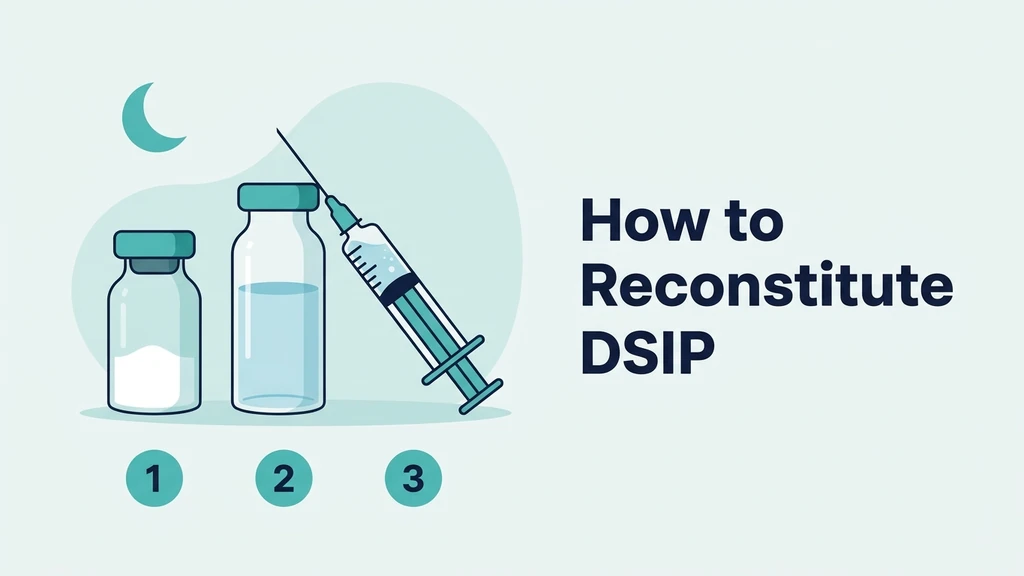
A 5 mg vial of white DSIP powder, a 30 mL bottle of bacteriostatic water, and a syringe marked in units rather than milliliters. Here is the answer: add 2 mL of bacteriostatic water to a 5 mg DSIP vial for 25 mcg per unit, or 2 mL to a 10 mg vial for 50 mcg per unit, run the water down the glass wall, roll until clear, and refrigerate. At 25 mcg per unit, a 250 mcg draw is 10 units on a U-100 insulin syringe.
| Vial | Bac water | Concentration | mcg per unit | 250 mcg draw |
|---|---|---|---|---|
| 5 mg | 1 mL | 5 mg/mL | 50 mcg | 5 units |
| 5 mg | 2 mL | 2.5 mg/mL | 25 mcg | 10 units |
| 10 mg | 2 mL | 5 mg/mL | 50 mcg | 5 units |
| 10 mg | 4 mL | 2.5 mg/mL | 25 mcg | 10 units |
This page covers mixing, unit math, and the mistakes that double a dose. Which dose to draw belongs to the DSIP dosage guide, and what to expect after the injection to how long DSIP takes to work. The compound itself, a nine-amino-acid peptide first isolated from rabbit brain and approved by no regulator for any use, is profiled on the DSIP peptide page. Technique that applies to every lyophilized vial lives in the peptide reconstitution walkthrough, and the full storage timeline in how long reconstituted peptides last.
Once the vial is mixed, site choice and volume per site are covered in where to inject DSIP.
Get your custom peptide protocol:
- Tailored to your body and goals
- Precise dosing and cycle length
- Safe stacking combinations
- Backed by peer-reviewed studies
- Ready in under 2 minutes
What You Need Before You Open a DSIP Vial
Lay everything out on a clean surface before the first swab. The common failure is a needle already through the stopper while you search a drawer for the marker.
- Lyophilized DSIP vial, 5 mg or 10 mg
- Bacteriostatic water, 0.9% benzyl alcohol, 30 mL bottle
- One 3 mL syringe with an 18 to 22 gauge needle, for moving the water
- U-100 insulin syringes, 29 to 31 gauge, 0.3 mL or 0.5 mL
- Alcohol swabs, a fine permanent marker, a sharps container
The water is the one choice that decides how long the vial lives. Bacteriostatic water carries 0.9% benzyl alcohol, a preservative that suppresses microbial growth across the repeated punctures of a multi-dose vial (Meyer et al., J Pharm Sci, 2007, PMID 17722087). Sterile water has no preservative, so a DSIP vial mixed with it is a single-session vial.
A 10 mg vial at microgram doses is a multi-week, multi-puncture vial, exactly the situation the preservative exists for. The comparison is in the bacteriostatic vs sterile water guide, and the "reconstitution solution" labeling trap in is reconstitution solution the same as bacteriostatic water.
DSIP 5 mg and 10 mg Reconstitution: How Much Bacteriostatic Water
Think of a powdered drink mix. One packet in a small glass makes a strong drink, the same packet in a pitcher makes a weak one, and the sugar never changed. The milligrams of DSIP in the vial are fixed; the water you add sets how much peptide rides in every unit.
The arithmetic runs in one line. Micrograms per unit = milligrams in the vial times 10, divided by milliliters of water. A 5 mg vial plus 2 mL is 50 divided by 2, or 25 mcg per unit. A 10 mg vial plus 2 mL is 100 divided by 2, or 50 mcg per unit.
| Vial | Bac water | Concentration | mcg per unit |
|---|---|---|---|
| 5 mg | 1 mL | 5 mg/mL | 50 mcg |
| 5 mg | 2 mL | 2.5 mg/mL | 25 mcg |
| 5 mg | 2.5 mL | 2 mg/mL | 20 mcg |
| 5 mg | 3 mL | 1.67 mg/mL | 16.7 mcg |
| 10 mg | 1 mL | 10 mg/mL | 100 mcg |
| 10 mg | 2 mL | 5 mg/mL | 50 mcg |
| 10 mg | 3 mL | 3.33 mg/mL | 33.3 mcg |
| 10 mg | 4 mL | 2.5 mg/mL | 25 mcg |
| 10 mg | 5 mL | 2 mg/mL | 20 mcg |
Aim for 25 mcg per unit. It turns the three common draws into 4, 10, and 20 units: large enough to read, small enough for a 0.3 mL syringe. At 100 mcg per unit, a 100 mcg draw is a single unit, and one tick of misreading is a 100% error.
The 10 mg vial has a capacity problem. Many research vials hold 3 mL, so 4 or 5 mL of water does not fit; if yours is a 3 mL vial, use 2 mL and accept 50 mcg per unit, or 3 mL for 33.3 mcg per unit. The peptide reconstitution calculator takes vial size, water volume, and dose and returns the unit mark. The same table logic appears in the tesamorelin reconstitution guide, only in milligrams rather than micrograms.
DSIP Reconstitution and Dosage: Units to Draw for 100, 250 and 500 mcg
Units on a U-100 syringe = dose in mcg divided by mcg per unit. At 25 mcg per unit, 250 mcg is 250 divided by 25, or 10 units.
| Dose | At 20 mcg/unit | At 25 mcg/unit | At 33.3 mcg/unit | At 50 mcg/unit |
|---|---|---|---|---|
| 100 mcg | 5 units | 4 units | 3 units | 2 units |
| 250 mcg | 12.5 units | 10 units | 7.5 units | 5 units |
| 500 mcg | 25 units | 20 units | 15 units | 10 units |
Which of those three doses fits a given protocol is a separate question, answered in the dosage guide linked in the introduction; this table only converts a number into a syringe mark.
Some dose context is still owed. The human DSIP trials of the 1980s used intravenous infusion in a sleep laboratory, at about 25 nmol per kg, which is roughly 21 mcg per kg or 1.5 mg for a 70 kg adult (Schneider-Helmert et al., Int J Clin Pharmacol Ther Toxicol, 1981, PMID 6895513; Schneider-Helmert et al., Eur Neurol, 1986, PMID 3792404). Later double-blind trials in chronic insomniacs reported weaker and less consistent effects (Monti et al., Int J Clin Pharmacol Res, 1987, PMID 3583493; Bes et al., Neuropsychobiology, 1992, PMID 1299794). The 100 to 500 mcg subcutaneous range on vendor sites is a community convention with no trial behind it, and DSIP is not FDA-approved for sleep or anything else.
Match the syringe to the draw: the 0.3 mL insulin syringe marks every half unit, the 0.5 mL every unit, the 1 mL every 2 units, so a 4 unit draw lands on a printed line only on the 0.3 mL. Convert any dose at any concentration with the peptide unit converter.
DSIP Reconstitution Step by Step
The whole procedure takes five minutes. The slow part is the water going in, and that is where the peptide is protected or wasted.
- 1.Warm and wash. Let the vial and the water bottle sit at room temperature for 15 minutes. Wash your hands.
- 2.Swab both stoppers. Separate swabs for the DSIP vial and the water bottle. Let the alcohol dry for 10 seconds.
- 3.Draw the water into the 3 mL syringe. Pull 2 mL for a 5 mg vial. Do not use an insulin syringe for this step: 2 mL is two full refills of 100 units, and each refill is a chance to lose count.
- 4.Vent the vial. Push the needle through the DSIP stopper at a 45 degree angle, bevel up, then straighten. A steep stab cores the rubber.
- 5.Aim at the glass. Rest the needle tip against the inside wall and press the plunger over 30 to 60 seconds. A jet onto the powder clumps it.
- 6.Roll, never shake. Roll the vial between your palms for 30 to 60 seconds. Shaking drives peptides to aggregate in solution (Manning et al., Pharm Res, 2010, PMID 20143256), and aggregated peptide is peptide you cannot dose.
- 7.Inspect. Clear, colorless, nothing floating. A faint swirl that clears in a minute is fine.
- 8.Label. Write the date, the concentration in mcg per unit, and the unit mark for your draw. "25 mcg/unit, 250 mcg = 10 u" prevents every mistake in the next section.
- 9.Refrigerate. Upright, 2 to 8 degrees C, out of light.
Two other microgram-scale peptides use identical hands-on technique with different numbers: the PT-141 reconstitution guide and the CJC-1295 and ipamorelin reconstitution guide.
Mistakes That Change the DSIP Dose by 2x
Every error below is silent. The syringe looks the same, the injection feels the same, and the dose is wrong by a factor you only discover later.
| Mistake | What it does to the dose |
|---|---|
| Adding 1 mL when your unit chart assumed 2 mL | Every draw delivers double |
| Mixing a 10 mg vial with a chart written for 5 mg | Double |
| Reading a 1 mL syringe's 2-unit marks as 1-unit marks | Double |
| Using a U-40 syringe with U-100 math | 2.5 times the intended volume |
| Mixing up mcg and mg when entering the dose in a calculator | 1,000 times |
| Topping up a near-empty vial with fresh water | Unknown dilution; every draw after that is a guess |
The first row is the common one. A friend's protocol says "10 units," but the friend mixed 2 mL and you mixed 1 mL. Your 10 units carry 500 mcg, not 250 mcg. The unit count means nothing without the water volume next to it, which is why the label in step 8 writes both.
The syringe rows are a reading problem: on a 1 mL U-100 syringe the lines are 2 units apart, on a 0.3 mL syringe half a unit apart, so read the printed numbers and never count lines. An air bubble is a smaller error. A 1 unit bubble inside a 5 unit draw at 50 mcg per unit is a 20% underdose; tap, expel, re-draw to the mark, as shown in the generic reconstitution walkthrough.
Storage After Mixing, and the Two Risks That Matter
Mixed DSIP goes in the refrigerator at 2 to 8 degrees C, upright, dark, and is treated as a 14 day vial with 28 days as the outer limit for one that stayed cold and clear. Peptides in solution hydrolyze, deamidate, oxidize, and aggregate, and every one of those reactions speeds up with temperature (Nugrahadi et al., Pharmaceutics, 2023, PMID 36986796); no published stability study covers research-grade DSIP in bacteriostatic water, so the 14 to 28 days is convention, with the long form in how to store peptides and the water bottle's own 28 day clock in how long bacteriostatic water lasts.
Contamination. A 10 mg vial drawn at 250 mcg is 40 punctures. Hospital audits that cultured opened multi-dose vials still found contaminated vials among them, despite trained staff and preserved diluents (Baniasadi et al., Braz J Infect Dis, 2013, PMID 23294643), and sterility surveys of multi-dose vials in hospital use date back decades for the same reason (Bawden et al., Am J Hosp Pharm, 1982, PMID 6800255). Benzyl alcohol slows growth; it does not sterilize a stopper you forgot to swab. A fresh needle for every draw, a swab before every puncture, and the vial back in the refrigerator within minutes.
Dosing error. The smaller the draw, the larger each misread. A 1 unit misread on a 5 unit draw is 20%; the same misread on a 10 unit draw is 10%, and on a 20 unit draw 5%. That is the whole argument for 25 mcg per unit rather than 50, and for a 0.3 mL syringe rather than a 1 mL one. DSIP itself has a thin human safety record, so a doubled dose is a step into territory nobody has studied.
Signs of a Bad DSIP Vial
The acceptance test is the same for every lyophilized peptide: clear, colorless, free of particles. Anything else fails, and no filter rescues it.
- Cloudy after 10 minutes of gentle rolling. Aggregated peptide, not slow dissolution.
- Floating strands, flecks, or a film on the glass. Discard.
- Any yellow or tan tint. DSIP solution is colorless.
- Powder that arrived wet, shrunken, or stuck to one side. A broken cold chain before you opened it.
- Rubber flecks. Coring from a steep needle angle.
- Warm overnight, or past 28 days. No visual check certifies a vial that broke its clock.
Keep unmixed powder refrigerated and dark, and buy water in a sealed, dated bottle; sourcing is in where to buy bacteriostatic water for injection.
Frequently Asked Questions
How much bacteriostatic water for DSIP 10 mg reconstitution?
Add 2 mL for 50 mcg per unit, or 4 mL for 25 mcg per unit if the vial holds that much. Many research vials are 3 mL, so 2 mL is the safe default. Check your own vial size and dose in the peptide reconstitution calculator before the water goes in.
How much bacteriostatic water for DSIP 5 mg reconstitution?
Add 2 mL for 25 mcg per unit, which puts 100 mcg at 4 units, 250 mcg at 10 units, and 500 mcg at 20 units. Adding 1 mL doubles every number to 50 mcg per unit. The water choice itself is explained in the bacteriostatic vs sterile water guide.
DSIP reconstitution and dosage: how many units is 250 mcg?
Divide the dose by the mcg per unit. At 25 mcg per unit (5 mg plus 2 mL), 250 mcg is 10 units; at 50 mcg per unit (10 mg plus 2 mL), it is 5 units. The peptide unit converter does the division for any concentration and any syringe.
Can I reconstitute DSIP with sterile water instead?
Yes, for a vial you will finish in one session. Sterile water carries no preservative, so repeated punctures over weeks invite microbial growth. A 5 or 10 mg DSIP vial at microgram doses is a multi-week vial, which is the case for bacteriostatic water, as detailed in how to reconstitute a peptide.
How long does reconstituted DSIP last in the fridge?
Treat it as 14 days at 2 to 8 degrees C, with 28 days as the outer limit for a vial that stayed cold, dark, and clear. No published stability study covers research-grade DSIP in solution, so these are conventions. Peptide-by-peptide timelines are in how long reconstituted peptides last.
Which insulin syringe should I use for DSIP?
A 0.3 mL U-100 syringe marked in half units, because DSIP draws fall between 4 and 20 units and half-unit marks make a 4 unit draw readable. A 1 mL syringe marks every 2 units and invites double counting. The syringe-reading rules are the same as in the PT-141 reconstitution guide.
Why is my DSIP cloudy after mixing?
Water jetted straight onto the powder, or shaking, aggregates the peptide. Let the vial stand upright for 10 minutes and roll it again. If it stays cloudy or shows strands, discard it. Unmixed powder that was stored warm also dissolves badly; storage rules are in how to store peptides.
The Bottom Line
Reconstituting DSIP comes down to one number written on the label: micrograms per unit. Add 2 mL to a 5 mg vial for 25 mcg per unit, or 2 mL to a 10 mg vial for 50 mcg per unit, run the water down the glass, roll instead of shaking, and refrigerate. At 25 mcg per unit, 100 mcg is 4 units, 250 mcg is 10, and 500 mcg is 20.
The mistakes that matter are all arithmetic: the wrong water volume, the wrong vial size, the wrong syringe. Write the concentration and the unit mark on the vial the moment it is mixed, swab before every puncture, and retire the vial at 14 to 28 days. DSIP has decades of small human trials and no regulatory approval anywhere, so the one variable fully in your control is whether the number in the syringe is the number you intended.
Check every vial size and dose in the calculators, read the compound profile, and browse the full library of reconstitution guides at PeptidesExplorer.
Related Articles
How to Reconstitute BPC-157 (5 mg & 10 mg): Units per Dose
How to reconstitute BPC-157: bacteriostatic water for 5 mg and 10 mg vials, mcg per unit at 1 to 5 mL, units for 250 and 500 mcg doses, mixing steps, mistakes.
Where to Inject DSIP: Sites, Units per Shot, Night Routine
Where to inject DSIP: abdomen 2 inches off the navel, thigh or flank, subQ with a 29-31G insulin syringe. Units per shot, rotation grid, night routine.
How to Reconstitute PT-141: Water, Units & Shelf Life
How to reconstitute PT-141: 2 mL bacteriostatic water per 10 mg vial gives 5 mg/mL, so 1 mg is 20 units. Steps, 1/2/3 mL unit table, and how long it keeps.
How to Reconstitute Cagrilintide (5 mg, 10 mg)
How to reconstitute cagrilintide: bacteriostatic water for 5 mg and 10 mg vials, mg to units on a U-100 syringe, fridge storage and the 28-day clock.