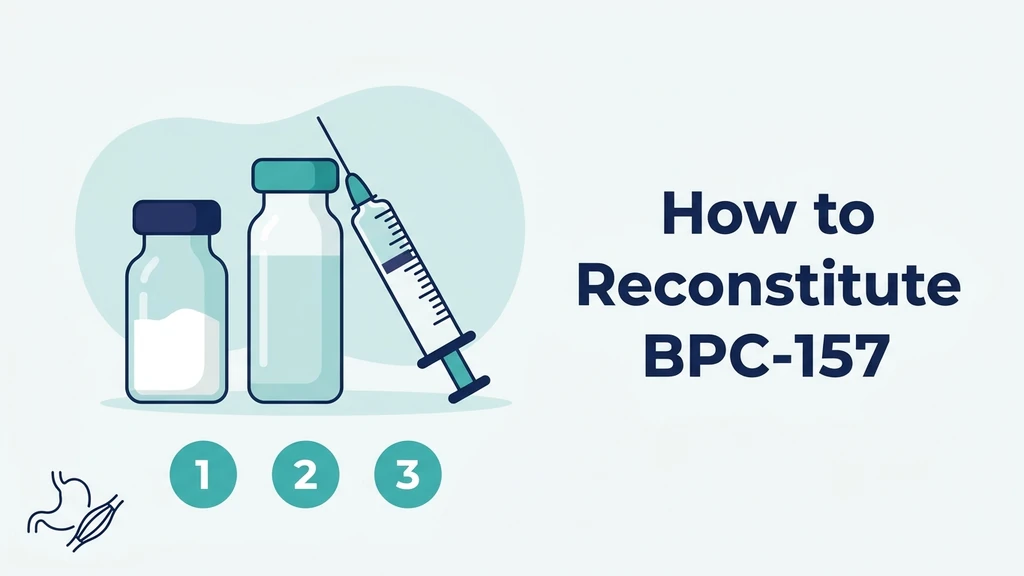
A 5 mg vial of white powder, a 30 mL bottle of bacteriostatic water, and an insulin syringe marked in units rather than micrograms. Here is the answer: add 2 mL of bacteriostatic water to a 5 mg BPC-157 vial for 25 mcg per unit, so 250 mcg is 10 units and 500 mcg is 20 units. A 10 mg vial with 2 mL gives 50 mcg per unit: 250 mcg is 5 units and 500 mcg is 10 units. Run the water down the glass, swirl until clear, never shake.
| Vial | Bac water | mcg per unit | 250 mcg draw | 500 mcg draw |
|---|---|---|---|---|
| 5 mg | 1 mL | 50 | 5 units | 10 units |
| 5 mg | 2 mL | 25 | 10 units | 20 units |
| 10 mg | 2 mL | 50 | 5 units | 10 units |
| 10 mg | 5 mL | 20 | 12.5 units | 25 units |
This page covers single-peptide vials only: the water, the unit math, the mixing, and what a good vial looks like. Blend vials that combine BPC-157 with TB-500 use their own ratios, covered in the BPC-157 and TB-500 blend dosage guide. Which dose to draw belongs to the BPC-157 dosage calculator and the BPC-157 dosage by body weight chart. How long a mixed vial lasts is in the reconstituted peptide shelf-life guide, the fasting question in BPC-157 on an empty stomach or with food, and site selection in where to inject BPC-157. The compound itself is profiled on the BPC-157 peptide page, and the technique for any lyophilized vial is in the peptide reconstitution walkthrough.
Get your custom peptide protocol:
- Tailored to your body and goals
- Precise dosing and cycle length
- Safe stacking combinations
- Backed by peer-reviewed studies
- Ready in under 2 minutes
What You Need Before You Open the Vial
Lay everything out first. Mixing goes wrong when you are hunting for a swab with a needle already through the stopper.
- Lyophilized BPC-157 vial, 5 mg or 10 mg, single peptide
- Bacteriostatic water, 0.9% benzyl alcohol, 30 mL bottle
- One 3 mL syringe with an 18 to 22 gauge needle, for the water
- U-100 insulin syringes, 29 to 31 gauge, 0.5 mL barrel
- Alcohol swabs, a fine permanent marker, and a sharps container
The water decides how long the vial lives. At 250 to 500 mcg per day, a 5 mg vial takes 10 to 20 punctures to empty and a 10 mg vial takes 20 to 40. Bacteriostatic water carries 0.9% benzyl alcohol, a preservative that suppresses microbial growth between those punctures (Meyer et al., J Pharm Sci, 2007, PMID 17722087). Sterile water has none. The full comparison is in the bacteriostatic vs sterile water guide, and sourcing in where to buy bacteriostatic water.
The syringe decides how well you read the dose. A 0.5 mL U-100 syringe marks every single unit, and a 10 or 20 unit draw sits in the readable middle of the barrel. The 1 mL syringe marks every 2 units, which is where half the counting errors below begin.
How Much Bacteriostatic Water for a 5 mg or 10 mg BPC-157 Vial
Two lines of arithmetic run every row of this table. Micrograms per unit = micrograms in the vial divided by (mL of water times 100). Units to draw = dose in mcg divided by mcg per unit.
Worked once: 5 mg is 5,000 mcg. Two mL of water is 200 units of liquid. 5,000 divided by 200 is 25 mcg per unit. A 250 mcg dose is 250 divided by 25, which is 10 units.
| Vial | Bac water | Concentration | mcg per unit | 250 mcg | 500 mcg |
|---|---|---|---|---|---|
| 5 mg | 1 mL | 5,000 mcg/mL | 50 | 5 units | 10 units |
| 5 mg | 2 mL | 2,500 mcg/mL | 25 | 10 units | 20 units |
| 5 mg | 3 mL | 1,667 mcg/mL | 16.7 | 15 units | 30 units |
| 5 mg | 5 mL | 1,000 mcg/mL | 10 | 25 units | 50 units |
| 10 mg | 1 mL | 10,000 mcg/mL | 100 | 2.5 units | 5 units |
| 10 mg | 2 mL | 5,000 mcg/mL | 50 | 5 units | 10 units |
| 10 mg | 3 mL | 3,333 mcg/mL | 33.3 | 7.5 units | 15 units |
| 10 mg | 5 mL | 2,000 mcg/mL | 20 | 12.5 units | 25 units |
Pick the row that lands your draw between 10 and 50 units. Below 10 units, one tick of misreading is 10% or more of the dose; above 50, you are near the top of a 0.5 mL barrel. Rows that produce half units (2.5, 7.5, 12.5) only work on a 0.3 mL syringe with half-unit marks.
For a 5 mg vial, 2 mL is the sweet spot. For a 10 mg vial, 2 mL keeps the 500 mcg draw at a clean 10 units, and 5 mL gives the most readable numbers if the glass holds it. Many research vials are 3 mL, so confirm capacity before the water goes in. Run any other combination through the peptide reconstitution calculator, and convert a draw you already know with the peptide unit converter.
How to Mix BPC-157, Step by Step
The whole procedure takes five minutes. The slow part is the water going in.
- 1.Warm and clean. Let the vial and the water bottle sit at room temperature for 15 minutes. Wash your hands.
- 2.Swab both stoppers. One alcohol swab for the peptide vial, a fresh one for the water bottle. Let them dry for 10 seconds.
- 3.Draw the water. Pull 2 mL into the 3 mL syringe and read the barrel at eye level. An insulin syringe holds 1 mL at most, so 2 mL means two refills and a chance to lose count; use the bigger syringe.
- 4.Aim at the glass. Push the needle through the stopper at an angle so the tip rests against the inside wall. Press the plunger over 30 to 60 seconds. Water jetted straight onto the cake clumps it and foams it.
- 5.Swirl, never shake. Tilt the vial and rotate it slowly, or roll it between your palms. Shaking shears peptides into aggregates that stay in the vial as haze (Manning et al., Pharm Res, 2010, PMID 20143256). BPC-157 dissolves fast; most vials clear within 1 to 2 minutes at 2 mL.
- 6.Inspect. Clear, colorless, nothing floating. Anything else fails, and the section below describes each failure.
- 7.Label the vial. Date, "25 mcg per unit", and the unit count for your draw: "250 mcg = 10 units". Ten seconds of marker that prevent every mistake in the scenarios below.
- 8.Refrigerate. Upright, 2 to 8 degrees C, away from light. Use a fresh insulin syringe for every draw.
Why the Water, Not the Vial, Sets Your Units
Think of a teaspoon of salt. Stirred into a cup of broth, it makes every spoonful salty. Stirred into a stockpot, the same teaspoon barely registers, and each spoonful carries a fraction of the salt. The pot still holds exactly one teaspoon.
Literally stated: the micrograms of BPC-157 in the vial are fixed. The water you add sets the concentration, and the concentration sets how many units deliver your dose. Two people with identical 5 mg vials inject different volumes for the same 250 mcg if one added 1 mL and the other added 2 mL.
BPC-157 is unusually robust for a peptide; the Sikiric group reports it stable in human gastric juice for more than 24 hours, which is the reason it is called the stable gastric pentadecapeptide (Sikiric et al., Inflammopharmacology, 2024, PMID 38980576). That robustness describes the peptide chain in acid. It says nothing about a punctured vial sitting warm on a counter, where aggregation and microbial growth proceed on their own clocks.
What a Correctly Dissolved Vial Looks Like
A good vial passes a 10-second visual test. Hold it against a white wall under good light.
- Clear and colorless. The dry cake is white; the solution looks like water.
- Dissolved within 1 to 2 minutes. Gentle swirling at 2 mL leaves no visible powder.
- Bubbles that collapse. A few bubbles from the water stream vanish inside a minute. Standing foam means the cake got hit directly; let it sit upright for 10 minutes and swirl again.
- Nothing floating. No particles, no strands, no film on the glass.
Failures, in order of how often they appear:
- Cloudy or hazy after 10 minutes. Aggregated peptide, not undissolved powder. Discard.
- Rubber flecks. Coring from a steep needle angle. Enter at 45 degrees with the bevel up, then straighten.
- Yellow or tan tint. Degradation or contamination. BPC-157 solution has no color.
- Powder that arrived wet, shrunken, or stuck to one side. The vial lost vacuum or got warm in transit. Suspect before you add water.
When a vial fails, photograph it, note the lot number, and contact the supplier. Do not filter it, do not inject it to see.
Mistakes That Change the Dose 2x
Four errors account for most doubled or halved doses. Each one is invisible in the syringe, which is why the label on the vial matters more than memory.
Half the water, double the dose. You planned 2 mL into a 5 mg vial, but the syringe held 1 mL. The vial is now 50 mcg per unit, and your 10-unit draw delivers 500 mcg instead of 250 mcg, every day, until the vial empties in 10 doses instead of 20. Fix: read the 3 mL barrel before the water goes in, and write the real concentration on the vial.
New vial, old units. You finished a 5 mg vial mixed at 2 mL, where 10 units was 250 mcg. The next vial is 10 mg, also mixed at 2 mL. The habitual 10 units now delivers 500 mcg, double, for the next 20 draws. Fix: recalculate units every time you mix, and run the new vial through the BPC-157 dosage calculator before the first draw.
Wrong syringe scale. A 1 mL U-100 syringe marks every 2 units. Counting five ticks as "5 units" draws 10 units, 500 mcg instead of 250 mcg. A 0.3 mL syringe marks every half unit; counting ten ticks as "10 units" draws 5 units, 125 mcg instead of 250. Fix: the 0.5 mL syringe, where every tick is one unit.
Topping up a half-empty vial. One mL left at 25 mcg per unit plus 1 mL of fresh water gives 12.5 mcg per unit. Your 10-unit draw is now 125 mcg, half the dose. Fix: never add water to a vial that already has peptide in solution.
The consequence of a doubled dose is uncertain, which is the problem. BPC-157 is not FDA-approved for any use, and no human dose-finding trial exists. The rodent literature uses 10 mcg/kg and 10 ng/kg, a thousand-fold spread, and both doses improved ligament healing in rats (Cerovecki et al., J Orthop Res, 2010, PMID 20225319). A 2x error is unlikely to change what the compound does, but it doubles your exposure to a research chemical with no human safety file, and the effects users report are collected in BPC-157 side effects.
Contamination and Dosing Risk, Quantified
A BPC-157 vial is a multidose vial by definition: 10 to 40 punctures over 2 to 4 weeks. Multidose vials are a documented infection route. In one hospital investigation, contaminated multidose vials were identified as the source of a Klebsiella oxytoca pseudo-outbreak (Perez et al., Infect Control Hosp Epidemiol, 2014, PMID 24442075). Benzyl alcohol at 0.9% suppresses growth; it does not sterilize a needle that brushed a fingertip.
The defenses are cheap. Swab the stopper before every draw, use a fresh needle every time, never re-enter with a needle that touched skin, and discard the water bottle 28 days after its first puncture, per the bacteriostatic water shelf-life guide.
Dosing error scales inversely with draw size. A 2024 study of low-dose insulin drawn from vials found that accuracy varies with the dose and with the person drawing it, and small draws are the least reliable (Kondo et al., Diabetol Int, 2024, PMID 39101185). At 5 units, a one-unit misread is 20% of the dose; at 2.5 units it is 40%; at 20 units it is 5%. That arithmetic is why 25 mcg per unit beats 100 mcg per unit for a 250 mcg draw.
Storage in one paragraph: the mixed vial lives in the refrigerator at 2 to 8 degrees C, upright and dark. Community practice uses it within 4 weeks, the same clock as the water bottle, and no published stability study covers research-grade BPC-157 in bacteriostatic water, so treat 4 weeks as the outer limit for a vial that stayed cold and clear. Never freeze it, and never leave it on the counter overnight.
Frequently Asked Questions
How much bacteriostatic water do you add to a 5 mg BPC-157 vial?
2 mL is the standard volume, giving 25 mcg per unit: 250 mcg is 10 units and 500 mcg is 20 units on a U-100 syringe. Adding 1 mL instead gives 50 mcg per unit, where 250 mcg is 5 units. Check any other volume with the peptide reconstitution calculator.
How do you reconstitute 10 mg of BPC-157?
Add 2 mL of bacteriostatic water for 50 mcg per unit, so 250 mcg is 5 units and 500 mcg is 10 units. If the vial holds 5 mL, that volume gives 20 mcg per unit and more readable draws of 12.5 and 25 units. Convert any draw with the peptide unit converter.
How many units of BPC-157 should I take?
Units follow from two numbers: your dose in mcg and the mcg per unit you mixed. At 25 mcg per unit, 250 mcg is 10 units and 500 mcg is 20 units; at 50 mcg per unit, halve those. Which dose fits your weight and goal is a separate question, answered by the BPC-157 dosage calculator.
Can you shake BPC-157 to dissolve the powder?
No. Shaking shears peptides into aggregates that remain as haze in the vial (PMID 20143256). Swirl or roll the vial gently; BPC-157 dissolves within 1 to 2 minutes at 2 mL. The same rolling technique applies to every lyophilized peptide, including the tesamorelin reconstitution guide at milligram concentrations.
What should reconstituted BPC-157 look like?
Clear, colorless, and free of particles, with no powder visible after 2 minutes of swirling. Cloudiness after 10 minutes, floating strands, a yellow tint, or rubber flecks from stopper coring all mean discard. A vial that has turned cloudy with age is covered in does BPC-157 expire.
Can you use sterile water to reconstitute BPC-157?
Only for a vial you empty in a single draw. A 5 mg vial at 250 mcg per day is punctured 20 times over 3 weeks, and without the 0.9% benzyl alcohol in bacteriostatic water nothing suppresses the microbes each puncture can introduce. The difference is explained in bacteriostatic vs sterile water.
What syringe do you use to draw BPC-157?
A 0.5 mL U-100 insulin syringe with a 29 to 31 gauge needle, because it marks every single unit and a 10 to 20 unit draw sits mid-barrel. The 1 mL syringe marks every 2 units and invites counting errors. Needle length and gauge choices are compared in what size needle for peptide injections.
Does the same BPC-157 reconstitution math work for a 10 mg vial?
Yes. Micrograms in the vial divided by units of water gives mcg per unit: 10,000 mcg over 200 units is 50 mcg per unit at 2 mL, double the 5 mg vial at the same volume. Every 5 mg draw must be halved on a 10 mg vial. Storage rules for both sizes are in how to store peptides.
The Bottom Line
2 mL of bacteriostatic water into a 5 mg BPC-157 vial gives 25 mcg per unit: 10 units for 250 mcg, 20 units for 500 mcg. The same 2 mL into a 10 mg vial gives 50 mcg per unit, and every draw halves. Aim at the glass, swirl for a minute, confirm it is clear and colorless, label it, and refrigerate.
The principle: the vial fixes the micrograms, the water fixes the concentration, and the label you write is the only record of it. Every 2x error in the scenarios above happened in a vial that carried no label.
Check your setup with the peptide reconstitution calculator before the water goes in. BPC-157 is a research compound with no FDA approval for any use, and this content is educational, not medical advice. More guides at PeptidesExplorer.
Related Articles
How to Reconstitute PT-141: Water, Units & Shelf Life
How to reconstitute PT-141: 2 mL bacteriostatic water per 10 mg vial gives 5 mg/mL, so 1 mg is 20 units. Steps, 1/2/3 mL unit table, and how long it keeps.
How to Reconstitute DSIP: Water, Units, 5 mg and 10 mg Vials
How to reconstitute DSIP: bacteriostatic water volumes for 5 mg and 10 mg vials, mcg per unit, units to draw for 100, 250 and 500 mcg, steps and mistakes.
How to Reconstitute Cagrilintide (5 mg, 10 mg)
How to reconstitute cagrilintide: bacteriostatic water for 5 mg and 10 mg vials, mg to units on a U-100 syringe, fridge storage and the 28-day clock.
How to Reconstitute Tesamorelin: Water Volumes & Units
How to reconstitute tesamorelin: bacteriostatic water volumes for 2, 5, 10 and 20 mg vials, U-100 unit math, mixing steps, storage window, and bad-vial signs.