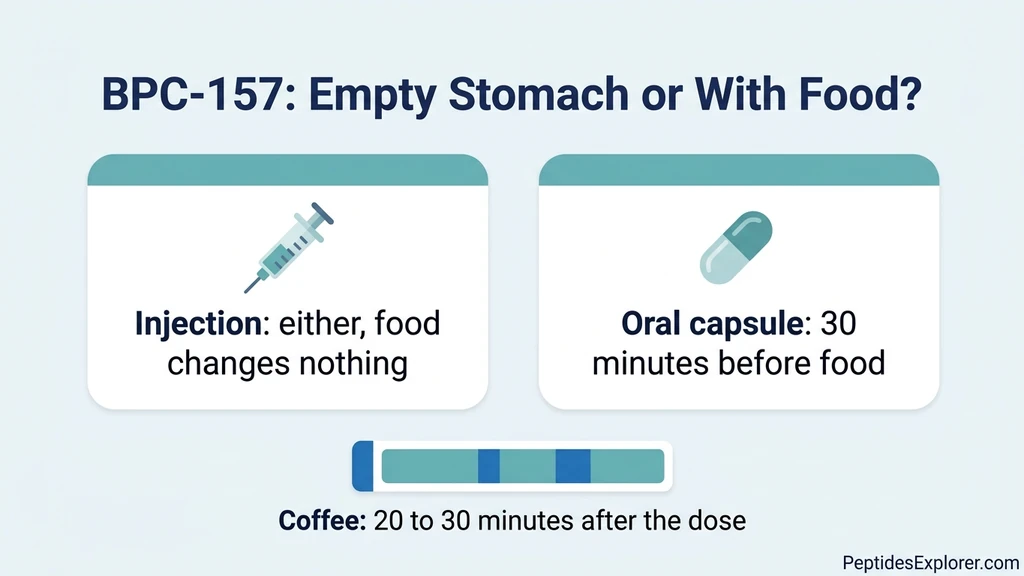
The capsule is in your hand, breakfast is on the table, and the label says nothing about meals. Here is the answer: for a subcutaneous injection, food is irrelevant, because the dose never enters your stomach. For oral BPC-157, an empty stomach is the cleaner default, but the peptide was isolated from gastric juice and survives it, so a capsule taken with a meal still reaches the gut lining it is meant to coat.
| Situation | Empty stomach or with food? |
|---|---|
| Subcutaneous injection | Either. Food changes nothing about absorption |
| Oral capsule, gut-lining goal | 20 to 30 minutes before a meal, or with the meal if that is the only slot you keep |
| Oral capsule, systemic goal | Empty stomach, 30 minutes before food, water only |
| Oral liquid from a reconstituted vial | Empty stomach, 60 seconds under the tongue, then swallow |
| Coffee | 20 to 30 minutes after the dose, for comfort rather than chemistry |
| NSAID day | Take BPC-157 within an hour of the NSAID, food or not |
Whether oral BPC-157 works at all is argued in can you take BPC-157 orally, the route decision in BPC-157 oral vs injection, the milligram numbers in the BPC-157 and TB-500 dosage guide, and the bedtime question in does BPC-157 cause insomnia. This page settles one thing: what food does, and does not do, to the dose.
Get your custom peptide protocol:
- Tailored to your body and goals
- Precise dosing and cycle length
- Safe stacking combinations
- Backed by peer-reviewed studies
- Ready in under 2 minutes
Injection: Food Never Meets the Dose
A subcutaneous injection places the peptide in the fat under your skin. From there it diffuses into capillaries and the bloodstream. Your stomach, whether full of eggs or empty since last night, sits on a different road entirely.
The only full pharmacokinetic study of BPC-157 measured intravenous and intramuscular dosing in rats and beagle dogs, found an elimination half-life under 30 minutes, and reported intramuscular bioavailability of roughly 14 to 19% in rats (He et al., Front Pharmacol, 2022, PMID 36588717). Nothing in that profile depends on gastric contents. A 250 mcg shot after a steak and a 250 mcg shot at 6 AM fasted deliver the same peptide to the same tissue.
Food changes comfort only. A few users feel light-headed injecting fasted, a few feel queasy injecting after a heavy meal, and both pass within an hour. Eat normally, inject at an hour you can repeat, morning or before bed, and get the site and technique right with how to inject BPC-157 and where to inject BPC-157.
Why BPC-157 Survives the Stomach at All
A cast-iron pan does not mind the stove. It was made for that heat, and the same fire that ruins a plastic spatula seasons the pan. BPC-157 has the same relationship with stomach acid.
Literally stated: BPC-157 is a 15-amino-acid fragment of a larger protein that the Zagreb group isolated from gastric juice, active at microgram and nanogram per kilogram doses after intraperitoneal, intragastric and local application (Sikiric et al., J Physiol Paris, 1993, PMID 8298609). The group's later reviews describe it as stable in human gastric juice, unlike most peptides, which pepsin and acid cut apart within minutes (Sikiric et al., Curr Pharm Des, 2011, PMID 21548867).
That stability is why the empty-stomach question is even open. For a peptide that acid destroys, meals are beside the point. For BPC-157, the argument shifts from survival to concentration and contact time, which is where meals enter.
One caveat the vendors leave out: "stable in gastric juice" comes from test tubes and rat stomachs. No human study has measured how much of a swallowed capsule reaches the blood, fasted or fed, and the 2022 pharmacokinetic work never ran an oral arm. Every oral bioavailability percentage you see online is an estimate, a patent claim, or a guess.
The Case for an Empty Stomach
Two arguments favor dosing oral BPC-157 before you eat, and both are about concentration and travel.
Less dilution. A 500 mcg capsule dissolving into the 30 to 50 mL of fluid in a resting stomach gives roughly 10 to 17 mcg per mL. The same capsule swallowed with a 750 mL meal-and-drink volume lands near 0.7 mcg per mL, a 15-fold drop in what touches each square centimeter of lining.
Faster transit. Water leaves the stomach within about half an hour. A solid meal keeps the stomach working for hours, with the capsule contents mixed into that bolus. If your target sits lower, in the small intestine, the fasted dose arrives sooner and in a tighter pulse.
Keep the dilution number in proportion. In the diclofenac toxicity model, BPC-157 worked when rats drank it at 0.16 mcg per mL, and even at 0.16 ng per mL, from their water bottles with food available the whole time (Ilic et al., Life Sci, 2011, PMID 21295044). A 15-fold dilution from a meal still leaves you thousands of times above the concentration that protected those rats. Empty stomach is the cleaner default and nowhere near a make-or-break rule.
The Case for Taking It With Food
If your goal is the lining of the stomach and upper intestine, digestion is the moment that lining is under load. Acid output peaks, the mucosa stretches, and whatever irritant you swallowed, from alcohol to ibuprofen, is in contact with the tissue. A peptide that coats the mucosa during that window is working at the right time.
The Zagreb group tested exactly this geometry. In a fully distended rat stomach, absolute alcohol produced gastric, esophageal and duodenal lesions within minutes and the serosal blood vessels disappeared from view. When BPC-157 was instilled into that same stretched, liquid-filled stomach, the vessels stayed visible and the lesions were inhibited, while atropine, ranitidine and omeprazole gave only partial protection (Sikiric et al., Inflammopharmacology, 2006, PMID 17186181). A full stomach did not switch the peptide off.
Comfort and adherence are the other two arguments. Oral BPC-157 produces mild nausea or loose stools in a minority of users during the first week, and a capsule with food is gentler; can BPC-157 cause diarrhea covers how often. An 8-week course is 56 or 112 doses, and the protocol tied to a meal you never skip gets taken, while the one demanding a fasted 6 AM window gets forgotten by week three.
What the Rat Studies Actually Did
Almost every oral claim about BPC-157 traces back to rat work from one laboratory in Zagreb. None of it looks like a fasted capsule.
| Study | Route used | Dose | Feeding state |
|---|---|---|---|
| Alcohol liver lesions, 3 months (Prkacin et al., J Physiol Paris, 2001, PMID 11595456) | Intragastric gavage or intraperitoneal, once daily | 10 mcg/kg or 10 ng/kg | Free access to chow, alcohol in drinking water |
| Diclofenac toxicity (Ilic et al., Life Sci, 2011, PMID 21295044) | Drinking water, sipped all day, or intraperitoneal | 0.16 mcg/mL or 0.16 ng/mL | Free access to chow |
| Distended-stomach alcohol lesions (Sikiric et al., Inflammopharmacology, 2006, PMID 17186181) | Instilled directly into the stomach | Microgram range | Stomach already full of liquid |
| Short-bowel syndrome (Sikiric et al., Curr Pharm Des, 2011, PMID 21548867) | Peroral and parenteral, 4 weeks | Microgram and nanogram range | Free access to chow |
Two things stand out. The rats were never fasted for the peptide; drinking-water dosing means it arrived in dozens of small sips around meals, the opposite of a single fasted bolus. And the intragastric and intraperitoneal routes gave similar results at the same microgram and nanogram doses, which is why the group calls the two regimens equipotent (Sikiric et al., Curr Pharm Des, 2013, PMID 22950504).
No study, in rats or humans, has compared a fasted oral dose against a fed one. The "empty stomach" line on supplement labels is borrowed from general peptide practice and from the dilution logic above, not from a BPC-157 experiment.
Practical Rules by Goal
Match the timing to the tissue you want the peptide to reach.
| Goal | Timing | Why |
|---|---|---|
| Stomach lining, reflux, gastritis-type complaints | 20 to 30 minutes before meals, or split before breakfast and dinner | Coats the mucosa before the acid load arrives |
| Lower gut, IBS-type symptoms, post-antibiotic repair | Empty stomach on waking, water only, breakfast 30 minutes later | Tighter pulse reaches the intestine sooner |
| Systemic, tendon or joint, oral because you will not inject | Empty stomach, twice daily, 30 minutes before food | Minimizes dilution for the absorbed fraction |
| Any oral goal, and you keep forgetting | With the first bite of a fixed meal | Adherence beats a theoretical absorption edge |
| Injection, any goal | Whenever you can repeat it daily | Stomach contents are irrelevant |
For systemic goals, be honest about the ceiling: the oral route puts an unknown fraction into circulation, and the nasal spray route sits between capsule and needle for people who will not inject.
Liquid oral dosing, where you draw from a reconstituted vial and swallow, follows the same rules with one addition: hold it under the tongue for about 60 seconds first, then swallow the rest for the gastric work. Set the concentration with the peptide reconstitution calculator, keep the vial cold between doses per how to store peptides, and fix the dose by weight with the BPC-157 dosage calculator.
Give any oral protocol 4 to 6 weeks before judging it. The timeline by route is in how long BPC-157 takes to work.
Coffee, Alcohol and NSAIDs Around the Dose
Coffee. No study has looked at coffee or caffeine with BPC-157. Coffee raises acid output and speeds gastric emptying, neither of which threatens a peptide isolated from gastric juice. The rule is about comfort: a capsule, black coffee and an empty stomach is the combination most often blamed for first-week nausea. Finish the dose, wait 20 to 30 minutes, then pour. Never drop a liquid dose into a hot drink; heat breaks peptide bonds that acid leaves alone.
Alcohol. Chronic alcohol in drinking water for 3 months raised portal pressure and damaged liver tissue in rats, and daily intragastric BPC-157 both prevented and reversed those changes (Prkacin et al., J Physiol Paris, 2001, PMID 11595456). That is a rescue finding, not a licence. A drink with dinner does not cancel the capsule you took before it; a drinking habit undermines the healing you are dosing for. The class-by-class rules are in can you drink alcohol on peptides.
NSAIDs. This pairing is the one with a scientific anchor. The diclofenac study gave BPC-157 in drinking water alongside the drug, and the rats avoided the gastric, intestinal and liver lesions untreated rats developed (Ilic et al., Life Sci, 2011, PMID 21295044). If you must take ibuprofen or naproxen during an oral course, take the capsule within an hour of the NSAID, with the same meal if that is how you take the NSAID. The point is overlap in the stomach, and a meal does not break it.
None of this has been tested in people. Oral BPC-157 is sold as a research compound, is not FDA-approved for any use, and these pairings are extrapolations from rat models.
Decision Table and Common Mistakes
| If you are... | Then... |
|---|---|
| Injecting | Ignore food. Pick a repeatable hour |
| Taking capsules for the stomach or upper gut | 20 to 30 minutes before meals, or with the meal when you must |
| Taking capsules for the lower gut or systemic effect | Empty stomach on waking, water, food 30 minutes later |
| Swallowing reconstituted liquid | Empty stomach, 60 seconds under the tongue, then swallow |
| Drinking coffee | 20 to 30 minutes after the dose |
| On an NSAID | Dose BPC-157 within an hour of it, food or not |
| Skipping doses because the fasted window is inconvenient | Move the dose to a meal you never miss |
Mistake 1: skipping the dose because you ate. Someone on 500 mcg twice daily misses the fasted morning window three days a week and drops those doses. Over 8 weeks that is 24 of 112 doses gone, a 21% cut to the course, to avoid a dilution effect that rats shrugged off at concentrations a thousand times lower. Fix: take it with the meal and keep the count.
Mistake 2: blaming the peptide for NSAID stomach pain. A capsule on an empty stomach at 7 AM, 400 mg of ibuprofen at 7:05, and by 9 AM the stomach burns. The fasted ibuprofen did that. Fix: move both to breakfast and keep BPC-157 inside the hour around the NSAID.
Mistake 3: dosing the liquid into coffee or tea. A 60 to 80 degree Celsius drink degrades the peptide before it reaches your mouth. Fix: dose from the syringe, drink whatever you like 20 minutes later, and check does BPC-157 expire for how a stored vial loses potency on its own.
Mistake 4: changing timing every few days. Fasted Monday, with lunch Tuesday, bedtime Wednesday, and you never get two comparable weeks. Fix: pick one slot, hold it 4 weeks, and keep the dose fixed by body weight.
Frequently Asked Questions
Should you take BPC-157 on an empty stomach?
For capsules, an empty stomach 20 to 30 minutes before food is the cleaner default, because the dose is less diluted and reaches the intestine faster. It is not a hard rule: BPC-157 was isolated from gastric juice and is stable in it (PMID 21548867). For injections, meals are irrelevant. The BPC-157 profile covers the pharmacology.
Can I take BPC-157 with food?
Yes. BPC-157 survives stomach acid, and in a rat model it still inhibited alcohol lesions when instilled into a stomach already distended with liquid (PMID 17186181). A 500 mcg capsule with a 750 mL meal is diluted about 15-fold, still thousands of times above the drinking-water concentrations that worked in rats. Dose by weight with the BPC-157 dosage calculator.
Does food matter for a BPC-157 injection?
No. A subcutaneous dose enters the bloodstream from the fat under the skin and never passes through the stomach, so a meal cannot dilute or degrade it. The pharmacokinetic study of injected BPC-157 found a half-life under 30 minutes (PMID 36588717). Eat normally and inject at a repeatable hour; technique is in how to inject BPC-157.
How long after eating can I take oral BPC-157?
For the empty-stomach advantage, wait about 2 hours after a normal meal, or 3 hours after a large or fatty one, then take the capsule and hold off food for 20 to 30 minutes. If that window never fits your day, take it with the meal instead and keep the count. The onset timeline is in how long BPC-157 takes to work.
Can I take BPC-157 with coffee?
No study has tested the pairing. Coffee raises acid output and speeds gastric emptying, neither of which harms an acid-stable peptide, so the rule is comfort: wait 20 to 30 minutes after the capsule to avoid the nausea some users get from a fasted dose plus caffeine. Never mix liquid BPC-157 into a hot drink; heat limits are in how to store peptides.
Should I take BPC-157 with or without NSAIDs like ibuprofen?
If you must take an NSAID during an oral course, take BPC-157 within an hour of it, with the same meal. In rats, BPC-157 in drinking water alongside diclofenac prevented the gastric, intestinal and liver lesions the drug otherwise caused (PMID 21295044). No human data exist. The gut-side effects to watch for are in can BPC-157 cause diarrhea.
Did the rat studies give oral BPC-157 on an empty stomach?
No. The rats had free access to chow and received the peptide by intragastric gavage once daily at 10 mcg/kg or 10 ng/kg (PMID 11595456), or sipped it from drinking water at 0.16 mcg/mL (PMID 21295044). No fasted-versus-fed comparison exists for BPC-157 in any species. Route-by-route onset is in where to inject BPC-157.
The Bottom Line
For an injection, food is irrelevant; the dose never enters the stomach. For oral BPC-157, an empty stomach 20 to 30 minutes before a meal is the cleaner default, and a capsule taken with food still reaches the gut lining, because the peptide was isolated from gastric juice and survives it.
The principle: meals change concentration and timing, not survival. The rats that built the evidence base were never fasted, so the fasted rule is a reasonable optimization rather than a requirement. Pick the slot you will keep for 4 weeks and let adherence do the work.
BPC-157 is a research compound, not FDA-approved for any use, and no human study has compared fasted and fed oral dosing. Set the dose with the BPC-157 dosage calculator and find the rest of the cluster at PeptidesExplorer. Educational content, not medical advice.
Helpful Tools
Related Articles
How Long Does BPC-157 Take to Work?
BPC-157 timelines: gut healing 1-2 weeks, pain relief 1-2 weeks, tendon repair 4-8 weeks, bone healing 6-12 weeks. Factors that speed results.
BPC-157 Oral vs Injection: Which Route to Pick
BPC-157 oral vs injection: 80-95% injectable bioavailability vs 3-90% oral. PK data, condition matrix, combo protocol, and cost breakdown.
BPC-157 Benefits for Women: Guide
Evidence-based guide to BPC-157 benefits for women. Gut healing, joint recovery, skin repair, hormonal considerations, and safety data from published studies.
Where to Inject BPC-157 for Elbow Pain: Sites
Where to inject BPC-157 for tennis elbow and golfer's elbow: 1-2 cm from the epicondyle, the ulnar nerve no-go zone, two-site rotation, 4-8 week timeline.