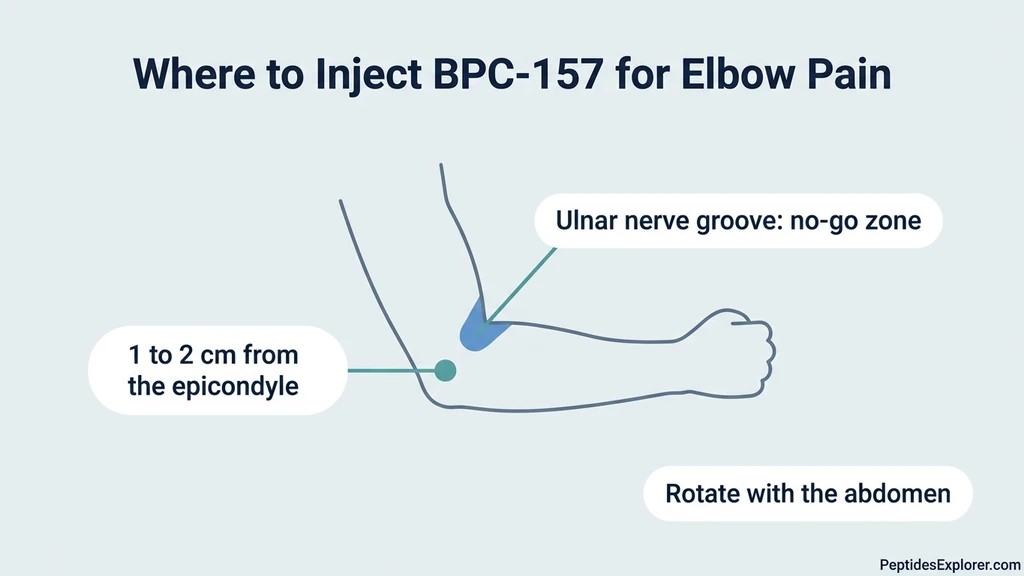
You are at the kitchen table with your sleeve pushed up, one thumb pressing the bony knob on the outside of your elbow, a loaded insulin syringe in the other hand. Here is the answer: inject BPC-157 subcutaneously into a pinch of skin 1 to 2 cm from the sore point on the epicondyle, on the forearm side of the bone, never into the groove behind the inner elbow where the ulnar nerve runs. Tennis elbow gets the outer (lateral) epicondyle, golfer's elbow the inner (medial) one. The lower abdomen is the systemic alternative, and the rat tendon studies were run that way.
| Elbow problem | Primary site | Secondary site | Route |
|---|---|---|---|
| Tennis elbow (lateral epicondylitis) | Skin fold 1 to 2 cm below and in front of the lateral epicondyle | Lower abdomen | Subcutaneous |
| Golfer's elbow (medial epicondylitis) | Skin fold 1 to 2 cm below and in front of the medial epicondyle, never behind it | Lower abdomen | Subcutaneous |
| Both elbows or diffuse ache | Lower abdomen, rotated | Alternate the two epicondyle sites | Subcutaneous |
| Wolverine stack (BPC-157 + TB-500) | BPC-157 at the elbow, TB-500 in the abdomen | Lower abdomen for both | Subcutaneous |
This page is elbow only. The whole-body map is in the BPC-157 injection site guide, the knee has its own knee injection guide, and the microgram numbers live in the BPC-157 and TB-500 dosage guide.
Get your custom peptide protocol:
- Tailored to your body and goals
- Precise dosing and cycle length
- Safe stacking combinations
- Backed by peer-reviewed studies
- Ready in under 2 minutes
Why the Elbow Is the Easiest Tendon to Reach
Tennis elbow and golfer's elbow are both problems of a tendon origin, the point where forearm muscle becomes tendon and anchors to bone. On the lateral epicondyle, the extensor carpi radialis brevis shares a common origin with the extensor digitorum and extensor digiti minimi on the upper surface of the bone (Zoner et al., AJR Am J Roentgenol, 2010, PMID 20729438). On the medial epicondyle, the wrist flexors and pronator teres anchor the same way. That anchor is what hurts when you grip a mug.
Think of a tent peg. The rope frays where it loops around the peg, and the peg sits at the surface, so you can reach the frayed loop with your fingers. Stated literally: a few millimetres of skin and fat cover the elbow tendon origin, with no muscle belly in the way, so a subcutaneous injection beside the epicondyle lands closer to the damaged tendon than a subcutaneous injection can land to any other tendon in the body.
Both conditions are common. In a Finnish population sample of 4,783 adults aged 30 to 64, definite lateral epicondylitis had a prevalence of 1.3% and medial epicondylitis 0.4%, with repetitive and forceful arm work multiplying the risk (Shiri et al., Am J Epidemiol, 2006, PMID 16968862). The BPC-157 benefits overview covers what else the peptide has been studied for.
Local vs Systemic: What the Rat Data Support
The strongest BPC-157 tendon evidence is systemic. In the transected rat Achilles model, BPC-157 was given intraperitoneally once a day at 10 mcg, 10 ng or 10 pg per kg, and treated tendons showed higher load to failure, higher Young's modulus and better fibroblast and collagen formation across days 1 to 14 (Staresinic et al., J Orthop Res, 2003, PMID 14554208). The tendon-to-bone model, the closest thing to an epicondyle in a rat, also used daily intraperitoneal dosing and improved function, stiffness and collagen type I through day 21 (Krivic et al., J Orthop Res, 2006, PMID 16583442).
The case for a local site rests on cell culture: tendon fibroblast migration and FAK-paxillin activation rose with BPC-157 concentration in a dose-dependent manner (Chang et al., J Appl Physiol (1985), 2011, PMID 21030672). No study has injected BPC-157 beside a rat epicondyle, and no human trial of BPC-157 for tennis elbow or golfer's elbow exists. The compound has no FDA approval for any use.
Choose the elbow site when the pain sits under one fingertip and you can pinch skin beside it. Choose the abdomen when both elbows hurt, the ache is diffuse, or you are stacking with TB-500, which is systemic wherever the pain is. The BPC-157 vs TB-500 comparison explains why the two are placed differently.
What Happens When You Inject in the Wrong Place
Scenario 1: The inner-elbow nerve shot. Golfer's elbow burns on the inside, so you inject into the soft groove directly behind the medial epicondyle, where the skin is thin and easy to pinch. That groove is the cubital tunnel, and the ulnar nerve lies in it under 2 to 5 mm of skin and fat, the nerve you hit when you bang your funny bone. An 8 mm insulin needle at 45 degrees reaches 5 to 6 mm deep, which is far enough. The result is an electric shock to the ring and little fingers, and a bolus inside the nerve sheath can leave numbness and grip weakness for weeks. The fix: every medial site sits in front of the epicondyle, on the forearm side, never behind it.
Scenario 2: The deep "get it into the tendon" shot. Clinics needle tennis elbow under ultrasound, so you load a 25 mm intramuscular needle and drive it at the lateral epicondyle. About 2 cm below that bone lies the radiocapitellar joint, and a research solution that was never sterile-compounded inside a joint capsule risks septic arthritis, which destroys cartilage within 24 to 48 hours and needs intravenous antibiotics and often surgical washout. The fix: an 8 mm needle into a lifted fold stops in fat. Depth you cannot pinch is depth you do not inject.
Scenario 3: The cortisone combination. You add a corticosteroid injection at the same visit. In a 165-patient randomised trial, corticosteroid injection cut 1-year recovery from 96% to 83% and raised 1-year recurrence from 12% to 54% compared with placebo injection (Coombes et al., JAMA, 2013, PMID 23385272). In the rat tendon-to-bone model, methylprednisolone consistently aggravated healing. The fix: pick one approach with your clinician; do not use a research peptide to chase a steroid shot.
Exact Injection Sites for Tennis Elbow and Golfer's Elbow
Every site below is subcutaneous fat. The needle tip stops in the layer you can lift between finger and thumb: never in muscle, never in a joint, never in the groove behind the inner elbow.
Tennis Elbow (Lateral Epicondylitis)
Bend the elbow to 90 degrees, palm down. The lateral epicondyle is the bony knob on the outside, and the sore spot in tennis elbow sits on or just below its front edge, where the extensor origin is.
Site A: a skin fold 1 to 2 cm below and slightly in front of the epicondyle, over the extensor muscle mass. Site B: a fold 1 to 2 cm directly below the epicondyle, toward the back of the forearm. Alternate them.
Stay within 2 cm of the bone. The posterior interosseous nerve passes under the supinator at a distance from the lateral epicondyle of 72% to 100% of the width between your two epicondyles, depending on forearm rotation, in 63 cadaveric arms (Kamineni et al., World J Orthop, 2017, PMID 28473958). That is 4 to 7 cm down the forearm and under muscle; a subcutaneous needle beside the epicondyle never approaches it.
Golfer's Elbow (Medial Epicondylitis)
Palm up, elbow at 90 degrees. The medial epicondyle is the knob on the inside, larger than the lateral one. Run a fingertip just behind it, toward the tip of the elbow, and you feel a soft groove with a rope-like cord in it: the ulnar nerve. Tap it and your little finger tingles. That is the one place a needle never goes.
Site A: a skin fold 1 to 2 cm below and in front of the medial epicondyle, over the flexor-pronator mass, toward the palm side of the forearm. Site B: a fold 2 to 3 cm below the epicondyle along the same line. Both sit in front of the bone, with the epicondyle between the needle and the nerve.
If you cannot lift a 1 cm fold in front of the medial epicondyle, common on lean arms, move 1 cm further down the forearm rather than closer to the bone, or use the abdomen.
Both Elbows or the Wolverine Stack
Two sore elbows means four sites in rotation or one abdominal site; most people keep the elbow sites for the worse arm and put the rest in the abdomen.
For the Wolverine peptide stack, BPC-157 goes beside the painful epicondyle and TB-500 goes in the lower abdomen in a separate syringe. TB-500 works through the bloodstream, so a local site adds nothing, and keeping the two injections apart tells you which one caused a site reaction. Its volume comes from the TB-500 dosage calculator.
How to Find Your Landmarks by Touch
Find the epicondyle. Bend the elbow to 90 degrees and run your thumb along the outer (or inner) edge of the joint until it drops off a bony knob. Pressing the front-lower edge of the lateral knob reproduces tennis elbow pain; the same spot on the medial knob reproduces golfer's elbow.
Confirm the sore point. Lateral: make a fist, cock the wrist up, and resist while someone pushes it down. Medial: curl the wrist toward you against resistance. The point that lights up is the target, and the injection site sits 1 to 2 cm from it.
Find the ulnar groove. On the inside, slide a fingertip from the medial epicondyle backward toward the point of the elbow. Within 1 cm you feel a shallow channel with a cord in it. Every medial site goes on the opposite, forearm-facing side of the epicondyle.
Test the pinch. Lift the skin between thumb and index finger. A fold of at least 1 cm means there is fat to inject into. Skin that stays tight against bone, which is the case directly on top of either epicondyle, is never a site; move 1 cm down the forearm until a fold lifts.
Needle, Depth, Angle and Rotation
The elbow has thinner subcutaneous fat than the abdomen or thigh, so needle length and angle matter more here than at any other BPC-157 site. The sterile walkthrough is in how to inject BPC-157; the elbow numbers are below.
| Variable | Elbow setting | Why |
|---|---|---|
| Needle | 29 to 31 gauge, 8 mm (5/16 inch) insulin needle | Short enough to stay in fat beside bone |
| Angle | 45 degrees into a lifted fold; 90 degrees only if the fold is 2 cm or more | 45 degrees at 8 mm reaches 5 to 6 mm, inside the fat layer |
| Volume per site | 0.1 to 0.3 mL | More than 0.3 mL stretches thin elbow fat and leaks back up the track |
| Sites per elbow | Two, at least 2 cm apart | Daily shots at one spot form a tender nodule within a week |
| Rotation | Site A, site B, abdomen, repeat | Three days between injections at any one elbow site |
| After | 10 seconds of dry gauze, no rubbing | Rubbing spreads the peptide and bruises thin skin |
- 1.Swab the site and let it dry for 30 seconds. Wet alcohol stings far more on the elbow than on the belly.
- 2.Lift the fold. On the medial side, rest your lifting thumb on the epicondyle itself, which keeps the needle on the forearm side of the bone.
- 3.Insert at 45 degrees, bevel up, in one motion, until the hub touches skin.
- 4.Push the plunger over 5 to 10 seconds, count to 5, withdraw at the same angle, and hold dry gauze for 10 seconds.
| Day | Site |
|---|---|
| Mon | Elbow site A |
| Tue | Elbow site B |
| Wed | Lower abdomen |
| Thu | Elbow site A |
| Fri | Elbow site B |
| Sat | Lower abdomen |
| Sun | Lower abdomen or rest |
For twice-daily dosing, the morning dose goes at the elbow and the evening dose in the abdomen. Set the concentration with the peptide reconstitution calculator so that no elbow site ever receives more than 0.3 mL, and use bacteriostatic water for a vial you will draw from daily.
Frequency, the 4 to 8 Week Timeline, and Loading the Tendon
The rat models dosed once a day and measured tendon strength to day 14 (Staresinic et al., J Orthop Res, 2003, PMID 14554208) and day 21 (Krivic et al., J Orthop Res, 2006, PMID 16583442). Human tendon origins remodel far more slowly, so the working convention is daily injection for 4 to 8 weeks with a judgment point at week 4. The week-by-week pattern is in how long BPC-157 takes to work.
| Week | What to expect | What to do |
|---|---|---|
| 1 to 2 | No reliable change; some report less morning stiffness | Daily injection; start eccentric wrist work at a load that causes mild, not sharp, pain |
| 3 to 4 | Light grips less painful; pressing the epicondyle still hurts | Add load to the eccentric sets; judge at day 28 whether to continue |
| 5 to 8 | Pressing the sore point hurts less; heavier grips tolerated | Taper injections once pain-free gripping lasts a week |
| Beyond 8 | No further change expected from the peptide | Stop injecting; the exercise programme runs 3 months in total |
Exercise is the part with human evidence. In 120 adults with tennis elbow lasting more than three months, daily eccentric wrist extension at home for three months reduced pain faster than concentric exercise, with a 10% higher responder rate and strength gains that persisted to 12 months (Peterson et al., Clin Rehabil, 2014, PMID 24634444). The programme: forearm supported, hand over the edge holding 1 to 2 kg, lift with the other hand, lower over 3 to 4 seconds, 3 sets of 15, once a day.
Rest means relative rest. In a 198-participant trial, physiotherapy combining elbow manipulation and exercise beat wait-and-see at 6 weeks and beat corticosteroid injection at 52 weeks, with 47 of 65 early steroid successes regressing (Bisset et al., BMJ, 2006, PMID 17012266). Keep gripping, drop the one activity that reproduces the sharp pain, and reintroduce it in the week-5 window.
When to Stop Injecting and See a Clinician
- Numbness, tingling or weakness in the ring and little fingers: stop all medial injections; this is the ulnar nerve.
- Redness spreading more than 3 cm from a site, warmth, or fever within 72 hours: skin or joint infection, same-day care.
- A hot, swollen elbow that will not fully straighten: possible joint infection, urgent care today.
- No change in epicondyle tenderness by week 8 despite daily injections and eccentric loading: the diagnosis may be wrong. Radial tunnel syndrome, cervical radiculopathy and elbow arthritis all mimic tennis elbow.
- Pain past 6 months: in a population cohort, about 1 in 10 patients still symptomatic at 6 months went on to surgery, and recurrence within 2 years ran at 8.5% (Sanders et al., Am J Sports Med, 2015, PMID 25656546). That is the point for imaging and a specialist, not another vial.
Injecting a research compound beside a joint is a choice made ahead of the evidence. The thresholds above are where that choice stops. The same logic, with different anatomy, runs through the back pain injection guide.
Common Mistakes
Injecting behind the medial epicondyle. The soft groove feels like the obvious target for golfer's elbow, and it is the cubital tunnel. One shot there can mean weeks of numb fingers. Fix: lifting thumb on the bone, needle in front of it.
Injecting on top of the bone. Skin directly over either epicondyle has no fat to lift, so the needle scrapes periosteum, which hurts for days and delivers nothing to the tendon. Fix: 1 to 2 cm away, into a fold.
One site, every day. A tender lump forms by day 5 to 7 and absorption from it falls. Fix: two elbow sites plus the abdomen, three days between visits to the same spot.
Peptide instead of loading. Daily injections with the arm in a brace treat the tendon like a rat Achilles that was cut and left to heal. Human epicondyle tendons remodel under load. Fix: the 3-sets-of-15 eccentric programme from week 1, every day, for three months.
Frequently Asked Questions
Where do you inject BPC-157 for tennis elbow?
Into a pinch of skin 1 to 2 cm below and slightly in front of the lateral epicondyle, the bony knob on the outside of the elbow, using an 8 mm insulin needle at 45 degrees. Alternate two outer-forearm sites with the lower abdomen. The whole-body map is in the BPC-157 injection site guide.
Where do you inject BPC-157 for golfer's elbow?
Into a skin fold 1 to 2 cm below and in front of the medial epicondyle, on the palm-facing side of the inner forearm. Never inject the groove behind the epicondyle: the ulnar nerve sits there under 2 to 5 mm of skin, and an 8 mm needle reaches it. Technique details are in how to inject BPC-157.
Is a local elbow injection better than injecting BPC-157 in the stomach?
No human study has compared them. The rat Achilles and tendon-to-bone models that showed faster healing used daily systemic intraperitoneal dosing (PMID 14554208, PMID 16583442). The local argument comes from cell culture, where fibroblast migration rose with concentration (PMID 21030672). The BPC-157 profile covers the full evidence base.
Where do you inject the Wolverine stack for tennis elbow?
BPC-157 goes beside the lateral epicondyle, 1 to 2 cm from the sore point, and TB-500 goes in the lower abdomen in a separate syringe. TB-500 acts through the bloodstream, so a local elbow site adds nothing. The split and schedule are in the Wolverine peptide stack guide.
How deep should a BPC-157 elbow injection go?
Into subcutaneous fat only: an 8 mm, 29 to 31 gauge insulin needle at 45 degrees into a lifted fold reaches about 5 to 6 mm. The joint capsule lies around 2 cm below the lateral epicondyle, and a research solution inside it risks septic arthritis. Needle lengths are compared in the peptide injection guide.
How long does BPC-157 take to work for elbow tendonitis?
Plan on 4 to 8 weeks of daily injection with a judgment point at week 4. Rat tendons improved between days 1 and 21 (PMID 14554208), but human tendon origins remodel more slowly and no elbow trial exists. The week-by-week pattern is in how long BPC-157 takes to work.
Should you keep doing exercises while injecting BPC-157 for elbow pain?
Yes. Daily eccentric wrist exercise for three months reduced tennis elbow pain faster than concentric exercise in a 120-person trial, with gains lasting 12 months (PMID 24634444). Injections without loading leave the tendon unconditioned. Set the dose with the BPC-157 dosage calculator and keep the 3 sets of 15 going.
The Bottom Line
Inject BPC-157 subcutaneously 1 to 2 cm from the sore point on the epicondyle, on the forearm side of the bone: below and in front of the lateral epicondyle for tennis elbow, below and in front of the medial epicondyle for golfer's elbow, and never into the ulnar groove behind the inner elbow. Use an 8 mm insulin needle at 45 degrees into a lifted fold, rotate two elbow sites with the abdomen, and run 4 to 8 weeks alongside daily eccentric loading.
The principle: the elbow tendon origin sits a few millimetres under the skin, so a subcutaneous site beside the bone is as close as a needle can safely get, while the strongest tendon evidence for BPC-157 is systemic rat data and no human elbow trial exists.
BPC-157 is a research compound with no FDA approval. Set your dose with the BPC-157 dosage calculator and find the rest of the injection-site cluster at PeptidesExplorer. Educational content, not medical advice.
Helpful Tools
Related Articles
Where to Inject BPC-157 for Back Pain: Lower Back Sites
Where to inject BPC-157 for lower back pain, herniated disc, sciatica and SI joint pain: abdomen vs paraspinal sites, landmarks, zones to avoid, red flags.
Where to Inject BPC-157: Site Guide
Where to inject BPC-157 for shoulder, back, hip, gut, elbow, and Achilles injuries. Anatomical sites, local vs systemic delivery, and rotation.
Where to Inject BPC-157 for Knee Pain
Exact injection sites for BPC-157 knee pain: subcutaneous locations by injury type, needle gauge, angles, and site rotation technique.
Where to Inject KPV: Best Sites and Technique
Where to inject KPV: belly fat, outer thigh, arm or flank with a 29 to 31G insulin needle. Why the site barely matters, rotation grid and step-by-step.