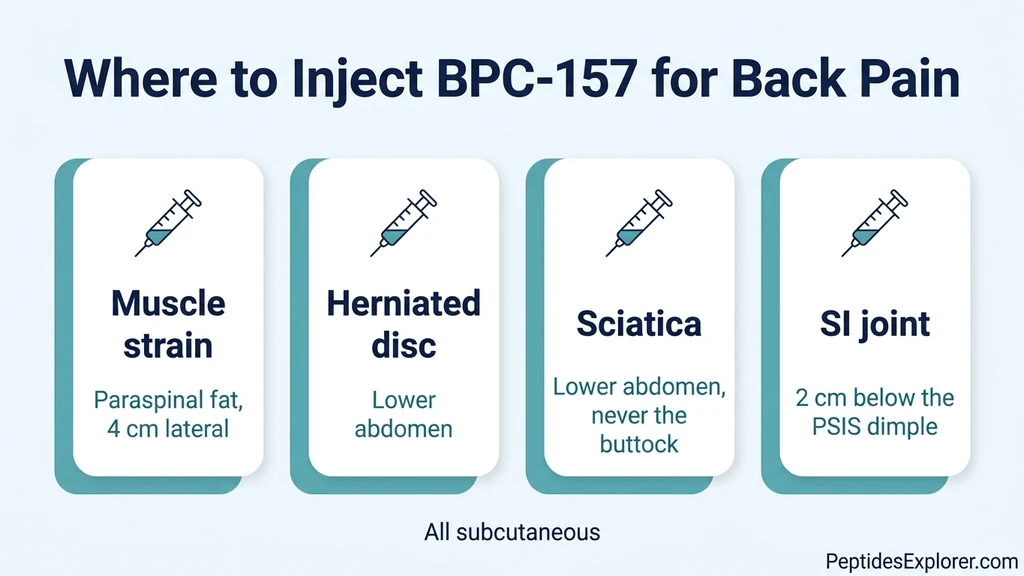
You are twisted sideways in front of the bathroom mirror, a loaded insulin syringe in one hand, trying to see your own lower back. Here is the answer: inject BPC-157 subcutaneously, either in the lower abdomen or in the fat of the lower back at least 4 cm (three finger-widths) to the side of the spine, above the hip bones and below the ribs. Never toward the spine, never into the buttock, never past the fat layer. Sites for the rest of the body live in the BPC-157 injection site guide.
| Lower back problem | Primary site | Secondary site | Route |
|---|---|---|---|
| Lumbar muscle strain | Paraspinal fat, 4 cm lateral to the sore segment | Lower abdomen | Subcutaneous |
| Herniated disc (L4-L5, L5-S1) | Lower abdomen (systemic) | Paraspinal fat at the disc level | Subcutaneous |
| Sciatica | Lower abdomen (systemic) | Low lumbar paraspinal fat; never the buttock | Subcutaneous |
| SI joint pain | Fat 2 cm below and outside the PSIS dimple | Lower abdomen | Subcutaneous |
| Diffuse or unclear pain | Lower abdomen, rotated | Alternate paraspinal sides | Subcutaneous |
This page covers where, not how much. Dose numbers are in the BPC-157 and TB-500 dosage guide and the BPC-157 dosage calculator.
Get your custom peptide protocol:
- Tailored to your body and goals
- Precise dosing and cycle length
- Safe stacking combinations
- Backed by peer-reviewed studies
- Ready in under 2 minutes
Why the Lower Back Is Different From the Knee
The case for injecting near a knee ligament rests on proximity: the MCL sits about a centimeter under the skin. A lumbar disc does not. In an ultrasound series of 31 adults, the distance from the skin to the ligamentum flavum at L3-L4 averaged 5.15 cm, plus or minus 0.95 cm (Gnaho et al., Rev Bras Anestesiol, 2012, PMID 22793967). The disc lies in front of that, past the spinal canal.
Think of mail delivery. When the mailbox is at the curb, walking the letter over works. When the recipient is inside a locked building, hand delivery and the postal service both end at the same door, and the mail room carries it the rest of the way. Stated literally: for a disc or a nerve root, a paraspinal injection and an abdominal one both deliver BPC-157 through the bloodstream. The 8 mm needle ends in fat either way.
The animal data agrees. The rat spinal cord study people cite for back pain used a single systemic intraperitoneal dose (Perovic et al., J Orthop Surg Res, 2019, PMID 31266512). Systemic dosing also healed a transected ligament (Cerovecki et al., J Orthop Res, 2010, PMID 20225319) and reattached tendon to bone (Krivic et al., J Orthop Res, 2006, PMID 16583442). The knee injection guide is the page for superficial ligaments; the lower back follows different rules.
Systemic vs Paraspinal: Which to Choose
Lower abdomen: disc, nerve root or sciatica; pain you cannot reach or see; pain that moves around; any stack with TB-500, which is dosed systemically anyway.
Paraspinal fat: a specific sore muscle band you can press on; SI joint pain with one tender dimple; local coverage of a superficial structure on top of systemic exposure.
Alternating days between abdomen and back is simpler than splitting a dose across a site you cannot see. No human study has compared these routes, so this is pharmacological reasoning, not trial evidence.
What Happens When You Inject in the Wrong Place
Scenario 1: The deep midline shot. You read "get it close to the disc," load a 1.5 inch (38 mm) intramuscular needle, and push it straight in between two spinous processes at L4-L5. The epidural space sits roughly 4 to 6 cm deep there, so in a lean person the needle stops within a centimeter or two of the ligamentum flavum, having already pierced the interspinous ligament. One more centimeter puts a solution that was never made preservative-free or sterile-compounded into the epidural space: epidural abscess, meningitis, or a dural puncture headache that lasts a week. Pain clinics use fluoroscopy for this injection for exactly that reason. The fix: 8 mm needle, skin pinch, 4 cm off the midline.
Scenario 2: The sciatica buttock shot. Your sciatica burns through the buttock, so you inject a 25 mm needle where it hurts. The sciatic nerve runs through that region. One neurophysiology lab diagnosed 217 sciatic nerve injuries from gluteal intramuscular injection over 10 years, every one at the dorsogluteal site (Geyik et al., Turk Neurosurg, 2017, PMID 27593812). Direct injury adds foot drop and permanent numbness to a nerve that was only irritated. The fix: sciatica gets the abdomen or low lumbar paraspinal fat. The buttock is never a BPC-157 site.
Exact Injection Sites by Lower Back Problem
Every site below is subcutaneous fat. The needle tip stops in the layer you can pinch: never in muscle, never in a joint, never toward the spine.
Lumbar Muscle Strain
The erector spinae run as two thick columns 2 to 4 cm either side of the spine, and a strain feels like a rope-hard band you can press on. Find the band, move your fingers 4 cm out from the midline at the same level, pinch the fat there and inject. Alternate sides daily, even if only one side hurts.
The rationale is cellular: BPC-157 increased tendon fibroblast migration in a dose-dependent way through the FAK-paxillin pathway (Chang et al., J Appl Physiol (1985), 2011, PMID 21030672), and systemically dosed rats healed crushed calf muscle faster (Novinscak et al., Surg Today, 2008, PMID 18668315). Rats and cell cultures, not human backs.
Herniated Disc and Sciatica
A herniated disc presses on a nerve root inside the spinal canal. No self-administered needle reaches either, so the lower abdomen is the primary site, rotated 5 cm from the navel.
The secondary site is paraspinal fat at the disc level. The line across the top of your hip bones crosses L4, so L4-L5 sits at that line and L5-S1 two finger-widths below it. Inject 4 cm lateral, alternating sides. Sciatica follows the same protocol, because the root is the target and the buttock is a hazard.
The nerve data is thinner than vendor pages imply. BPC-157 improved regeneration of a surgically cut rat sciatic nerve (Gjurasin et al., Regul Pept, 2010, PMID 19903499). A cut peripheral nerve is a different injury from a compressed root, and no study has tested BPC-157 on a herniated disc in any species.
SI Joint Pain
The sacroiliac joint is the one lower back structure with ligaments near the skin. Its posterior ligaments sit under the two dimples above the buttock crease, the posterior superior iliac spines, and SI pain is sharply tender there.
Inject in the fat 2 cm below and outside the tender dimple, never into the dimple, where skin sits tight on bone. Alternate sides if both hurt. The ligament evidence is the rat MCL model, in which systemic, oral and topical BPC-157 all improved healing across 90 days (Cerovecki et al., J Orthop Res, 2010, PMID 20225319). The wider field is in peptides for joint pain.
For diffuse pain with no single structure, rotate four abdominal quadrants plus both paraspinal sides across the week: six sites, the systemic-coverage logic of the Wolverine stack.
How to Find Your Landmarks by Touch
The spinous processes. Run a thumb down the middle of your lower back. The row of bumps is the spine. Nothing gets injected within 3 cm of that row.
The iliac crests. Hands on hips, slide your thumbs backward until they meet bone. A line between the two crests crosses L4; paraspinal sites sit at or just above it.
The PSIS dimples. Two dimples a hand-width apart, just above the buttock crease. They mark the SI joints.
The lowest rib. Trace your side backward until you feel the last rib. Everything above that line on the back is the kidney zone. An 8 mm needle cannot reach a kidney, but the skin there is thin over bone and every deep-needle error in that zone carries organ risk. Stay below it.
The pinch test. Lift a fold of skin at the chosen spot. A 2 cm fold means enough fat for an 8 mm needle. Tight skin on bone means move 2 cm further out.
Mark the site with a pen in a mirror, or have someone else inject. A steady second pair of hands beats a contortion every time.
Needle Length, Technique and Rotation
Use a 29 to 31 gauge insulin syringe with an 8 mm (5/16 inch) needle. In a pinched fold it cannot reach the lumbar muscle, which is the point. Keep 25 mm and 38 mm intramuscular needles out of the room; they are the instrument behind both scenarios above.
- 1.Clean and dry. Swab with 70% isopropyl and let it dry for 30 seconds.
- 2.Pinch. Lift a 2 cm fold between thumb and index finger.
- 3.Insert at 45 degrees. Full 8 mm, angled away from the spine.
- 4.Inject over 5 seconds. Slow delivery lowers pressure and stinging.
- 5.Count to 5, withdraw, press. Same angle out, gauze for 10 seconds, no rubbing.
| Day | Site |
|---|---|
| Mon | Lower abdomen, right |
| Tue | Paraspinal, right, at the sore level |
| Wed | Lower abdomen, left |
| Thu | Paraspinal, left, at the sore level |
| Fri | Lower abdomen, upper right |
| Sat | SI or paraspinal, sorer side |
| Sun | Lower abdomen, upper left |
Keep sites 2 cm apart and log each one. The full draw-and-inject walkthrough is in how to inject BPC-157; mix the vial with the peptide reconstitution calculator and the reconstitution guide.
Realistic Timelines
| Problem | Earliest plausible change | Reassess point | What blurs the reading |
|---|---|---|---|
| Lumbar muscle strain | 1-2 weeks | 4 weeks | Strains settle on their own |
| SI joint pain | 2-4 weeks | 6 weeks | Flares come and go regardless |
| Herniated disc / sciatica | 4-8 weeks | 8-12 weeks | Discs regress spontaneously |
| Chronic diffuse pain | 3-4 weeks | 8 weeks | Placebo response |
The disc row needs its honesty flag. A systematic review found spontaneous regression in 96% of sequestered discs, 70% of extrusions and 41% of protrusions (Chiu et al., Clin Rehabil, 2015, PMID 25009200). A disc that stops hurting in week 8 may have done what discs do. Onset across other injuries is in how long BPC-157 takes to work.
If nothing has changed at the reassess point, more weeks will not change it. Stop and get the diagnosis checked.
What the Evidence Actually Supports
Spinal cord, rats. After a 60-second compression of the sacrocaudal cord, one intraperitoneal BPC-157 dose given 10 minutes later produced steady tail motor recovery, resolved spasticity by day 15, and preserved motoneurons and myelinated axons through 360 days (Perovic et al., J Orthop Surg Res, 2019, PMID 31266512). That is an acute crush of the cord itself, treated within minutes: not a disc, not a chronic root, not a human.
Tendon, ligament and muscle, rats. These are the strongest results in the literature: tendon-to-bone reattachment, MCL healing across 90 days, crush-muscle recovery, all with systemic dosing. A review from the Zagreb group frames the mechanism as angiogenic and growth-factor mediated (Seiwerth et al., Curr Pharm Des, 2018, PMID 29998800). Nearly all of it comes from that single group.
Humans. The only published injection series is knee pain: a retrospective chart review in which 11 of 12 patients given intra-articular BPC-157 alone reported improvement, with no control group, no blinding and no functional scores (Lee and Padgett, Altern Ther Health Med, 2021, PMID 34324435). No human back pain trial exists. No human disc, sciatica or SI joint data exists. BPC-157 is not FDA-approved for any use, and back pain use runs ahead of the evidence. Expectation-setting continues in peptides for healing and peptides for inflammation.
Red Flags: Stop Injecting and See a Doctor
A peptide protocol must never delay a diagnosis. The first three below mean a same-day evaluation:
- Cauda equina signs: new trouble starting urination, urinary retention, bowel incontinence, or numbness in the saddle area (inner thighs, groin, around the anus). A surgical emergency measured in hours.
- Progressive weakness: a dragging foot, a buckling leg, weakness spreading day by day.
- Numbness that spreads instead of staying in one strip of the leg.
- Back pain with fever, night sweats or unexplained weight loss.
- Pain after a fall, or any back pain with osteoporosis or a cancer history.
- Injection site trouble: spreading redness, heat, swelling that grows after 48 hours, or fever.
Read the BPC-157 side effects profile first, so you can tell a peptide reaction from a spinal one.
Common Mistakes
Aiming at the spine. Angling toward the midline to "reach the disc." A short needle reaches only fat; a long one reaches the epidural space at 4 to 6 cm. Fix: angle away, 4 cm lateral, always.
The buttock for sciatica. The pain is in the buttock, so the needle goes there. That is the dorsogluteal site behind injection sciatic nerve injury. Fix: abdomen or low lumbar fat.
One paraspinal spot every day. A single daily site hardens into a tender nodule within 2 weeks and cuts absorption. Fix: six sites in rotation, 2 cm apart, logged.
Judging a disc on a strain's clock. Reassessing at 2 weeks and doubling the dose. The window is 8 to 12 weeks, and the disc may resolve on its own. Fix: hold the dose, hold the date, and let the BPC-157 dosage calculator set the number instead of frustration.
Frequently Asked Questions
Where do you inject BPC-157 for lower back pain?
Subcutaneously, in the lower abdomen or in the fat of the lower back at least 4 cm to the side of the spine, above the hip bones and below the lowest rib. Use an 8 mm insulin needle at 45 degrees. The BPC-157 profile covers the compound itself.
Can you inject BPC-157 near a herniated disc?
Only in the subcutaneous fat 4 cm lateral to the spine at the disc level, and the abdomen works equally well because the disc sits 5 cm or more deep. Never inject toward the midline. No study has tested BPC-157 on a herniated disc; see how long BPC-157 takes to work for expectations.
Does BPC-157 help sciatica?
No human data exists. Rats with a surgically cut sciatic nerve regenerated faster on BPC-157 (PMID 19903499), but a cut nerve is a different injury from a compressed root. If you use it, inject in the abdomen or low lumbar fat, never the buttock, following the how to inject BPC-157 technique.
Why should you never inject BPC-157 into the buttock for sciatica?
The sciatic nerve runs through the buttock. One lab recorded 217 sciatic nerve injuries from gluteal intramuscular injections in 10 years (PMID 27593812). Direct injury adds foot drop to an irritated nerve. Systemic sites carry none of that risk; the BPC-157 side effects guide covers what to watch instead.
Is the abdomen or the back a better injection site for BPC-157 back pain?
For discs and nerve roots they are equivalent, because both deliver the peptide through the bloodstream. For a superficial muscle band or the SI ligaments, paraspinal fat adds local exposure. Alternating the two across a week is the practical answer. The BPC-157 and TB-500 dosage guide has the dose numbers.
What needle length should you use for lower back injections?
An 8 mm (5/16 inch) needle on a 29 to 31 gauge insulin syringe, in a pinched 2 cm fold at 45 degrees. Intramuscular needles of 25 or 38 mm can reach the epidural space at the midline and the sciatic nerve in the buttock. The complete peptide injection guide covers gauges and angles.
How long does BPC-157 take to work for back pain?
Muscle strains may change in 1 to 2 weeks, SI joint pain in 2 to 4, disc problems in 4 to 8 with reassessment at 8 to 12. Disc herniations regress on their own in 41 to 96% of cases depending on type (PMID 25009200), which blurs the picture. Compare timelines in peptides for healing.
Can you stack TB-500 with BPC-157 for back pain?
Yes; the pairing is the standard systemic repair stack, and TB-500 goes in the abdomen rather than locally because it acts systemically. No human back pain data supports the combination. Protocols and ratios are laid out in the Wolverine peptide stack guide.
The Bottom Line
Inject BPC-157 for lower back pain subcutaneously: the lower abdomen for discs, nerve roots and sciatica, and the paraspinal fat 4 cm off the midline for muscle strains and SI joint pain. Stay below the lowest rib, above the hip bones, 3 cm clear of the spinous processes, and out of the buttock entirely.
The principle: a short needle in fat reaches the spine only through the blood, so the site matters far less than the depth. Depth is where the harm lives.
Set your dose with the BPC-157 dosage calculator and read the BPC-157 profile before your first cycle. BPC-157 is a research compound with no human back pain trial and no FDA approval; this guide is educational, not medical advice. Cauda equina symptoms, spreading numbness or new weakness end the protocol and start a doctor's visit. More guides at peptidesexplorer.com.
Related Articles
Where to Inject BPC-157: Site Guide
Where to inject BPC-157 for shoulder, back, hip, gut, elbow, and Achilles injuries. Anatomical sites, local vs systemic delivery, and rotation.
How to Take BPC-157: Dosage and Timing
How to take BPC-157: inject 250-500 mcg subcutaneously near the injury once daily for 4-8 weeks. Reconstitution, dosing, and cycle length.
Where to Inject BPC-157 for Knee Pain
Exact injection sites for BPC-157 knee pain: subcutaneous locations by injury type, needle gauge, angles, and site rotation technique.
Where to Inject IGF-1 LR3: Sites, SubQ vs IM, Rotation
Where to inject IGF-1 LR3: abdomen, thigh or glute, subcutaneous, 29-31G needle. Why site-specific growth is a myth, a rotation map, and the hypoglycemia rule.