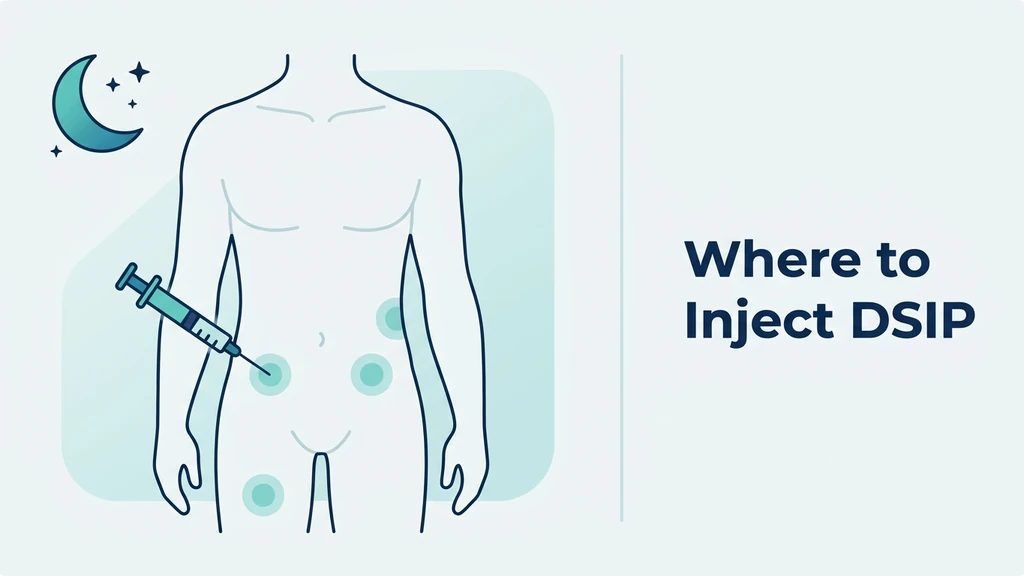
It is 10 PM, the DSIP vial is mixed, the insulin syringe is drawn, and you are at the bathroom mirror choosing between belly and thigh. Here is the answer: inject DSIP subcutaneously into abdominal fat at least 2 inches from the navel with a 29 to 31 gauge insulin syringe, rotate to the outer thigh, flank and back of the upper arm, and keep every shot under 30 units (0.3 mL). The peptide reaches circulation from any fat pad; the site decides comfort and consistency.
| Question | Short answer |
|---|---|
| Best place to inject DSIP? | Abdomen, 2 or more inches from the navel; outer thigh and flank as rotation partners |
| SubQ or IM? | Subcutaneous. No human study has tested intramuscular DSIP, and subQ is slower, steadier and easier to self-administer |
| Needle | 29 to 31G, 4 to 8 mm, U-100 insulin syringe (0.3 or 0.5 mL barrel) |
| How much to inject per site | 4 to 12 units (0.04 to 0.12 mL) at 2.5 mg/mL; never more than 30 units in one spot |
| When to inject | 30 to 60 minutes before lights out, the same window every night |
| Rotation | Move at least 1 inch each night, change quadrant weekly, rest each spot 4 weeks |
This page covers sites, needle, volume per shot and the evening routine. Micrograms per night belong to the DSIP dosage guide, mixing the powder to how to reconstitute DSIP, the onset timeline to how long DSIP takes to work, and general technique to how to inject peptides. The compound is profiled on the DSIP page. DSIP is a research compound with no FDA approval for any use.
Get your custom peptide protocol:
- Tailored to your body and goals
- Precise dosing and cycle length
- Safe stacking combinations
- Backed by peer-reviewed studies
- Ready in under 2 minutes
Subcutaneous or Intramuscular: Why SubQ Is the Default for DSIP
A sugar cube and a spoon of loose sugar sweeten the same glass; the cube just takes longer. Subcutaneous fat is the cube, muscle is the loose sugar.
Literally stated: every human DSIP trial used slow intravenous injection. Across five double-blind studies, tolerability was good, slow injection proved essential, sleep induction lagged by about 1 hour, and the effect lasted up to 20 hours (Schneider-Helmert et al., Neuropsychobiology, 1983, PMID 6689058). No published human study has given DSIP under the skin or into a muscle, so the subcutaneous route used in research settings rests on general peptide pharmacology.
That pharmacology favors fat. Radiolabeled insulin placed in superficial thigh muscle instead of the fat above it absorbed at least 50% faster and far less predictably, while abdominal fat and abdominal muscle absorbed at the same rate (Frid et al., Diabetes Care, 1988, PMID 3276476). For a peptide you want to land as you drift off, slow and repeatable beats fast and variable.
DSIP was isolated from rabbit blood in 1977 (Schoenenberger et al., Proc Natl Acad Sci U S A, 1977, PMID 265572), and its gene and receptor remain unidentified (Kovalzon et al., J Neurochem, 2006, PMID 16539679). With no receptor map, no tissue can claim to be a better target. Pick the route for comfort and consistency; the peptide injection guide covers the technique shared by every compound.
DSIP Injection Site Map
Every site targets the fat between skin and muscle. Skin is thin and consistent, 1.9 to 2.4 mm across arm, thigh, abdomen and buttocks in 388 adults measured by ultrasound, while the fat beneath varies enormously by site and body weight (Gibney et al., Curr Med Res Opin, 2010, PMID 20429833). The fat layer is what the choices below are about.
Abdomen, 2 Inches from the Navel
Draw a mental ring 2 inches wide around the navel and stay outside it, above the waistband and below the ribs. Tissue hugging the navel is denser and more vascular, so it bruises more and absorbs less predictably. The abdominal pad is the thickest and most uniform on most bodies, and in the Frid study it was the one site where depth errors did not change absorption speed. If you remember one site, remember this one.
Outer Thigh
Use the middle third, front-outer quadrant, sitting down so the muscle is relaxed. Avoid the inner thigh and the band above the knee, where fat is thin and nerves run shallow. Thigh skin is the thinnest of the four sites and the fat under it is often the shallowest in lean people, so this is where an 8 mm needle at 90 degrees ends up in muscle. Pinch a fold and use 45 degrees, or switch to a 4 to 6 mm needle.
Flank and Back of the Upper Arm
The flank is the soft pad above the hip bone, toward the side; reach across your body or use a mirror. It adds two rotation zones the abdomen quadrants never touch. The back of the upper arm averaged 10.8 mm of fat in the Gibney measurements, enough for a short needle, but it is awkward to pinch one-handed. Press the arm against a door frame to bunch the tissue, or save it for nights when someone else injects.
How Much DSIP to Inject per Site: Units and Volume
One line on dose, then the volume math. Research protocols shared in the community sit between 100 and 300 mcg subcutaneously per night, while the human trials used 25 to 30 nmol/kg intravenously, about 1.7 to 2 mg for an 80 kg adult (Schneider-Helmert et al., Eur Neurol, 1986, PMID 3792404). Choosing between those numbers belongs to the DSIP dosage guide; this section converts a chosen dose into syringe units.
On a U-100 insulin syringe, 100 units equal 1 mL, so each unit is 0.01 mL.
| Vial + bacteriostatic water | Concentration | 100 mcg | 200 mcg | 300 mcg |
|---|---|---|---|---|
| 5 mg + 1 mL | 5 mg/mL (50 mcg per unit) | 2 units | 4 units | 6 units |
| 5 mg + 2 mL | 2.5 mg/mL (25 mcg per unit) | 4 units | 8 units | 12 units |
| 5 mg + 2.5 mL | 2 mg/mL (20 mcg per unit) | 5 units | 10 units | 15 units |
| 2 mg + 1 mL | 2 mg/mL (20 mcg per unit) | 5 units | 10 units | 15 units |
| 2 mg + 2 mL | 1 mg/mL (10 mcg per unit) | 10 units | 20 units | 30 units |
Every row stays under 0.3 mL, a volume any single subcutaneous site accepts without a lump or a leak. Accuracy is the real constraint: a 2-unit draw on a 5 mg/mL mix carries a 25% error for every half unit you misread. Dilute to 2 mL or more so the dose lands between 4 and 15 units, and use a 0.3 mL syringe with half-unit marks.
Check your vial and water volume in the peptide reconstitution calculator, and convert between mcg, mg and units in the peptide unit converter before the first draw.
Needle Gauge, Length and Angle
A 29 to 31 gauge insulin syringe is the tool. Thinner gauges hurt less and draw slowly; at DSIP volumes the slow draw does not matter.
Length decides whether the needle lands in fat or muscle. Because skin is about 2 mm thick everywhere, a 4 mm needle at 90 degrees without a pinch reaches fat in almost every adult, and the 2016 international injection recommendations name 4 mm as the safest length for all adults regardless of body weight (Frid et al., Mayo Clin Proc, 2016, PMID 27594187). In a head-to-head trial, a 4 mm by 32G needle matched longer needles on glucose control with less pain (Hirsch et al., Curr Med Res Opin, 2010, PMID 20429832).
Most insulin syringes sold for peptide research carry an 8 mm (5/16 inch) needle. That length works with two adjustments: pinch a fold, and enter at 45 degrees on the thigh and arm. On a thick abdominal pad, 90 degrees with a pinch is fine. The needle size guide compares every gauge sold.
At the site: insert in one motion, press the plunger over 5 seconds, hold 5 more, withdraw along the same line, and press (do not rub) with a dry pad.
A Nightly Rotation Grid
DSIP is injected every night, which means 30 punctures a month into a small area of skin. Rotation is the difference between skin that looks the same in a year and skin with rubbery lumps.
Those lumps are lipohypertrophy. In 430 insulin users, 64.4% had it; among people who rotated correctly only 5% did, while 98% of those with lumps never rotated or rotated badly, and reusing a needle more than 5 times raised the risk further (Blanco et al., Diabetes Metab, 2013, PMID 23886784). The lumps change what the drug does: insulin injected into lipohypertrophic tissue was absorbed about 21% less and far more variably than from normal fat (Famulla et al., Diabetes Care, 2016, PMID 27411698). No study has measured this for DSIP, and there is no reason to expect a peptide to behave differently in scar-like fat.
The grid that prevents it:
- 1.Split the abdomen into four quadrants around the navel, each at least 2 inches from it.
- 2.Spend one week in one quadrant, moving at least 1 inch (one finger width) from the previous night's puncture.
- 3.Switch quadrants weekly, clockwise, so each quadrant rests 3 weeks.
- 4.Swap one abdominal week per month for the thighs or flanks, so the abdomen rests 4 weeks.
- 5.New needle every night, no exceptions.
Log the spot in a phone note. The how often to inject peptides guide explains why daily compounds need a stricter grid than weekly ones, and the maps for MOTS-c and IGF-1 LR3 follow the same logic.
When to Inject DSIP: The Evening Routine
Timing in one paragraph. After intravenous dosing, sleep induction lagged by about 1 hour, and the community window of 30 to 60 minutes before lights out lines up with that. In the insomnia series, single injections of 25 nmol/kg before sleep improved the night, repeated nightly doses normalized sleep structure after four administrations, morning injections still helped night sleep, and two doses a day did not (Schneider-Helmert et al., Eur Neurol, 1984, PMID 6391925). Once per evening, same window, is what the human data supports; the week-by-week build-up is in how long DSIP takes to work.
Inject under a lamp, never in the dark. You need to see the site for bruises and lumps, the barrel for air bubbles, and unit marks on a syringe 0.3 mL wide. Dim the lights after the needle is in the sharps bin.
Take the vial out of the fridge 5 minutes before the shot; cold liquid stings under the skin, and 5 minutes at room temperature changes nothing about stability. The reconstituted peptide shelf life guide covers how long the mixed vial keeps. Swab the stopper, draw, tap bubbles up, and return the vial to the fridge before you inject so it is never forgotten on the counter.
Sharps: the used syringe goes straight into a rigid, puncture-proof container with a lid. Never recap a used needle or drop it loose into household trash. A pharmacy sharps box or a heavy-walled detergent bottle both qualify, and a bedside container means the needle never crosses a dark room.
Site Reactions: What Is Normal and How Often
Honest framing first: no DSIP study has reported injection-site reaction rates, because every human trial used an intravenous line, where tolerability was described as good (Schneider-Helmert et al., Neuropsychobiology, 1983, PMID 6689058). The table is the pattern of subcutaneous peptide injections in general.
| Reaction | How common | Typical course | Action |
|---|---|---|---|
| Pinpoint bleeding or small bruise | Most users, a few times a month | Fades in 3 to 7 days | Press without rubbing; avoid the bruise for 2 weeks |
| Pink welt or itch at the site | Common in the first weeks | Resolves within 24 to 48 hours | Cold pack; rotate; check for cold or fast injection |
| Firm lump under the skin | Grows with poor rotation; 64.4% of insulin users in the Blanco survey | Months to regress once rested | Stop using the area; restart the grid |
| Spreading redness over 2 inches, warmth, pus or fever | Rare | Worsens over days | Stop injecting and see a clinician |
A welt that appears within an hour and is gone by morning is a local histamine response; a cold or rapid push makes it more likely. A reaction that grows over 2 to 3 days, feels hot, or comes with a fever needs a clinician. The injection site reaction guide walks through the same red flags, and the peptides for sleep guide puts DSIP next to its alternatives.
Mistakes That Cost You Skin or Sleep
- Injecting in the dark: misread units, missed bubbles, no view of the site.
- Mixing 5 mg into 1 mL: a 100 mcg dose becomes 2 units, and a half-unit misread is a 25% error. Dilute to 2 mL or more.
- Confusing units with micrograms: a unit is 0.01 mL, and the micrograms inside depend on concentration. Run both through the peptide unit converter.
- The same spot every night: the 64.4% lipohypertrophy figure came almost entirely from people who did not rotate.
- Reusing needles: risk rose sharply past 5 uses in the Blanco data, and a 31G tip is blunt after one pass through rubber and skin.
- 90 degrees with an 8 mm needle on a lean thigh: that is an intramuscular shot. Pinch and angle to 45 degrees, or buy 4 to 6 mm needles.
- Two doses a day: splitting the dose removed the benefit in the 1984 series. One evening shot in a fixed window.
Frequently Asked Questions
Where is the best place to inject DSIP?
The abdomen, at least 2 inches from the navel, is the best place to inject DSIP: the fat pad is thick and uniform, and absorption there is the most consistent of any site. Rotate to the outer thigh, flank and back of the upper arm so no spot is used more than once a month. The DSIP profile covers what the peptide does once absorbed.
How much DSIP do you inject per shot?
In volume terms, 4 to 12 units (0.04 to 0.12 mL) on a U-100 insulin syringe when 5 mg is mixed in 2 mL, which delivers 100 to 300 mcg. Dilute so the draw lands between 4 and 15 units for accuracy, and never exceed 30 units in one site. Choosing the microgram dose itself is covered in the DSIP dosage guide.
Can you inject DSIP intramuscularly?
No human study has tested intramuscular DSIP; the clinical trials used slow intravenous injection and research use is subcutaneous. Muscle absorbs faster and less predictably than fat (PMID 3276476), the opposite of what a nightly sleep peptide needs. Subcutaneous fat is the route taught in how to inject peptides, and the default here.
When should you inject DSIP?
Once per evening, 30 to 60 minutes before lights out, in the same window every night. Human trials found a sleep-induction lag of about 1 hour after intravenous dosing, a build-up over four nightly doses, and no benefit from splitting into two daily doses (PMID 6391925). The onset timeline is detailed in how long DSIP takes to work.
What needle size do you use for DSIP?
A 29 to 31 gauge U-100 insulin syringe with a 0.3 or 0.5 mL barrel. A 4 to 6 mm needle goes in at 90 degrees without a pinch; the common 8 mm (5/16 inch) needle needs a pinched fold and a 45-degree angle on the thigh and arm. The needle size guide compares every option sold for peptides.
How often should you rotate DSIP injection sites?
Every night. Move at least 1 inch from the previous puncture, stay in one abdominal quadrant for a week, switch quadrants weekly, and rest each spot for 4 weeks. In insulin users, correct rotation cut lipohypertrophy to 5% versus 64.4% overall (PMID 23886784). The how often to inject peptides guide explains why daily compounds need a stricter grid.
The Bottom Line
Inject DSIP subcutaneously into abdominal fat 2 inches from the navel, rotate nightly through a four-quadrant grid with thigh and flank weeks, use a 29 to 31 gauge insulin syringe, and keep each shot between 4 and 15 units by diluting to 2 mL or more. Inject once per evening, 30 to 60 minutes before bed, under a lamp, with a sharps container at the bedside.
The principle: the site never decides whether DSIP works, only how predictably it is absorbed and what your skin looks like in a year. Rotation and a fresh needle each night are the difference between 5% and 64% odds of lumps in the only large dataset that exists.
DSIP is a research compound with no FDA approval, and every human efficacy study used intravenous dosing; the subcutaneous practice described here is borrowed from general peptide pharmacology. Convert your dose with the peptide unit converter and find the rest of the DSIP cluster at PeptidesExplorer. Educational content, not medical advice.
Related Articles
Where to Inject KPV: Best Sites and Technique
Where to inject KPV: belly fat, outer thigh, arm or flank with a 29 to 31G insulin needle. Why the site barely matters, rotation grid and step-by-step.
Where to Inject IGF-1 LR3: Sites, SubQ vs IM, Rotation
Where to inject IGF-1 LR3: abdomen, thigh or glute, subcutaneous, 29-31G needle. Why site-specific growth is a myth, a rotation map, and the hypoglycemia rule.
How to Reconstitute DSIP: Water, Units, 5 mg and 10 mg Vials
How to reconstitute DSIP: bacteriostatic water volumes for 5 mg and 10 mg vials, mcg per unit, units to draw for 100, 250 and 500 mcg, steps and mistakes.
Where to Inject CJC-1295 and Ipamorelin: Sites & Rotation
Where to inject CJC-1295 and ipamorelin: abdomen 2 inches from the navel, thigh, love handles. Site table, rotation map, timing, and welt fixes.