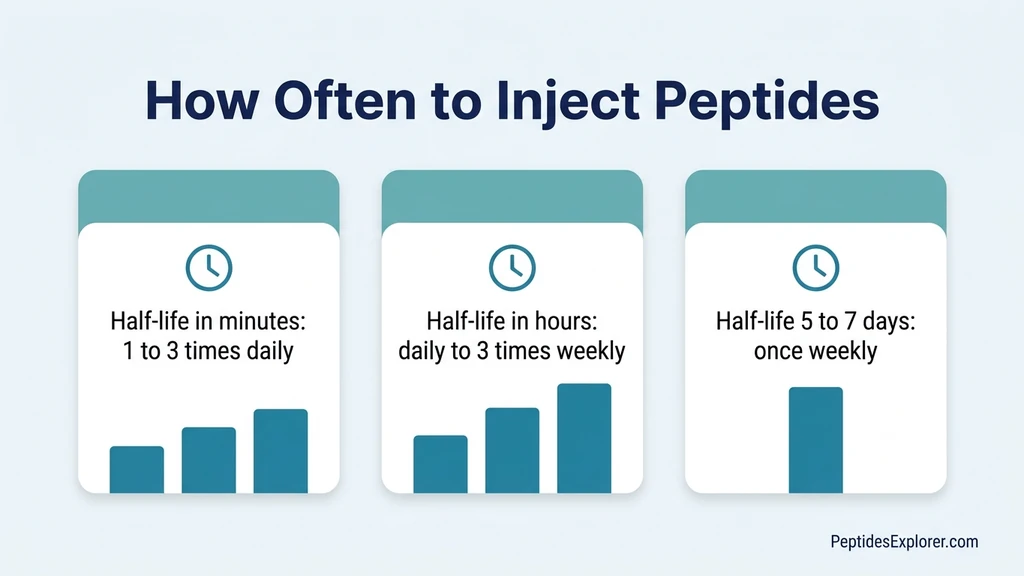
Two vials sit in the fridge door. One label says 5 mg, the other says 10 mg, and neither says how many times a week the needle comes out. Here is the rule: you inject a peptide roughly once per half-life, so compounds that clear in minutes to hours (BPC-157, ipamorelin, sermorelin) go in once or twice a day, and compounds that clear in days (semaglutide, tirzepatide, retatrutide, CJC-1295 with DAC) go in once a week. Everything else is a refinement of that one line.
| Half-life class | Examples | Typical frequency |
|---|---|---|
| Minutes | BPC-157, sermorelin, CJC-1295 without DAC, tesamorelin | 1 to 3 times daily |
| About 2 hours | Ipamorelin | 1 to 3 times daily, pulsed |
| Hours, dose-dependent | TB-500, GHK-Cu, KPV, MOTS-c | Daily to 2 or 3 times weekly |
| Not published in humans | IGF-1 LR3, melanotan 2, epitalon | Daily during a short cycle |
| About 5 to 7 days | Semaglutide, tirzepatide, retatrutide, CJC-1295 DAC | Once weekly |
| On demand | PT-141 | Per event, max 1 per 24 hours |
This page covers frequency only. The milligram and microgram amounts live in the peptide dosage chart, the needle, angle and site in how to inject peptides, and the copper peptide's own schedule in how often to inject GHK-Cu. Plug any half-life below into the peptide half-life tracker to see how much of a dose remains at the hour you plan the next one.
Get your custom peptide protocol:
- Tailored to your body and goals
- Precise dosing and cycle length
- Safe stacking combinations
- Backed by peer-reviewed studies
- Ready in under 2 minutes
Master Table: Peptide, Half-Life, Frequency
This is the table to bookmark. Half-lives are published values where they exist; "not published" means no human pharmacokinetic study has measured it and the frequency column reflects research-community convention only.
| Peptide | Half-life | Typical frequency | Schedule details |
|---|---|---|---|
| BPC-157 | Under 30 minutes (rats and dogs) | Daily or twice daily | Split morning and evening for an active injury |
| TB-500 | Hours, rises with dose (IV, human) | 2 times weekly loading, then weekly | 4 to 6 week loading phase |
| GHK-Cu | Not published for injection | Daily, 5 on / 2 off | 4 to 12 week cycles |
| CJC-1295 with DAC | 5.8 to 8.1 days | Once weekly | Some split it into 2 half-doses |
| CJC-1295 without DAC | Minutes | 1 to 3 times daily | Paired with ipamorelin, pulsed |
| Ipamorelin | About 2 hours | 1 to 3 times daily | Bedtime first, then pre-meal pulses |
| Sermorelin | About 4 minutes (IV) | Once daily at bedtime | 5 on / 2 off is common |
| Tesamorelin | Minutes (clearance about 1,060 L/h) | Once daily | Approved label uses daily 2 mg |
| IGF-1 LR3 | Not published in humans | Once daily, 5 on / 2 off | 4 week cycles, post-workout |
| MOTS-c | Not published in humans | 3 times weekly or daily | 4 to 6 week cycles |
| KPV | Not published in humans | Once daily | 4 to 8 week cycles |
| Semaglutide | About 1 week | Once weekly | Same weekday, any hour |
| Tirzepatide | About 5 days | Once weekly | 72 hour minimum gap |
| Retatrutide | About 6 days | Once weekly | Investigational, no label |
| Melanotan 2 | Rat data only | Daily loading, then 1 to 2 times weekly | Loading ends at target tan |
| PT-141 | Hours (on-demand drug) | Per event | Max 1 dose per 24 h, 8 per month |
| Epitalon | Not published | Once daily for 10 to 20 days | 1 to 2 courses per year |
Sources for the published values: BPC-157 elimination half-life under 30 minutes after intravenous and intramuscular dosing in rats and beagle dogs (He et al., Front Pharmacol, 2022, PMID 36588717); CJC-1295 DAC estimated half-life of 5.8 to 8.1 days (Teichman et al., J Clin Endocrinol Metab, 2006, PMID 16352683); ipamorelin terminal half-life of 2 hours (Gobburu et al., Pharm Res, 1999, PMID 10496658); GHRH(1-29)-NH2, the sermorelin sequence, disappearance half-time of 4.3 minutes by intravenous infusion (Soule et al., J Clin Endocrinol Metab, 1994, PMID 7962295); tesamorelin plasma clearance of 1,060 L/h with a 200 L volume of distribution (González-Sales et al., Clin Pharmacokinet, 2015, PMID 25358450); semaglutide half-life of about 1 week (Ikushima et al., Adv Ther, 2018, PMID 29536338); tirzepatide half-life of approximately 5 days (Furihata et al., Diabetes Obes Metab, 2022, PMID 34647404); retatrutide half-life of approximately 6 days (Urva et al., Lancet, 2022, PMID 36354040).
None of the research peptides in this table is FDA-approved for the uses people buy them for. Semaglutide, tirzepatide, tesamorelin and bremelanotide (PT-141) carry labels for specific indications; the frequencies above for the rest are community conventions built on the pharmacology, and the sections below explain where that reasoning holds and where it is guesswork.
Why Half-Life Sets the Rhythm
Think of a bathtub with the drain open. A compound with a wide drain (a half-life of minutes) empties almost as fast as you pour, so keeping any water in the tub means pouring again and again. A compound with a pinhole drain (a half-life of a week) stays full for days from a single pour, and topping it up daily would overflow the tub.
Literally stated: after one half-life, 50% of a dose remains; after two, 25%; after five, about 3%. Dosing once per half-life keeps blood levels oscillating between roughly 100% and 50% of the peak, which is the band most protocols aim for. Dosing far more often than the half-life stacks doses on top of each other; dosing far less often leaves long stretches near zero.
The arithmetic also tells you when a weekly compound reaches steady state. With a 5-day half-life, tirzepatide needs about 25 days of weekly dosing before each new injection lands on the same baseline. Semaglutide at a 1-week half-life takes about 5 weeks, which is why the escalation steps on its label are 4 weeks apart. Check any schedule in the peptide half-life tracker before you change it.
Two caveats keep this rule honest. Short-half-life peptides like BPC-157 are not dosed every 30 minutes, because the tissue signal they trigger outlasts the molecule; once or twice a day is a compromise between coverage and practicality. And several peptides in the table have no human half-life at all, so their frequency is inherited from similar molecules, which is a weaker basis than it looks on a vendor chart.
Why GH Secretagogues Are Pulsed and GLP-1s Are Weekly
The two biggest frequency classes in peptide use follow opposite logic, and the reason is receptor behavior rather than half-life alone.
A growth hormone secretagogue is meant to trigger a pulse, not a plateau. Ipamorelin produces a single episode of GH release that peaks at 0.67 hours and declines exponentially to negligible levels, at every dose tested (Gobburu et al., Pharm Res, 1999, PMID 10496658). One injection equals one pulse. Three injections a day equal three pulses, spaced so the previous one has fully cleared, which mimics the body's own pattern of several GH bursts per 24 hours. More on the pairing in CJC-1295 and ipamorelin dosing.
Continuous stimulation costs you response at the ghrelin receptor. When healthy older adults took hexarelin, a ghrelin-receptor peptide like ipamorelin, twice daily for 16 weeks, the GH area under the curve fell from 19.1 to 10.5 micrograms per liter per hour, a 45% loss; after 4 weeks off, the response returned to baseline (Rahim et al., Growth Horm IGF Res, 1998, PMID 10990150). That one study is the basis for cycling every ghrelin-receptor secretagogue.
The GHRH side behaves differently. Fourteen days of continuous intravenous GHRH in normal men doubled IGF-1, preserved pulsatile GH secretion, and produced no attenuation of the GH response to a bolus dose (Vance et al., J Clin Endocrinol Metab, 1989, PMID 2491864). This is why CJC-1295 with DAC can sit in the blood for a week and still work, and why the pulsed-versus-continuous debate matters most for the ghrelin-receptor half of a stack. The two sides are compared in ipamorelin vs sermorelin.
GLP-1 agonists are built for the opposite goal: constant receptor occupancy. Their half-lives of 5 to 7 days come from albumin binding, and weekly dosing holds the level inside a narrow band. The receptors that slow gastric emptying do desensitize with round-the-clock exposure, while the appetite and weight effect does not, which is the reason nausea fades over weeks and weight loss continues (Jelsing et al., Diabetes Obes Metab, 2012, PMID 22226053). Injecting semaglutide more often than weekly buys you nothing on the weight side and more on the nausea side.
Loading vs Maintenance Phases
A loading phase front-loads frequency to reach a working level fast; a maintenance phase drops to the minimum that holds it. Only some peptides have a meaningful version of this.
| Peptide | Loading | Maintenance | Why the split exists |
|---|---|---|---|
| TB-500 | 2 times weekly, 4 to 6 weeks | Once weekly or every 2 weeks | Long tissue effect; the weekly dose holds the gain |
| Melanotan 2 | Daily until target tan | 1 to 2 times weekly | Pigment persists for weeks after the signal stops |
| GHK-Cu | Daily 5 on / 2 off, 8 weeks | 2 to 3 times weekly | Gene expression changes persist between doses |
| GLP-1 agonists | None; dose escalates, frequency stays weekly | Weekly | Half-life fills the reservoir on its own |
| Ipamorelin, sermorelin | None; frequency is set by pulse count | Same | A pulse cannot be banked |
Note what is missing from the table. Daily GH secretagogues have no loading phase, because a pulse today does nothing for tomorrow. Weekly GLP-1 agonists have no loading phase either; the half-life accumulates them automatically, and the escalation schedule already spaces doses 4 weeks apart to let each step reach steady state. The loading concept belongs to peptides whose effect lives in tissue longer than the molecule lives in blood: TB-500, melanotan 2 and GHK-Cu.
The research evidence for loading is thin. The human thymosin beta 4 study gave daily intravenous doses for 14 days and found them well tolerated with a dose-proportional profile, but it did not test a two-phase schedule (Ruff et al., Ann N Y Acad Sci, 2010, PMID 20536472). Treat loading as a convention with a plausible mechanism, and shorten it if the goal is met early. The peptide stacking guide shows how loading phases line up when two compounds share a cycle.
Splitting a Daily Dose, 5 On / 2 Off, and Cycling
Splitting a daily dose. Splitting helps when the half-life is shorter than the gap you want to cover. With BPC-157 at under 30 minutes, a single morning injection has cleared by lunch; 250 mcg at 8 AM and 250 mcg at 8 PM covers two windows of the day for the same total. Ipamorelin follows the same logic with pulses: 100 mcg three times a day gives three separate GH episodes, where 300 mcg once gives a single larger one. For weekly compounds the trade-off is different and is covered in splitting a semaglutide dose twice a week.
5 on / 2 off. Weekend breaks make pharmacological sense only for short-half-life peptides, where two skipped days mean two days at zero. For a weekly compound, 5 on / 2 off is meaningless; the drug is there all 7 days regardless. The pattern is used for GHK-Cu, IGF-1 LR3 and sermorelin mostly as a tolerance buffer and a practical rest from the needle, and there is no trial comparing it with 7-day dosing for any of them.
Cycling. Cycle length follows the receptor, not the half-life. Ghrelin-receptor secretagogues get 8 to 12 weeks on and 4 weeks off, because the hexarelin data above showed a partial, reversible loss of response by week 4 that recovered after a 4-week break. GLP-1 agonists are run continuously by label. Peptides cycled for copper load (GHK-Cu) or for lack of long-term safety data (MOTS-c, epitalon, KPV) follow community cycles rather than measured ones; the MOTS-c cycle length guide is the clearest example of a schedule built on caution rather than kinetics.
Reconstituted vials have their own clock. A peptide dosed 3 times a week from a vial that is only stable for 4 weeks in the fridge may expire before it is empty; how long reconstituted peptides last gives the stability windows so frequency and vial size match. Multi-peptide schedules can be laid out in the peptide stack calculator.
What Happens If You Inject More Often Than the Half-Life Justifies
Over-frequent injection has two failure modes: cumulative exposure for long-half-life compounds and receptor desensitization for pulsed ones. Both are measurable.
Scenario 1, CJC-1295 DAC dosed daily. A reader buys CJC-1295 DAC but follows a no-DAC protocol of 100 mcg every day. With a half-life near 7 days, about 91% of each dose is still present when the next one lands. By day 7 the blood level is 5.3 times a single dose; by week 4 it approaches 10 times. In the original trial a single dose already raised GH 2 to 10 fold for 6 days or more and IGF-1 for 9 to 11 days, and multiple doses showed a cumulative effect (Teichman et al., J Clin Endocrinol Metab, 2006, PMID 16352683). Daily DAC turns a weekly pulse into a month-long IGF-1 plateau at ten times the intended exposure. Fix: confirm DAC on the label and dose once a week; the CJC-1295 dosage guide separates the two products.
Scenario 2, semaglutide twice a week at the full dose. Someone on 1 mg weekly reads that "more frequent is smoother" and injects 1 mg every Wednesday and Sunday. Average weekly exposure doubles, equivalent to jumping from the 1 mg step to the 2 mg step overnight instead of over 4 weeks. The gastrointestinal side effects of these drugs are dose-related, so the predictable result is the nausea and vomiting of a skipped titration. Fix: if you split, split the same weekly total in half, and change nothing else.
Scenario 3, a GHRP three times a day with no breaks for four months. The hexarelin study is the template: twice-daily injections for 16 weeks cut the GH response by 45%. Three daily injections of ipamorelin without a cycle break are heading the same way. Fix: 8 to 12 weeks on, 4 weeks off, and measure response by sleep and recovery changes rather than by adding a fourth injection.
The common thread: for a weekly compound, extra injections add drug; for a pulsed compound, extra injections subtract response. Neither adds results.
Missed-Dose Logic by Frequency Class
The right move after a missed dose depends entirely on the half-life class.
| Class | If you miss a dose | Never do this |
|---|---|---|
| Minutes to hours (BPC-157, ipamorelin, sermorelin, tesamorelin) | Skip it and take the next scheduled dose | Double the next dose |
| Loading-phase peptides (TB-500, melanotan 2) | Take it when remembered, keep the loading count | Compress two loading doses into one day |
| Tirzepatide | Inject within 4 days, otherwise skip; keep 72 hours between doses | Two doses inside 72 hours |
| Semaglutide | Inject if the next dose is more than 2 days away, otherwise skip | Two doses inside 48 hours |
| Retatrutide (no label) | Inject within 3 days, otherwise skip | Any make-up double |
| CJC-1295 DAC | Inject when remembered, then restart the 7-day count | A second dose that week |
For the short class, a missed dose is simply gone. Ipamorelin at a 2-hour half-life is 0.02% present 24 hours later; there is nothing to catch up on, and a double dose gives one bigger pulse rather than two. For the weekly class, the window exists because of the reservoir: 4 days after a tirzepatide dose, about 57% remains, which is enough to accept a late injection without stacking. The tirzepatide rule comes from its FDA label (Zepbound prescribing information, 2023, label PDF) and the semaglutide rule from its own (Wegovy prescribing information, 2021, label PDF).
A gap of two weeks or more on a weekly compound deserves a step down, because the tolerance to gastrointestinal effects partly unwinds while levels fall. The day-shifting rules, which apply to all three weekly agonists, are worked through in the best time to take retatrutide.
Common Frequency Mistakes
Treating DAC and no-DAC as the same product. One has a half-life of days, the other of minutes. The daily-dosed DAC error above produces ten times the intended exposure. Fix: read the vial label for "DAC" before choosing between weekly and daily.
Running 5 on / 2 off on a weekly peptide. It changes nothing pharmacologically and tempts people into irregular injection days. Fix: weekly compounds get a fixed weekday and nothing else.
Chasing a stronger GH response with a fourth daily injection. The ghrelin receptor responds to spacing, and the hexarelin data showed the response shrinking, not growing, under continuous stimulation. Fix: hold at 2 to 3 pulses, cycle off at week 12.
Letting a vial outlive its stability window because the schedule is sparse. A 3-times-weekly protocol from a 5 mg vial can stretch past the 4-week fridge limit. Fix: match vial size to frequency using how to store peptides.
Frequently Asked Questions
How often do you inject peptides?
Once per half-life, roughly. Peptides that clear in minutes to hours, such as BPC-157, ipamorelin and sermorelin, are injected 1 to 3 times a day. Peptides that clear in 5 to 7 days, such as semaglutide, tirzepatide and CJC-1295 DAC, are injected once a week. The peptide dosage chart lists the amount per injection for each.
How often do you inject peptides for weight loss?
Once a week for the GLP-1 class. Semaglutide has a half-life of about 1 week (PMID 29536338), tirzepatide about 5 days (PMID 34647404) and retatrutide about 6 days (PMID 36354040), so a single weekly dose keeps levels steady. Pick a weekday and keep it; the retatrutide dosage calculator handles the amount.
Can you inject peptides every day?
Yes for short-half-life peptides, and it is the standard for BPC-157, ipamorelin, sermorelin, tesamorelin and KPV. Daily injection of a weekly compound like CJC-1295 DAC stacks about 91% of each dose on the next and reaches roughly 10 times the intended level within a month. The CJC-1295 dosage guide shows the weekly schedule.
Why are growth hormone peptides injected several times a day?
Because each injection produces one GH pulse. Ipamorelin triggers a single GH episode peaking at 0.67 hours and then clears with a 2-hour half-life (PMID 10496658), so three spaced injections give three pulses that mimic natural secretion. The schedule for the pairing is in the CJC-1295 and ipamorelin dosage calculator.
What happens if you inject peptides too often?
Two outcomes, depending on class. Weekly compounds accumulate: semaglutide at the full dose twice a week doubles exposure and brings on escalation-level nausea. Pulsed secretagogues lose response: twice-daily hexarelin for 16 weeks cut the GH response by 45% (PMID 10990150). The ipamorelin dosage guide sets the pulse count that avoids this.
Should you take breaks from injecting peptides?
Ghrelin-receptor secretagogues such as ipamorelin get 8 to 12 weeks on and 4 weeks off, because the attenuation seen with hexarelin was reversible after a 4-week break. GLP-1 agonists run continuously by label. Peptides without long-term safety data, including MOTS-c and epitalon, use precautionary cycles; see the MOTS-c cycle length guide.
What should you do if you miss a peptide injection?
Short-half-life peptides: skip it and never double, since the dose is gone within hours. Tirzepatide: inject within 4 days, otherwise skip, keeping 72 hours between doses. Semaglutide: inject if the next dose is more than 2 days away. Retatrutide follows a 3-day convention; the best time to take retatrutide covers day switching.
The Bottom Line
You inject a peptide about once per half-life: 1 to 3 times daily for the minutes-to-hours class (BPC-157, ipamorelin, sermorelin, tesamorelin, CJC-1295 without DAC), daily during short cycles for the unmeasured class (IGF-1 LR3, melanotan 2, epitalon), and once a week for the 5-to-7-day class (semaglutide, tirzepatide, retatrutide, CJC-1295 DAC).
The principle: half-life sets the rhythm, and the receptor sets the ceiling. Weekly compounds punish extra injections with accumulated drug; pulsed secretagogues punish them with a shrinking response. Loading phases belong only to peptides whose effect outlives the molecule, and a missed short-acting dose is gone rather than owed.
None of the research peptides here is FDA-approved for these uses, and several have no human half-life data at all, so their schedules are conventions rather than measurements. Check any plan against the peptide half-life tracker, lay a multi-compound schedule out in the peptide stack calculator, and find the rest of the dosing cluster at PeptidesExplorer. Educational content, not medical advice.
Helpful Tools
Related Articles
How Often to Inject GHK-Cu
How often to inject GHK-Cu: once daily, 5 days on / 2 off for 4-12 weeks. See frequency by goal (skin, hair, healing) and cycling schedules.
How Long Does Retatrutide Stay in Your System?
Retatrutide stays in your system about 30 days after the last dose (6-day half-life): 45% left at day 7, 3% at day 30. Washout table, switching and surgery.
Best Time to Take Retatrutide: Morning or Night?
Best time to take retatrutide: any hour, same weekday. Evening blunts nausea, morning suits diarrhea. Missed-dose rule, day switching, food, travel, alcohol.
Microdosing GLP-1: What It Is and the Risks
Microdosing GLP-1 means dosing below the range trials tested. What the dose-response data shows, how it differs from titration, and the cost and safety risks.