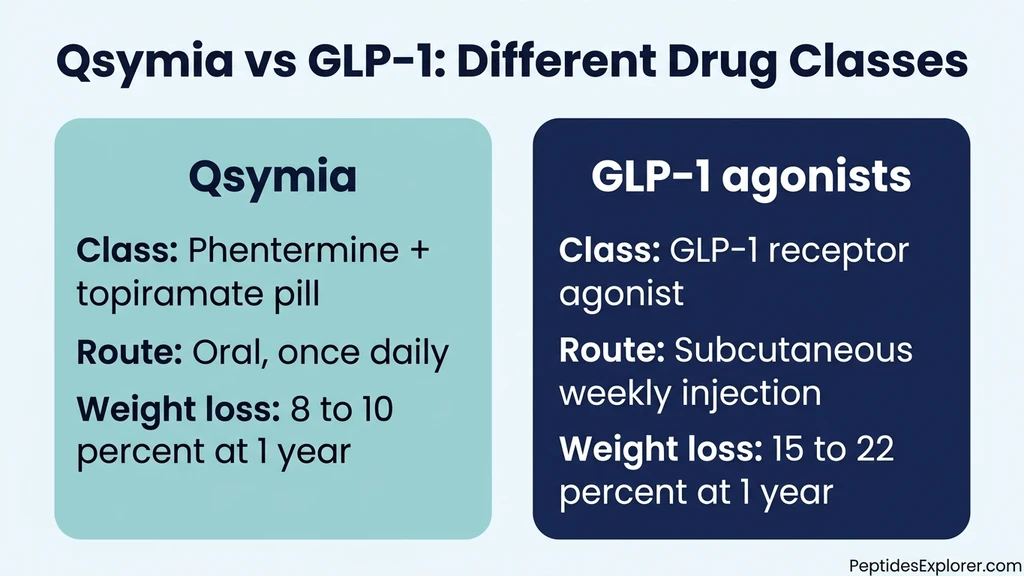
Your pharmacist mentioned Qsymia and now you are trying to figure out if it is another Ozempic-style injection. No. Qsymia is not a GLP-1. Qsymia is an oral pill that combines phentermine (a CNS stimulant and appetite suppressant) with topiramate (an anticonvulsant that also reduces food cravings). It does not activate GLP-1 receptors, is not injected, and works through a completely different mechanism. The confusion happens because both Qsymia and GLP-1s are FDA-approved for weight loss, but they are otherwise unrelated drug classes with very different side effect profiles, costs, and outcomes.
| Quick Reference | Qsymia | GLP-1 agonists (Wegovy, Zepbound, etc.) |
|---|---|---|
| Drug class | Phentermine + topiramate ER combination | GLP-1 (or GLP-1/GIP) receptor agonist |
| Route | Oral capsule, once daily | Subcutaneous injection, weekly |
| FDA approval | 2012 (obesity) | Wegovy 2021, Zepbound 2023 |
| Average weight loss (1 year) | 8 to 10% | 15 to 22% |
| Insurance coverage | Limited | Improving but still spotty |
| Monthly cost (cash) | $200 to $300 | $500 to $1,300 |
| Main side effects | Insomnia, dry mouth, paresthesias, cognitive effects | Nausea, diarrhea, constipation |
| Contraindications | Glaucoma, hyperthyroidism, recent MAOI use, pregnancy | Thyroid C-cell tumors, MEN-2, pancreatitis history |
| Withdrawal potential | Yes (phentermine is a controlled stimulant) | No |
The mechanisms are so different that they are sometimes combined: a patient taking Wegovy (a GLP-1) might also take Qsymia to address specific hunger patterns, though this is uncommon and not standard practice. For a full comparison including other non-GLP-1 weight loss drugs, see phentermine vs GLP-1.
This is educational content. Consult a healthcare provider before starting any prescription weight loss medication.
Get your custom peptide protocol:
- Tailored to your body and goals
- Precise dosing and cycle length
- Safe stacking combinations
- Backed by peer-reviewed studies
- Ready in under 2 minutes
What Qsymia Actually Is
Qsymia is a once-daily oral capsule containing two drugs that have been used separately for decades:
Phentermine: A sympathomimetic amine (related structurally to amphetamines, though less potent). It has been used for short-term weight loss since 1959. Phentermine works by triggering norepinephrine release in the central nervous system, which suppresses appetite and increases metabolic rate. It is a Schedule IV controlled substance because of its stimulant properties.
Topiramate: An anticonvulsant first approved for epilepsy in 1996, later approved for migraine prevention. It has a secondary effect of reducing food intake and cravings, likely through GABA modulation and carbonic anhydrase inhibition (De Simone et al., 2007). Topiramate alone produces modest weight loss in patients taking it for other reasons.
The Qsymia combination: By pairing lower doses of each drug than either monotherapy typically uses, Qsymia produces additive weight loss with a more tolerable side effect profile than phentermine monotherapy. The extended-release (ER) topiramate component smooths out what would otherwise be uneven drug levels through the day.
Standard dosing: - Week 1 to 2: 3.75 mg phentermine / 23 mg topiramate daily (titration) - Week 3 onward: 7.5 mg phentermine / 46 mg topiramate daily (maintenance) - Escalation options: 11.25 mg / 69 mg, or 15 mg / 92 mg (maximum)
FDA indication: Chronic weight management in adults with BMI ≥ 30, or BMI ≥ 27 with a weight-related comorbidity (hypertension, type 2 diabetes, dyslipidemia). Qsymia must be used with diet and exercise.
Why Qsymia Is Not a GLP-1
GLP-1 receptor agonists are a specific drug class defined by their binding to the glucagon-like peptide-1 receptor. Qsymia does not bind this receptor at all. Qsymia's two ingredients have completely different targets:
- Phentermine targets norepinephrine release via the central nervous system.
- Topiramate targets GABA-A receptors, voltage-gated sodium channels, and carbonic anhydrase.
Mechanistic comparison:
| Target | Qsymia | GLP-1 agonists |
|---|---|---|
| GLP-1 receptor | No activation | Primary mechanism |
| Gastric emptying | No effect | Slows significantly |
| Pancreatic insulin release | No effect | Stimulates (glucose-dependent) |
| CNS appetite suppression | Yes (via norepinephrine) | Yes (via hypothalamus) |
| Food craving reduction | Yes (via topiramate) | Yes (via gastric satiety and brain reward pathways) |
| Blood glucose effect | Neutral | Significant glucose reduction |
| Weight loss driver | Appetite suppression, mild metabolic rate increase | Satiety, reduced calorie intake, improved metabolism |
The practical consequence: Qsymia does not help with type 2 diabetes blood sugar control the way GLP-1s do. A GLP-1 provides cardiovascular benefit independent of weight loss (SELECT trial for semaglutide). Qsymia does not. If you have type 2 diabetes and obesity, a GLP-1 class drug is almost always preferred over Qsymia. See phentermine vs GLP-1 for the full comparison and decision framework.
For the GLP-1 class itself, see semaglutide mixing chart, how to inject tirzepatide, and retatrutide vs tirzepatide for the next-generation triple-agonist drugs.
Weight Loss: Qsymia vs GLP-1 Head-to-Head
Qsymia was approved in 2012 based on two Phase 3 trials: CONQUER and EQUIP. Across 56 weeks in CONQUER (Gadde et al., 2011):
- Qsymia 7.5 mg / 46 mg: 8.1 kg mean weight loss
- Qsymia 15 mg / 92 mg: 10.2 kg mean weight loss
- Placebo: 1.4 kg weight loss
- 70% of patients on the higher dose achieved ≥5% weight loss vs 21% on placebo
GLP-1 and dual-agonist trials produced stronger results over similar or longer timeframes:
- Semaglutide 2.4 mg (Wegovy), STEP-1, 68 weeks: 14.9% weight loss (Wilding et al., 2021)
- Tirzepatide 15 mg (Zepbound), SURMOUNT-1, 72 weeks: 20.9% weight loss (Jastreboff et al., 2022)
- Retatrutide 12 mg (investigational), Phase 2, 48 weeks: 24.2% weight loss
The efficacy gap is roughly 2x. Qsymia at its maximum dose produces about half the weight loss that Zepbound produces at its maximum dose. That is a meaningful clinical difference.
Why GLP-1s win on efficacy: - They act on multiple pathways (satiety, gastric emptying, reward circuits, glucose metabolism) - They are sustained-release by engineering (weekly dosing with flat PK curves) - They avoid the tolerance phenomena that plague stimulant-based drugs like phentermine
Why Qsymia still has a role: - Oral, not injectable (preference matters) - Cheaper (about $200 to $300/month vs $500 to $1,300 for brand-name GLP-1s) - Generic phentermine monotherapy is very affordable (though less effective than Qsymia) - Faster onset for some patients (appetite suppression within days vs weeks) - Useful when GLP-1s are contraindicated (history of medullary thyroid cancer, for example)
For patients where cost dominates the decision, see peptide cost calculator and how much is semaglutide for GLP-1 cost-reduction strategies (including compounded versions). For comprehensive weight loss strategy options, see not losing weight on semaglutide.
Who Should Not Take Qsymia
Qsymia has a distinct contraindication list that is largely separate from GLP-1 contraindications:
Do not take Qsymia if you have: - Glaucoma (topiramate can worsen) - Hyperthyroidism (phentermine exacerbates symptoms) - Pregnancy or breastfeeding (topiramate causes cleft lip/palate; phentermine has no safety data) - Used an MAO inhibitor within 14 days - History of cardiovascular disease, especially arrhythmias or severe hypertension - Kidney stones history (topiramate increases risk) - Metabolic acidosis history
Use with caution: - History of substance use disorder (phentermine has abuse potential) - Severe anxiety or panic disorder (stimulant effect) - Renal or hepatic impairment (dose adjustment needed) - Age > 65 (not well studied)
Contraceptive consideration: Topiramate at Qsymia doses can reduce the effectiveness of estrogen-containing oral contraceptives. Women taking Qsymia need a backup contraceptive method or a non-hormonal option.
Withdrawal: Phentermine can produce rebound appetite when discontinued. Dose-tapering is recommended if you have been on Qsymia for more than 12 weeks. Topiramate also requires tapering to avoid seizure risk, even in non-epileptic patients.
Compare this list to GLP-1 contraindications (medullary thyroid carcinoma, MEN-2, history of pancreatitis, severe gastroparesis), which are more specific and affect fewer patients overall. GLP-1 contraindications, for context, are in tirzepatide drug interactions and tirzepatide long-term side effects.
Can Qsymia Be Combined With a GLP-1?
Sometimes, under specialist supervision. This is not standard practice and no head-to-head trial has tested the combination.
The theoretical rationale: Qsymia and GLP-1s work on different pathways. Phentermine drives norepinephrine-mediated appetite suppression (fast, behavior-modifying). GLP-1 drives satiety-mediated reduced food intake (slower, physiological). In a patient who has plateaued on a GLP-1 alone, adding Qsymia might address food cravings that the GLP-1 is not reaching.
The clinical reality: - Most patients who plateau on a GLP-1 respond better to GLP-1 dose escalation than to adding Qsymia - Cardiovascular side effects stack: both drugs can elevate heart rate, Qsymia more so - The combination is expensive (two prescriptions, often not covered by insurance for dual use) - No trial data guides dosing or safety monitoring
When combination is considered: - Severe obesity (BMI > 40) with plateau at maximum GLP-1 dose - Addictive eating patterns that GLP-1 alone does not resolve - Under obesity medicine specialist supervision - With cardiovascular monitoring (baseline and periodic ECGs, blood pressure tracking)
Safer alternatives to consider first: - Switch to a higher-potency GLP-1 class drug (tirzepatide if on semaglutide; retatrutide if available) - Add cagrilintide (amylin analogue) instead of Qsymia; mechanism stacks without stimulant load. See cagrilintide weight loss dosage. - Address lifestyle factors: protein intake, resistance training, sleep. See why am I not losing weight on tirzepatide.
If your provider suggests Qsymia + GLP-1, ask specifically whether cagrilintide or a higher-dose GLP-1 has been tried first.
Frequently Asked Questions
Is Qsymia similar to Ozempic or Wegovy?
No. Ozempic and Wegovy are GLP-1 agonists (semaglutide), weekly injections that mimic a gut hormone. Qsymia is an oral pill combining phentermine (a stimulant) with topiramate (an anticonvulsant). They both help with weight loss but through completely different mechanisms and with different side effect profiles.
Does Qsymia work as well as Zepbound for weight loss?
No. Qsymia at maximum dose produces about 10.9% weight loss over 56 weeks. Zepbound (tirzepatide) at 15 mg produces 22.5% weight loss over 72 weeks. The efficacy gap is about 2x. Zepbound is currently the strongest FDA-approved weight loss drug. See retatrutide vs tirzepatide for the next tier.
Can I take Qsymia and Ozempic at the same time?
Possibly, under specialist supervision. It is not standard practice. The drugs work on different pathways, so combination could theoretically help patients who plateau on one drug. But the cardiovascular side effects of phentermine stack with some GLP-1 effects, and no trial has tested safety or efficacy of the combination. Most specialists would try GLP-1 dose escalation or cagrilintide first. See cagrilintide weight loss dosage.
Is phentermine the same as a GLP-1?
No. Phentermine is a stimulant-class appetite suppressant. It is chemically related to amphetamines. GLP-1 agonists are peptide hormones that mimic a gut-secreted satiety signal. Phentermine has been on the market since 1959; GLP-1 agonists were first approved in 2005. They work on different receptors and have different side effect profiles. See phentermine vs GLP-1.
Why do some doctors prescribe Qsymia over a GLP-1?
Cost, oral convenience, insurance coverage, contraindications to GLP-1 (like history of medullary thyroid cancer), or patient preference against injections. Qsymia at ~$200/month is cheaper than most brand-name GLP-1s. For patients with lower BMI or milder weight loss goals, the 8 to 11% Qsymia produces may be sufficient. For severe obesity, a GLP-1 is usually preferred.
What is the biggest side effect difference between Qsymia and a GLP-1?
Qsymia produces stimulant-type side effects: insomnia, dry mouth, paresthesias (tingling in hands and feet), dysgeusia (altered taste), and mild cognitive slowing. GLP-1s produce gastrointestinal side effects: nausea, vomiting, constipation, diarrhea. GI side effects usually improve over 4 to 8 weeks; Qsymia's CNS side effects tend to persist through continued use.
Does Qsymia help with diabetes?
Indirectly, by producing weight loss. Qsymia has no direct glucose-lowering mechanism. It does not lower HbA1c beyond what weight loss achieves. GLP-1s provide direct glucose lowering and have been shown to reduce cardiovascular events in diabetics. If you have type 2 diabetes, a GLP-1 is almost always preferred over Qsymia.
Is Qsymia a controlled substance like phentermine alone?
Yes. Because Qsymia contains phentermine, it is a Schedule IV controlled substance in the United States. This means it requires a prescription, cannot be called in without DEA registration, and has dependence liability (though lower than amphetamines). Refills are limited and vary by state. GLP-1s are not controlled substances. See are peptides legal for the legal landscape.
The Bottom Line
Qsymia is not a GLP-1. It is a phentermine-topiramate combination pill for chronic weight management. It works through central nervous system appetite suppression (phentermine) and craving reduction (topiramate), not through GLP-1 receptor activation. It produces about half the weight loss that tirzepatide produces at maximum dose, but it is oral, cheaper, and available to patients for whom GLP-1s are contraindicated.
If you are choosing between Qsymia and a GLP-1, the main factors are: severity of obesity, presence of type 2 diabetes, cost and insurance coverage, tolerance for injection vs oral pill, and any contraindications to either class. For BMI 30 to 35 without diabetes, Qsymia is a reasonable first try. For BMI > 35, BMI > 30 with type 2 diabetes, or significant comorbidities, GLP-1 is usually the right choice. For patients who fail both, cagrilintide (amylin) and retatrutide (triple-agonist) are next-line options.
For the complete decision framework, see phentermine vs GLP-1. For GLP-1 dosing and selection, see semaglutide mixing chart, how to inject tirzepatide, and cagrilintide weight loss dosage. For cost-minimization strategies on GLP-1s, see how much is semaglutide.
Related Articles: - Phentermine vs GLP-1 - How to Inject Tirzepatide - Semaglutide Mixing Chart - Cagrilintide Weight Loss Dosage - Retatrutide vs Tirzepatide - Tirzepatide Drug Interactions
Related Articles
Is Tresiba a GLP-1?
Tresiba (insulin degludec) is NOT a GLP-1. It is an ultra-long-acting basal insulin analog. Key differences from Ozempic, Mounjaro, and other GLP-1 agonists.
Does Tirzepatide Help With Inflammation?
Does tirzepatide help with inflammation? Yes: CRP drops 32.9%, IL-6 drops 17.8% in trials. SURMOUNT data and adipose tissue mechanisms.
Does Compounded Tirzepatide Work? Real Data
Does compounded tirzepatide work? Review SURMOUNT data, salt form differences (base, acetate, sodium), potency gaps, and FDA status in 2026.
Does Oral Tirzepatide Work? The Facts
Oral tirzepatide is not FDA-approved. Why peptide pills face absorption barriers, sublingual drops vs injections, and oral GLP-1 alternatives in 2026.