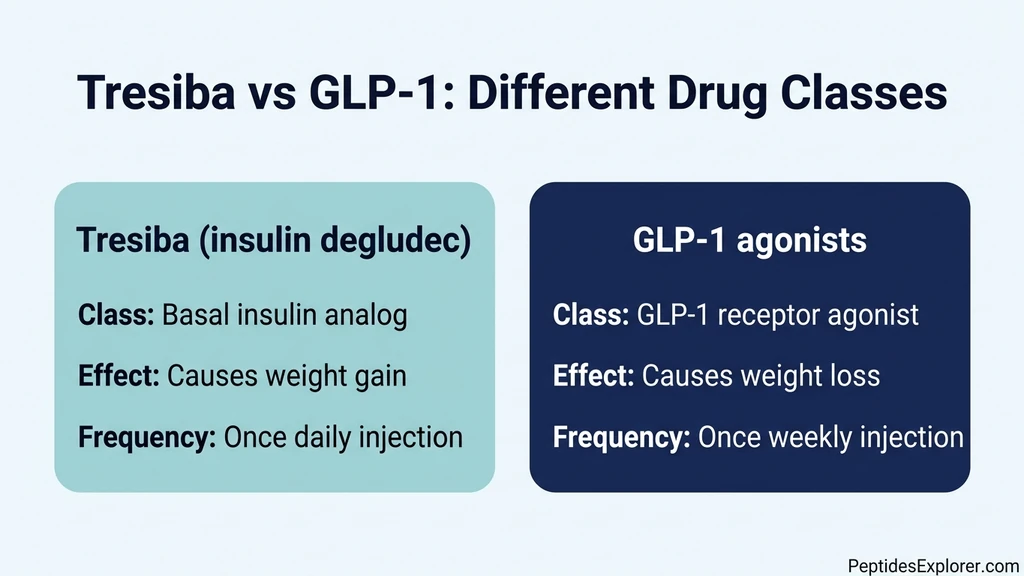
You saw Tresiba mentioned in the same sentence as Ozempic, Mounjaro, or Zepbound, and now you are trying to figure out if it is another weight loss drug. No. Tresiba is not a GLP-1. Tresiba is the brand name for insulin degludec, an ultra-long-acting basal insulin analog used to control blood sugar in people with diabetes. It does not activate GLP-1 receptors, does not promote weight loss, and in fact can cause weight gain like most insulin therapies. The confusion comes from both drug classes being injectable and prescribed for type 2 diabetes. Their mechanisms, effects, and goals are opposite.
| Quick Reference | Tresiba | GLP-1 agonists (Ozempic, Mounjaro, etc.) |
|---|---|---|
| Drug class | Basal insulin analog | GLP-1 receptor agonist (or dual GLP-1/GIP for tirzepatide) |
| Generic name | Insulin degludec | Semaglutide, liraglutide, tirzepatide, others |
| Primary use | Type 1 and type 2 diabetes blood sugar control | Type 2 diabetes and obesity |
| Weight effect | Often causes weight gain | Causes weight loss |
| Hypoglycemia risk | Yes, significant | Minimal (except when combined with insulin) |
| Injection frequency | Once daily | Once weekly (most), once daily (liraglutide) |
| Mechanism | Replaces missing/deficient insulin | Enhances endogenous GLP-1 signaling |
| FDA approved for obesity | No | Yes (Zepbound, Wegovy) |
If you were told "you need a GLP-1 for weight loss" and handed a Tresiba prescription, something is wrong with the prescription. If you were told "you need Tresiba for blood sugar" and expected weight loss, that is not how Tresiba works. For weight-loss GLP-1 options, see phentermine vs GLP-1. For tirzepatide specifically, see how to inject tirzepatide.
This is educational content. Consult a healthcare provider about your prescriptions.
Get your custom peptide protocol:
- Tailored to your body and goals
- Precise dosing and cycle length
- Safe stacking combinations
- Backed by peer-reviewed studies
- Ready in under 2 minutes
What Tresiba Actually Is
Tresiba is the brand name for insulin degludec, developed by Novo Nordisk and approved by the FDA in 2015. Chemically, it is a modified version of human insulin engineered to form stable multi-hexamers in subcutaneous tissue (Jonassen et al., 2012). This structure releases insulin slowly over more than 42 hours with a terminal half-life of more than 25 hours, producing the longest duration of action of any basal insulin on the market (Gough et al., 2013).
What Tresiba does: - Replaces the steady background insulin that a healthy pancreas produces continuously - Keeps fasting blood glucose stable between meals and overnight - Provides a smooth, flat glucose-lowering curve without pronounced peaks
What Tresiba does not do: - Stimulate insulin release (that is the pancreas's job; Tresiba IS the insulin) - Slow gastric emptying - Suppress appetite - Promote weight loss - Act on the GLP-1 receptor - Treat obesity
Tresiba is prescribed for type 1 diabetes (where the pancreas makes little or no insulin), type 2 diabetes (when oral medications and GLP-1s are not enough to control blood sugar), and occasionally during pregnancy-related diabetes management. It is typically used alongside a fast-acting insulin that covers meal-time glucose spikes.
The structural engineering behind Tresiba is why it has such a long half-life. After subcutaneous injection, the drug forms soluble hexamers that slowly dissociate, releasing insulin into the bloodstream over 42+ hours. This is why missing a dose by 8 to 12 hours is not a crisis (unlike with short-acting basal insulins).
What a GLP-1 Agonist Actually Is
GLP-1 receptor agonists are a completely different drug class. They mimic the action of glucagon-like peptide-1, a natural gut hormone that your small intestine releases after eating. Native GLP-1 has a 2-minute half-life. Pharmaceutical GLP-1 analogs are engineered to resist degradation and last for days or weeks.
What GLP-1 agonists do: - Stimulate your pancreas to release insulin *in response to food* (glucose-dependent) - Slow gastric emptying, making you feel full longer - Reduce appetite via central brain signaling - Suppress glucagon (which raises blood sugar) - Promote weight loss (5 to 22% depending on drug and dose)
Drugs in this class: - Semaglutide (Ozempic, Wegovy, Rybelsus) - Liraglutide (Victoza, Saxenda) - Dulaglutide (Trulicity) - Tirzepatide (Mounjaro, Zepbound): technically dual GLP-1/GIP agonist - Retatrutide (in development): triple GLP-1/GIP/glucagon agonist
Unlike insulin, GLP-1 agonists do not cause hypoglycemia on their own because they only stimulate insulin release when glucose is elevated. They also actively promote weight loss rather than causing weight gain. Semaglutide 2.4 mg weekly produced 14.9% mean weight loss at week 68 in the STEP-1 trial of adults with overweight or obesity (Wilding et al., 2021).
The crucial mechanistic difference: GLP-1 agonists *enhance your body's own insulin response*, while insulin (including Tresiba) *replaces* or *adds to* your body's insulin. These are opposite approaches to the same problem. For specific dosing guidance, see semaglutide dosage chart and the tirzepatide dosage chart in units. For drug-class comparisons to other weight loss options, see phentermine vs GLP-1 and peptides vs steroids.
Why the Confusion Happens
Several overlapping features make it easy to mix Tresiba up with GLP-1 drugs:
Both are injectable. If you have never injected a medication before, both look the same: a pen with a needle, administered subcutaneously. Tresiba is a FlexTouch pen; Ozempic is a pre-filled pen; Mounjaro is a pre-filled pen. Same delivery format, completely different drugs.
Both are prescribed for type 2 diabetes. A patient with type 2 diabetes might be on a GLP-1 (semaglutide) AND a basal insulin (Tresiba) simultaneously. This combination is common. The GLP-1 handles the postprandial (after-meal) glucose control and weight loss; Tresiba handles the fasting glucose baseline.
Both have weekly or longer-acting formulations. Tresiba can be dosed once daily with its 42-hour duration forgiving missed doses. Semaglutide is once-weekly. The similar dosing frequency confuses people who assume long-acting drugs work the same way.
Both have premium brand names. Ozempic, Mounjaro, Tresiba: all sound modern and similar. Pharmacy confusion is real. Always verify the generic name on your prescription label.
Both are made by Novo Nordisk. Tresiba and Ozempic share a manufacturer, which means the same company is producing a weight-neutral/weight-gain basal insulin and a weight-loss GLP-1. This is not unusual for diabetes drug portfolios.
If you are ever uncertain which drug you are on, read the label. It will say one of: - "Insulin degludec" = Tresiba = basal insulin, not GLP-1 - "Semaglutide" = Ozempic/Wegovy/Rybelsus = GLP-1 - "Tirzepatide" = Mounjaro/Zepbound = dual GLP-1/GIP agonist - "Liraglutide" = Victoza/Saxenda = GLP-1 - "Dulaglutide" = Trulicity = GLP-1
When Tresiba and a GLP-1 Are Used Together
Despite their opposite mechanisms, Tresiba and a GLP-1 agonist are commonly prescribed together for type 2 diabetes that has progressed past oral medications.
Typical combination protocol: - Tresiba once daily for fasting glucose stability - Semaglutide or tirzepatide once weekly for postprandial control and weight reduction - Optional: a fast-acting insulin (like Humalog or Fiasp) for meal-time coverage
Why this combination works: - GLP-1 reduces the total insulin requirement by improving insulin sensitivity and reducing food intake - Tresiba provides the steady baseline that GLP-1 alone cannot maintain in someone with significant beta cell dysfunction - Together, they produce better HbA1c control and often allow reduction of total insulin doses
Risk: hypoglycemia. When a GLP-1 is added to existing insulin therapy, insulin doses usually need to be reduced by 10 to 20% to prevent low blood sugar episodes. This is especially true for Tresiba because its long duration means the effect persists even after a meal is skipped. See tirzepatide drug interactions for the full picture of GLP-1 + insulin co-prescribing.
Weight outcomes: In patients on Tresiba + semaglutide, the GLP-1's weight loss typically dominates. Real-world studies show 5 to 10% weight loss over 12 months despite continuing Tresiba. The GLP-1 effect is strong enough to overcome the modest weight gain tendency of insulin.
Drugs People Confuse With Tresiba
If you landed here searching "is Tresiba a GLP-1" because you were looking for a weight-loss drug, the drug you actually want is probably one of these:
For weight loss: - Wegovy (semaglutide 2.4 mg weekly): FDA-approved specifically for obesity. 14 to 15% average weight loss. - Zepbound (tirzepatide): FDA-approved for obesity. 20 to 22% average weight loss. - Mounjaro (tirzepatide): same as Zepbound but labeled for type 2 diabetes. - Ozempic (semaglutide 0.5 to 2 mg weekly): labeled for type 2 diabetes; used off-label for weight loss.
For blood sugar, similar to Tresiba: - Lantus (insulin glargine): long-acting basal insulin, 24-hour duration - Levemir (insulin detemir): intermediate basal insulin, 12 to 24 hours - Toujeo (insulin glargine U-300): concentrated glargine
Other long-duration diabetes drugs that are NOT GLP-1s: - Jardiance, Farxiga, Invokana (SGLT-2 inhibitors): oral pills, not injections; cause modest weight loss but different mechanism - Metformin: oral pill, first-line diabetes drug, not a GLP-1
For a broader comparison of weight loss drugs, see phentermine vs GLP-1, cagrilintide weight loss dosage, and retatrutide vs tirzepatide for the newer triple-mechanism agents.
Frequently Asked Questions
Is Tresiba the same as Ozempic?
No. Tresiba is insulin degludec, a basal insulin analog for blood sugar control. Ozempic is semaglutide, a GLP-1 receptor agonist for type 2 diabetes and weight loss. Different drug classes, different mechanisms, different side effects. Both are made by Novo Nordisk but they do opposite things to weight.
Does Tresiba cause weight loss?
No. Like most insulin therapies, Tresiba tends to cause modest weight gain (usually 2 to 5 pounds over the first year of use). The weight gain is smaller than with older basal insulins because Tresiba has a flatter, more predictable action profile, but it is not a weight-loss drug.
Can you take Tresiba and Ozempic at the same time?
Yes, and this combination is common for type 2 diabetes. The GLP-1 (Ozempic) and basal insulin (Tresiba) work on different pathways. Insulin doses usually need to be reduced by 10 to 20% when starting a GLP-1 to prevent hypoglycemia. See tirzepatide drug interactions for the full co-prescribing framework.
If Tresiba is not a GLP-1, what is it?
Tresiba is a basal insulin analog, specifically insulin degludec. It is a modified form of human insulin that releases slowly over 42+ hours. Its job is to provide a steady baseline insulin level between meals, mimicking what a healthy pancreas does continuously. It is used for type 1 and type 2 diabetes.
Which drugs are actually GLP-1s?
Semaglutide (Ozempic, Wegovy, Rybelsus), liraglutide (Victoza, Saxenda), dulaglutide (Trulicity), and retatrutide (investigational). Tirzepatide (Mounjaro, Zepbound) is technically a dual GLP-1/GIP agonist, often grouped with GLP-1s. For dosing and timing, see best time to take tirzepatide.
Why does my doctor have me on Tresiba instead of a GLP-1?
Because you have insulin deficiency that a GLP-1 cannot fix. GLP-1s enhance your body's own insulin response. If your pancreas is not producing enough insulin (type 1 diabetes, or late-stage type 2), you need actual insulin, not a GLP-1. Many type 2 patients use both together. Ask your doctor if adding a GLP-1 to your Tresiba is appropriate for your case.
Does Tresiba cause nausea like Ozempic?
No. Nausea is a GLP-1-class side effect caused by slowed gastric emptying. Tresiba does not affect gastric emptying. Its main side effects are hypoglycemia (low blood sugar) and injection site reactions. If you are getting nausea on what you thought was Tresiba, check the label; you may actually be on a GLP-1.
Is there a GLP-1 made by Novo Nordisk similar to Tresiba?
Yes. Novo Nordisk makes semaglutide under three brand names: Ozempic (for diabetes, weekly injection), Wegovy (for obesity, weekly injection), and Rybelsus (for diabetes, oral daily tablet). Liraglutide (Victoza, Saxenda) is also Novo Nordisk's GLP-1. None are basal insulins. See can semaglutide cause depression and how long does semaglutide take to work for semaglutide specifics.
The Bottom Line
Tresiba is not a GLP-1. It is a basal insulin analog (insulin degludec) used for blood sugar control in diabetes. It does not cause weight loss, does not suppress appetite, and does not work through the GLP-1 receptor. The confusion comes from both drug classes being injectable and being used for diabetes, but their mechanisms and effects are distinct.
If you were looking for a weight loss drug, the GLP-1 options are Wegovy (semaglutide), Zepbound (tirzepatide), Ozempic (semaglutide, off-label for weight), and Saxenda (liraglutide). If you have type 2 diabetes and want both weight loss and blood sugar control, your doctor may prescribe Tresiba AND a GLP-1 together; this is a standard combination, not a contradiction.
Always verify the generic name on your prescription label. "Insulin degludec" means basal insulin. "Semaglutide" or "tirzepatide" means GLP-1 or GLP-1/GIP agonist. The brand names are engineered to sound similar, but the drugs themselves are not interchangeable.
For weight loss dosing protocols, see semaglutide mixing chart, tirzepatide dosage chart in units, and how to inject tirzepatide. For class comparisons, see phentermine vs GLP-1 and retatrutide vs tirzepatide. For safety information on GLP-1s, see tirzepatide long-term side effects.
Related Articles: - Phentermine vs GLP-1 - How to Inject Tirzepatide - Semaglutide Mixing Chart - Tirzepatide Drug Interactions - Retatrutide vs Tirzepatide - Cagrilintide Weight Loss Dosage
Related Articles
Is Qsymia a GLP-1?
Is Qsymia a GLP-1? No. It is an oral mix of phentermine (appetite suppressant) and topiramate. Mechanism, weight loss, and GLP-1 comparison.
Does Tirzepatide Help With Inflammation?
Does tirzepatide help with inflammation? Yes: CRP drops 32.9%, IL-6 drops 17.8% in trials. SURMOUNT data and adipose tissue mechanisms.
Does Compounded Tirzepatide Work? Real Data
Does compounded tirzepatide work? Review SURMOUNT data, salt form differences (base, acetate, sodium), potency gaps, and FDA status in 2026.
Does Oral Tirzepatide Work? The Facts
Oral tirzepatide is not FDA-approved. Why peptide pills face absorption barriers, sublingual drops vs injections, and oral GLP-1 alternatives in 2026.