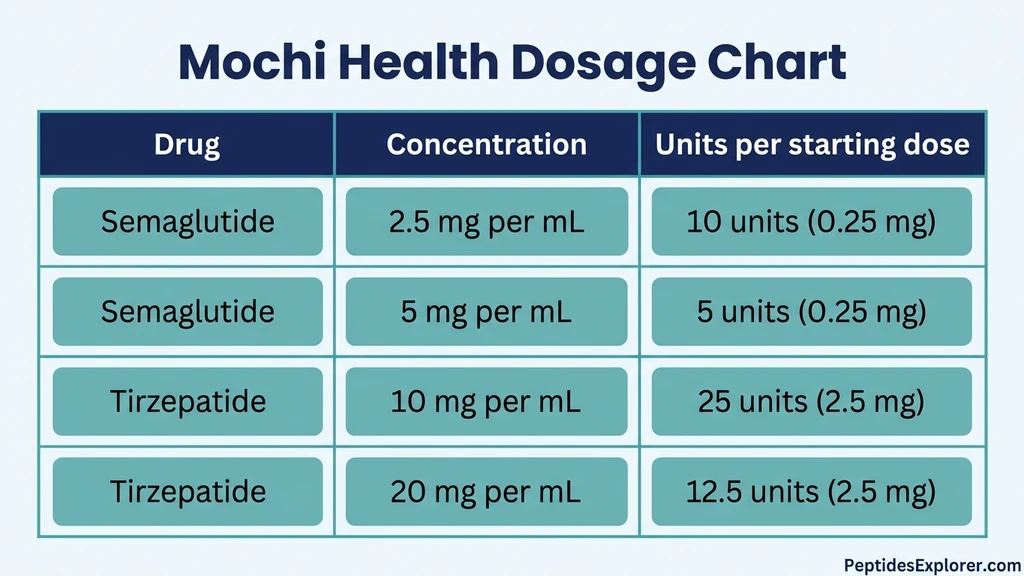
Your Mochi Health vial just arrived from Aequita Pharmacy, the label says "2.5 mg/mL semaglutide" or "10 mg/mL tirzepatide," and your provider's note says something like "draw 25 units." The syringe is in units. The label is in milligrams per milliliter. Mochi Health ships compounded semaglutide most commonly at 2.5 mg/mL and compounded tirzepatide most commonly at 10 mg/mL. At 2.5 mg/mL semaglutide, a 0.25 mg starting dose equals 10 units on a U-100 insulin syringe. At 10 mg/mL tirzepatide, a 2.5 mg starting dose equals 25 units. Mochi titrates semaglutide every 4 weeks (0.25 to 0.5 to 1.0 to 1.7 to 2.4 mg) and tirzepatide every 4 weeks (2.5 to 5 to 7.5 to 10 to 12.5 to 15 mg) following the standard FDA-approved ladders. The math is built on those two concentrations. If your vial is different, the unit numbers shift proportionally.
| Quick Reference | Mochi Compounded Semaglutide | Mochi Compounded Tirzepatide |
|---|---|---|
| Typical concentration | 2.5 mg/mL | 10 mg/mL |
| Starting dose | 0.25 mg | 2.5 mg |
| Starting units (U-100 syringe) | 10 units | 25 units |
| Titration interval | Every 4 weeks | Every 4 weeks |
| Maintenance dose range | 1.7 to 2.4 mg | 10 to 15 mg |
| Maintenance units at typical conc. | 68 to 96 units | 100 to 150 units |
| Vial size shipped | Typically 5 mg per vial | Typically 30 mg per vial |
| Vial duration at starting dose | ~5 weeks | ~3 weeks |
This dosage-chart article focuses on the unit math. For the broader Mochi Health review including pricing, membership, BBB complaint patterns, and provider experience, see our full Mochi Health reviews breakdown. For comparable telehealth providers, see Henry Meds reviews and Ivim Health reviews.
Always confirm your specific vial concentration on the label and follow the dose your prescriber wrote. This article walks through the math so you can verify what you are drawing. It is educational content, not personalized medical advice.
Get your custom peptide protocol:
- Tailored to your body and goals
- Precise dosing and cycle length
- Safe stacking combinations
- Backed by peer-reviewed studies
- Ready in under 2 minutes
How Mochi Health Compounded Vials Are Concentrated
Mochi partners with Aequita Pharmacy for its compounded GLP-1 medications. Like most 503A compounding pharmacies serving the telehealth weight loss market, Aequita standardizes on a small set of concentrations to keep prescription workflows clean and to make the syringe math survivable for patients dosing at home.
Compounded semaglutide from Mochi: typically 2.5 mg/mL.
The standard 5 mg vial is reconstituted to 2 mL of bacteriostatic water, producing 2.5 mg/mL. Some compounding runs ship at higher concentration (5 mg/mL) for higher-dose patients. Always check the label.
Compounded tirzepatide from Mochi: typically 10 mg/mL.
The standard 30 mg vial is reconstituted to 3 mL of bacteriostatic water, producing 10 mg/mL. Higher-dose vials sometimes ship at 12 mg/mL or 15 mg/mL.
The concentration matters because your insulin syringe reads in units, where 100 units equals 1 mL. The unit number you draw is determined by two things: the dose your provider prescribed (in mg) and the concentration of your specific vial (in mg/mL). Change either one and the unit number changes.
The single math equation that drives every chart in this article:
Units = (Dose in mg / Concentration in mg/mL) x 100
At 2.5 mg/mL semaglutide, 0.25 mg = (0.25 / 2.5) x 100 = 10 units. At 10 mg/mL tirzepatide, 2.5 mg = (2.5 / 10) x 100 = 25 units. Memorize the equation, not the chart.
For step-by-step reconstitution and unit math, see our reconstitution calculator and our semaglutide dosage chart for the full clinical reference. For the broader Mochi service review, see Mochi Health reviews.
Mochi Compounded Semaglutide Dosage Chart (Full Titration Ladder)
Mochi follows the FDA-approved Wegovy titration ladder for compounded semaglutide. The ladder exists because semaglutide's gastrointestinal side effects (nausea, vomiting, constipation) are dose-dependent and escalate with abrupt dose changes. The 4-week intervals give your gut time to adapt before the next step.
Standard 17-week titration on Mochi compounded semaglutide at 2.5 mg/mL:
| Week | Dose (mg) | Units (U-100 syringe at 2.5 mg/mL) | Volume (mL) | Notes |
|---|---|---|---|---|
| 1-4 | 0.25 | 10 units | 0.10 mL | Starter dose, gastrointestinal adaptation |
| 5-8 | 0.5 | 20 units | 0.20 mL | First step up |
| 9-12 | 1.0 | 40 units | 0.40 mL | Midpoint |
| 13-16 | 1.7 | 68 units | 0.68 mL | Lower maintenance |
| 17+ | 2.4 | 96 units | 0.96 mL | Full maintenance |
Same chart at 5 mg/mL semaglutide (less common Mochi formulation):
| Dose (mg) | Units at 5 mg/mL |
|---|---|
| 0.25 | 5 units |
| 0.5 | 10 units |
| 1.0 | 20 units |
| 1.7 | 34 units |
| 2.4 | 48 units |
Note that the milligram dose is the same in either chart. Only the unit number changes because the concentration changed. This is the most common source of dosing errors in compounded GLP-1 use: a patient on 2.5 mg/mL gets a vial refill at 5 mg/mL and continues to draw the old unit number, doubling their actual dose.
Wilding et al., 2021 STEP-1 trial showed mean weight reductions of 14.9% over 68 weeks at the 2.4 mg weekly maintenance dose. The titration ladder Mochi follows is the same one used in STEP-1.
For the standalone semaglutide titration walkthrough, see semaglutide titration schedule and our semaglutide dosage chart. Use the semaglutide dosage calculator for any non-standard concentration.
Mochi Compounded Tirzepatide Dosage Chart (Full Titration Ladder)
Mochi follows the Mounjaro/Zepbound titration ladder for compounded tirzepatide. Tirzepatide has six dose steps (vs five for semaglutide) and a slightly more permissive gastrointestinal profile, but the same 4-week interval rule applies.
Standard 25-week titration on Mochi compounded tirzepatide at 10 mg/mL:
| Week | Dose (mg) | Units (U-100 syringe at 10 mg/mL) | Volume (mL) | Notes |
|---|---|---|---|---|
| 1-4 | 2.5 | 25 units | 0.25 mL | Starter, no expected weight loss |
| 5-8 | 5.0 | 50 units | 0.50 mL | First effective dose |
| 9-12 | 7.5 | 75 units | 0.75 mL | Optional intermediate |
| 13-16 | 10.0 | 100 units | 1.00 mL | Common maintenance |
| 17-20 | 12.5 | 125 units | 1.25 mL | Optional intermediate |
| 21+ | 15.0 | 150 units | 1.50 mL | Maximum dose |
At 100 to 150 units, you exceed the capacity of a single 1 mL insulin syringe. Mochi typically ships 1 mL syringes; for doses above 100 units you either split into two injections at the same site (back-to-back) or request 1.5 mL or 3 mL syringes. Most Mochi providers will switch you to a higher-concentration vial (12 mg/mL or 15 mg/mL) at this stage to keep the volume manageable.
Same chart at 12 mg/mL tirzepatide:
| Dose (mg) | Units at 12 mg/mL |
|---|---|
| 2.5 | 21 units |
| 5.0 | 42 units |
| 7.5 | 63 units |
| 10.0 | 83 units |
| 12.5 | 104 units |
| 15.0 | 125 units |
Same chart at 15 mg/mL tirzepatide:
| Dose (mg) | Units at 15 mg/mL |
|---|---|
| 2.5 | 17 units |
| 5.0 | 33 units |
| 7.5 | 50 units |
| 10.0 | 67 units |
| 12.5 | 83 units |
| 15.0 | 100 units |
Jastreboff et al., 2022 SURMOUNT-1 trial showed mean weight reductions of 15.0%, 19.5%, and 20.9% at the 5, 10, and 15 mg doses over 72 weeks. The pharmacokinetic basis for the once-weekly dosing comes from Bastin and Andreadis, 2022, which characterized tirzepatide's ~5 day half-life that supports the weekly schedule.
For the standalone tirzepatide titration walkthrough, see our tirzepatide titration schedule and compound tirzepatide dosage chart. Use the tirzepatide dosage calculator for any non-standard concentration. For switching between providers, see semaglutide to tirzepatide conversion.
How Mochi Decides When to Step You Up
Mochi runs all titration through the patient portal and, when needed, a follow-up video visit. The default escalation rule is the standard 4-week interval, but providers adjust based on how you tolerate the current dose.
The Mochi titration decision tree (general pattern, individual cases vary):
- 1.You have been on the current dose for at least 4 weeks. This is the floor. Faster titration increases gastrointestinal side effects without speeding weight loss meaningfully.
- 1.Your weight loss trajectory is within the expected range. For semaglutide, this is roughly 1 to 2% body weight per month at lower doses, ramping to 2 to 4% per month at maintenance. For tirzepatide, it is similar but typically faster after the 5 mg dose.
- 1.Side effects are tolerable. Mild nausea that fades within 48 hours of injection is normal. Persistent vomiting, severe constipation, or symptoms that interfere with daily life are reasons to hold the current dose, not escalate.
- 1.You have not had any new contraindications or red-flag symptoms. Acute pancreatitis symptoms (severe abdominal pain radiating to the back), gallbladder symptoms, or significant changes in mood require medical review before escalation.
If you meet all four criteria, your provider approves the next step in the ladder. If you do not, you stay on the current dose for another 4 weeks.
Mochi specifically allows holding at sub-maximal doses indefinitely. If 1 mg semaglutide or 7.5 mg tirzepatide produces good weight loss with tolerable side effects, you can stay there. There is no clinical mandate to climb to the maximum. The SURMOUNT-1 data suggests diminishing returns above 10 mg tirzepatide for many patients, and many Mochi patients maintain at 7.5 to 10 mg long-term.
For more on the maintenance phase, see tirzepatide long-term side effects and semaglutide weight loss expectations. For the broader Mochi care model, see Mochi Health reviews.
Reading Your Mochi Vial Label and Drawing Your Dose
Every Mochi vial that arrives from Aequita Pharmacy carries a label with the same essential information. Reading it correctly is the difference between a 0.25 mg dose and a 2.5 mg dose.
What the label tells you:
- Drug name: "Semaglutide" or "Tirzepatide" (sometimes "Semaglutide/Cyanocobalamin" if B12 is included)
- Concentration: "2.5 mg/mL" or "10 mg/mL" (this is the number that drives every unit calculation)
- Total volume: "2 mL" or "3 mL" (concentration x volume = total mg in vial)
- Lot number and expiration date
- The compounding pharmacy name (Aequita)
- The prescribing provider name and your patient name
The four-step draw routine:
- 1.Confirm the concentration on the label. Read it out loud. If it changed from your last vial, recalculate your unit number using the formula in this article (units = mg / mg/mL x 100). Do not assume the unit number is the same as before.
- 1.Wipe the rubber stopper with an alcohol swab. Wait 10 seconds for the alcohol to dry. Wet alcohol can interfere with the stopper seal.
- 1.Pull air into your insulin syringe equal to your dose volume. If you are drawing 25 units, pull 25 units of air. Insert the needle into the inverted vial and inject the air. This equalizes pressure and makes the draw clean.
- 1.Pull your dose to the exact unit mark. Hold the syringe vertical, tap any air bubbles to the top, push the bubbles out and re-pull to the correct unit. Withdraw the needle.
The injection itself: subcutaneous, abdomen or thigh, 90-degree angle for 5/16 inch needles, 45-degree angle for 1/2 inch needles. Rotate sites between injections to prevent lipohypertrophy. For step-by-step injection technique, see how to inject peptides and how to inject semaglutide.
For storage between doses, refrigerate at 36 to 46 degrees Fahrenheit. Do not freeze. Do not leave at room temperature for more than 24 hours total over the vial's life. See how to store peptides and how long do reconstituted peptides last.
Common Mochi Dosage Mistakes That Cost You Results or Send You to the ER
Mistake 1: Treating units and milligrams as interchangeable. A patient prescribed 2.5 mg tirzepatide reads "2.5" on the syringe and draws 2.5 units. At 10 mg/mL concentration, 2.5 units = 0.25 mg. The patient is dosing at one-tenth the prescribed dose for weeks before noticing zero weight loss. The fix: always do the math (units = mg / mg/mL x 100). For 2.5 mg at 10 mg/mL, that is 25 units, not 2.5.
Mistake 2: Drawing from a new concentration without recalculating. Mochi sometimes ships a higher-concentration vial as your dose climbs. A patient on 0.5 mg semaglutide at 2.5 mg/mL was drawing 20 units. The new vial arrives at 5 mg/mL. The patient draws 20 units out of habit. Actual dose: 1.0 mg. Double the prescribed amount, double the side effects. The fix: every new vial, redo the math.
Mistake 3: Climbing the ladder without finishing the 4-week interval. A patient at 0.25 mg semaglutide for 2 weeks decides they "feel fine" and jumps to 1 mg. The expected gastrointestinal response is severe nausea and vomiting that derails them for a week. The fix: hold each dose for a full 4 weeks regardless of how easy the current dose feels. Side effects on a step-up emerge in week 2 to 3 of the new dose.
Mistake 4: Switching from compounded to brand-name without continuity coordination. A Mochi patient at 10 mg compounded tirzepatide gets insurance coverage for Zepbound and switches. They start Zepbound at the 2.5 mg pen because "that's the starting dose." This is wrong. You continue at the same milligram dose; you do not restart titration. The fix: tell your prescriber you are switching and have them write the prescription at your current dose level. See tirzepatide cost with insurance for switching logistics.
Mistake 5: Drawing from an expired or improperly stored vial. Compounded semaglutide and tirzepatide are stable for ~28 to 56 days refrigerated after reconstitution, depending on the formulation. After that, peptide degradation accelerates. The vial may look identical but contain less active drug. Result: stalled weight loss attributed to "drug failure." The fix: write the date of first use on the vial label and respect the beyond-use date the pharmacy listed.
Mistake 6: Stacking compounded vials with brand pens during a transition. Some patients keep both running "to be safe." This produces double dosing and severe side effects. The fix: choose one pathway and stop the other. Coordinate with your provider during any switch.
Mistake 7: Injecting into a recently bruised or hardened site. Lipohypertrophy from repeated injection at one site reduces absorption by 20 to 40%. The patient interprets this as drug failure and requests a dose increase that they do not actually need. The fix: rotate sites systematically. Abdomen left, abdomen right, left thigh, right thigh, repeat.
For broader injection error prevention, see our peptide safety guide, tirzepatide drug interactions, and semaglutide side effects.
Mochi vs Other Telehealth Dosage Charts
Most telehealth compounded GLP-1 providers use the same basic concentrations because they all source from a small set of 503A compounding pharmacies and follow the same FDA-approved titration ladders. The differences are at the margins.
Mochi vs Henry Meds: Henry Meds typically ships compounded semaglutide at 2.5 mg/mL and tirzepatide at 10 mg/mL, similar to Mochi. The titration ladder is identical. Pricing differs (Henry runs roughly $300/month flat for tirzepatide; Mochi runs $199/month plus $79 membership). See Henry Meds reviews for the full breakdown.
Mochi vs Ivim Health: Ivim Health uses similar concentrations but has occasionally shipped tirzepatide at 5 mg/mL for early-titration patients, doubling the unit count for the same milligram dose. Always check the label. Ivim's titration logic is more conservative on the upper end (often holding at 10 mg longer before climbing to 12.5 or 15). See Ivim Health reviews.
Mochi vs Brand-name Wegovy or Zepbound pens: Brand pens deliver fixed milligram doses per click. There is no unit math. Wegovy pens come at 0.25, 0.5, 1, 1.7, and 2.4 mg pre-set doses. Zepbound pens come at 2.5, 5, 7.5, 10, 12.5, and 15 mg pre-set doses. The titration intervals are the same as compounded products because they follow the same clinical evidence base (Wilding et al., 2021; Jastreboff et al., 2022).
Mochi vs research-vendor semaglutide or tirzepatide: Research vendors like Polaris Peptides, Transcend Peptides, or Amino USA ship in higher concentrations (often 5 mg/mL semaglutide, 20 mg/mL tirzepatide) because the vials are sized for "research" use. The unit math gets correspondingly smaller. There is no clinical oversight, no prescriber, and no titration framework, which puts the dosing burden entirely on the buyer.
The headline summary: as long as you read your specific vial label and apply the formula (units = mg / mg/mL x 100), the same titration logic applies across providers. The brand on the vial does not change the math.
For provider comparisons, see Mochi Health reviews, Henry Meds reviews, Ivim Health reviews, Vitastir tirzepatide review, and Calibrate weight loss reviews.
Frequently Asked Questions
What concentration does Mochi Health ship semaglutide at?
Mochi typically ships compounded semaglutide at 2.5 mg/mL through Aequita Pharmacy. Some higher-dose patients receive 5 mg/mL vials. Always confirm the concentration printed on your specific vial label, because the unit count for a given milligram dose changes when the concentration changes. Use the semaglutide dosage calculator for any custom concentration.
What concentration does Mochi Health ship tirzepatide at?
Mochi typically ships compounded tirzepatide at 10 mg/mL through Aequita Pharmacy. Higher-dose patients sometimes receive 12 mg/mL or 15 mg/mL vials to keep the injection volume reasonable. At 10 mg/mL, a 2.5 mg starting dose equals 25 units on a U-100 insulin syringe. See our compound tirzepatide dosage chart for the full titration math.
How many units of Mochi semaglutide is 0.25 mg?
At Mochi's typical 2.5 mg/mL concentration, 0.25 mg equals 10 units on a U-100 insulin syringe (units = mg / mg/mL x 100, so 0.25 / 2.5 x 100 = 10). At a 5 mg/mL vial, 0.25 mg equals 5 units. Always check your specific vial label. See our semaglutide titration schedule for the full ladder.
How many units of Mochi tirzepatide is 5 mg?
At Mochi's typical 10 mg/mL concentration, 5 mg equals 50 units on a U-100 insulin syringe. At 12 mg/mL, 5 mg equals 42 units. At 15 mg/mL, 5 mg equals 33 units. Always verify the concentration on your label before drawing. The 5 mg dose is the first clinically effective tirzepatide dose; 2.5 mg is a tolerance starter (Jastreboff et al., 2022). See tirzepatide titration schedule.
How often does Mochi Health step up your dose?
Every 4 weeks, following the FDA-approved Wegovy and Zepbound titration ladders. You stay on each dose for at least 28 days before stepping up, and your provider holds you at the current dose if side effects are not yet tolerable or weight loss is on track. Mochi allows indefinite holds at sub-maximal doses (e.g., 7.5 mg tirzepatide) if results are good. See Mochi Health reviews.
What syringe size does Mochi send with the medication?
Mochi typically ships 1 mL U-100 insulin syringes with 5/16 inch or 1/2 inch needles, suitable for subcutaneous abdominal or thigh injection. At higher tirzepatide doses (above 100 units volume), you may receive 1.5 mL or 3 mL syringes, or your provider may switch you to a higher-concentration vial. For injection technique, see how to inject peptides.
Can I use the same Mochi unit number when my vial concentration changes?
No. The unit number depends on both the milligram dose and the vial concentration. If your concentration changes (for example, from 2.5 mg/mL to 5 mg/mL semaglutide), you must redo the math. The most common Mochi dosing error is drawing the old unit number out of habit on a new concentration vial, doubling the actual dose. Use the formula: units = mg / mg/mL x 100. See our reconstitution calculator.
How long does a Mochi Health vial last?
A Mochi 5 mg semaglutide vial at 2.5 mg/mL contains 2 mL of medication. At a 0.25 mg starting dose (0.10 mL per week), it lasts about 5 weeks. At 1.0 mg (0.40 mL per week), it lasts about 5 weeks. A 30 mg tirzepatide vial at 10 mg/mL lasts about 3 weeks at 10 mg per week. Refrigerate and respect the pharmacy's beyond-use date. See how long do reconstituted peptides last.
The Bottom Line
Mochi Health's compounded semaglutide and tirzepatide arrive in standardized concentrations: typically 2.5 mg/mL semaglutide and 10 mg/mL tirzepatide. The titration ladders mirror the FDA-approved Wegovy and Zepbound schedules because they are built on the same clinical evidence base (Wilding et al., 2021; Jastreboff et al., 2022). Every dose calculation reduces to one equation: units = milligrams divided by milligrams per milliliter, multiplied by 100.
The most expensive mistakes in compounded GLP-1 dosing are not exotic. They are reading "2.5 mg" as "2.5 units," failing to redo the math when the concentration changes between vials, and climbing the titration ladder faster than the 4-week interval allows. None of these mistakes are inevitable. They happen because the unit-versus-milligram distinction is genuinely confusing the first time you encounter it. Once you have done the math three times, it becomes automatic.
For the broader Mochi service review (membership pricing, BBB complaint patterns, video visit experience, and side effect handling), see our complete Mochi Health reviews. For comparison shoppers, see Henry Meds reviews, Ivim Health reviews, and Vitastir tirzepatide review. For dosage tools, the semaglutide dosage calculator, tirzepatide dosage calculator, and reconstitution calculator handle any non-standard concentration in seconds.
For the underlying clinical references, see semaglutide dosage chart, compound tirzepatide dosage chart, semaglutide titration schedule, tirzepatide titration schedule, and our peptide safety guide.
Related Articles: - Mochi Health Reviews - Compound Tirzepatide Dosage Chart - Semaglutide Dosage Chart - Tirzepatide Titration Schedule - Henry Meds Reviews - Ivim Health Reviews - Vitastir Tirzepatide Review
Helpful Tools
Related Articles
Trava Health Review: Pricing & Plans
Trava Health review: pricing, legitimacy, pharmacy partners, real complaints, and how it compares to Henry Meds, Ivim, and brand Zepbound.
Ellie MD Reviews Negative: Honest Complaint Audit
Ellie MD reviews negative: real complaint patterns from Trustpilot, BBB, and Reddit. Refund issues, communication, dose changes. What's behind the bad reviews.
Ivim Weight Loss Review: Pricing & Legitimacy
Ivim weight loss review: telehealth GLP-1 service for compounded semaglutide and tirzepatide. Pricing, legitimacy, complaints, and how it compares.
Direct Meds Pricing: Review & Comparison
Direct Meds pricing review for compounded tirzepatide and semaglutide. Tier breakdown, what is included, and how Direct Meds compares to other telehealth.