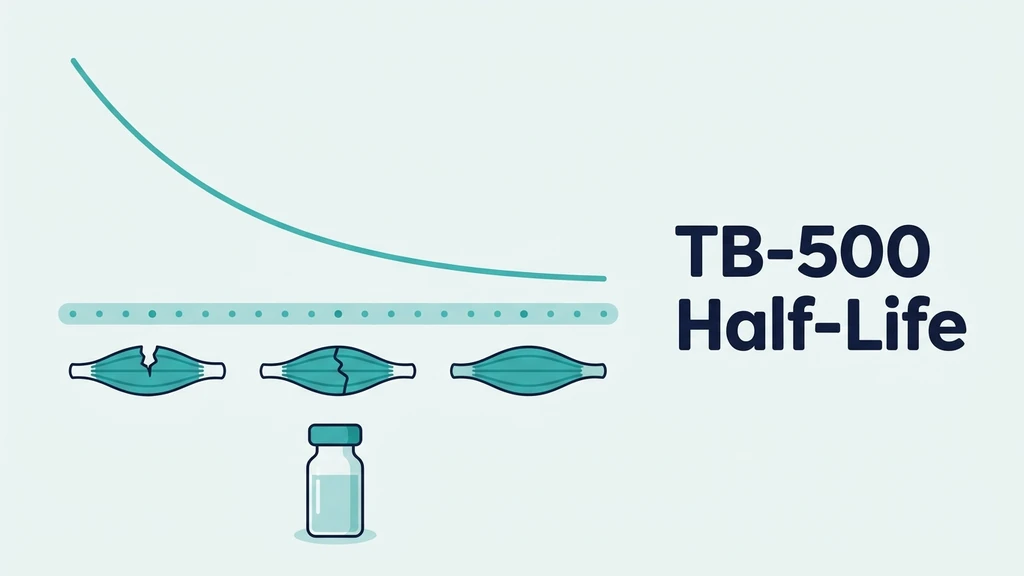
The TB-500 vial went back into the fridge an hour ago and you are already wondering whether anything is left in your blood. Here is the answer: no study has measured the half-life of TB-500 in humans. Its parent protein, thymosin beta-4, clears from blood within minutes to a few hours in mice and in people, with no build-up on once-daily dosing. The repair it starts runs on a slower clock: days for skin, 4 weeks for tendon in rats, up to 3 months for chronic ulcers in patients.
| Question | What the evidence says |
|---|---|
| Measured TB-500 half-life in humans? | None published. TB-500 is a 7-amino-acid fragment; every human PK number belongs to full-length thymosin beta-4 |
| Thymosin beta-4 in blood | Mouse serum rise lasts about 40 minutes; two human IV trials show no accumulation at once daily |
| Metabolites after a dose | Main fragment peaks within 6 hours; one fragment detectable up to 72 hours in rats |
| How long to work | Skin wounds: days. Tendon: 4 weeks in rats. Human chronic ulcers: up to 3 months |
| How long it stays detectable | Anti-doping LC/MS confirms the parent at 0.02 ng/mL in plasma; metabolites extend the window to days |
| Why weekly dosing? | Tissue remodeling moves over weeks. Animal protocols used twice weekly to daily; no human schedule has been tested |
This page covers the clock only. Dose numbers live in the TB-500 dosage chart, the mechanism in what TB-500 does, adverse effects in TB-500 side effects, and the stack math in the BPC-157 and TB-500 dosage guide. If you are asking how long BPC-157 and TB-500 take to work together: the only controlled comparison, a 4-week rat tendon study, found no additive benefit from combining them, so expect the TB-500 timeline below and read the BPC-157 half in how long BPC-157 takes to work. The compound profile is at TB-500.
Get your custom peptide protocol:
- Tailored to your body and goals
- Precise dosing and cycle length
- Safe stacking combinations
- Backed by peer-reviewed studies
- Ready in under 2 minutes
What Is Actually Published About the TB-500 Half-Life
TB-500 is the product name for a seven-residue peptide, Ac-LKKTETQ, copied from positions 17 to 23 of thymosin beta-4, the 43-amino-acid actin-binding protein present in nearly every human cell. The Ghent doping laboratory identified that exact acetylated fragment in a TB-500 vial by high-resolution mass spectrometry (Esposito et al., Drug Test Anal, 2012, PMID 22962027). No study has injected the fragment into a human and drawn a plasma curve.
What exists is pharmacokinetics for the full protein, and it points one way: fast. In mice given 400 micrograms intraperitoneally, serum thymosin beta-4 rose within 2 minutes and stayed elevated for about 40 minutes; 44.6% of the dose was recovered in urine, and the kidney was identified as the organ that pulls the peptide out of circulation (Mora et al., Int J Immunopharmacol, 1997, PMID 9226473).
Two human trials fill in the shape. Forty healthy volunteers received single intravenous doses of 42 to 1,260 mg of synthetic thymosin beta-4, then the same dose daily for 14 days; pharmacokinetics were dose proportional and the half-life increased with dose (Ruff et al., Ann N Y Acad Sci, 2010, PMID 20536472). A first-in-human trial of recombinant thymosin beta-4 at 0.05 to 25 micrograms per kilogram found consistent terminal clearance and no obvious accumulation after 10 once-daily doses (Wang et al., J Cell Mol Med, 2021, PMID 34346165).
No accumulation on a once-daily schedule is itself a half-life statement. A drug stacks only when the next dose arrives before most of the last one has left, and at a 24-hour interval that takes a half-life of many hours. The absence of build-up places thymosin beta-4 well inside a single day, which matches the 40-minute mouse curve.
| Evidence | Species, route, dose | What was measured | What it tells you |
|---|---|---|---|
| Mora 1997 | Mouse, intraperitoneal, 400 mcg | Serum elevated from 2 to 40 minutes; 44.6% in urine | Blood clearance in under an hour, through the kidney |
| Ruff 2010 | Human, IV, 42 to 1,260 mg | Dose-proportional PK; half-life rose with dose | Bigger doses linger longer, still a once-a-day drug |
| Wang 2021 | Human, IV, 0.05 to 25 mcg/kg | No accumulation at once daily | Half-life is a fraction of a day |
| Rahaman 2024 | Rat, urine after TB-500 | Ac-LK dominant from 0 to 6 hours; Ac-LKK detectable to 72 hours | The fragment breaks down fast; pieces linger for days |
TB-500 vs Thymosin Beta-4: Why the Fragment Has Its Own Clock
The two names are used as synonyms on vendor pages, and a 2026 orthopaedic review called that out: TB-500 is a distinct seven-amino-acid fragment that is routinely conflated with full-length thymosin beta-4 despite the absence of any validated biological or clinical equivalence (Tham et al., J Am Acad Orthop Surg, 2026, PMID 42937313). Every human clearance and safety number above belongs to the 43-residue protein. Your vial holds something smaller, and smaller peptides generally leave the blood faster.
The clearest picture of what happens to the fragment comes from a 2024 Korean doping-control study. In human serum, enzyme systems and rat urine, Ac-LK was the primary metabolite and peaked in the 0 to 6 hour window, Ac-LKK remained detectable up to 72 hours, and the metabolite Ac-LKKTE showed significant wound-healing activity in fibroblasts while the parent TB-500 did not (Rahaman et al., J Chromatogr B Analyt Technol Biomed Life Sci, 2024, PMID 38382158). In that assay, a breakdown product was doing the repair work.
The fragment's activity is well documented in animals: the LKKTETQ sequence promoted dermal repair in 26-month-old mice comparable to the full parent molecule (Philp et al., Wound Repair Regen, 2003, PMID 12581423). Activity transfers from protein to fragment. Pharmacokinetics will transfer only once someone measures them.
One more name to keep separate: thymosin alpha-1 is an unrelated 28-amino-acid immune peptide with its own half-life and its own uses. Nothing on this page applies to it.
Why a Short Plasma Half-Life Does Not Mean Short Action
Think of a match and a wood stove. The match burns for ten seconds. The fire it lights heats the room for hours, and nobody keeps striking matches to stay warm. TB-500 is the match. Cell migration, collagen deposition and new blood vessels are the fire.
Literally stated: thymosin beta-4 is the major actin-sequestering molecule in eukaryotic cells, holding the pool of unpolymerized G-actin that cells draw on to move, and that migration of keratinocytes and endothelial cells is the engine of dermal and corneal wound closure (Goldstein et al., Trends Mol Med, 2005, PMID 16099219). Once a cell has committed to migrating or a vessel has started sprouting, the peptide that triggered it is no longer needed to finish the job.
The lag shows up in the wound data. In treated mouse wounds, MMP-2 and MMP-9 expression rose several-fold over control on day 2 after wounding, and the 17 to 23 actin-binding region carried all of that activity (Philp et al., J Cell Physiol, 2006, PMID 16607611). Collagen deposition and contracture were measured at day 8 in diabetic mice. Both readouts sit days past a 40-minute serum window.
Plasma disappearance also partly means arrival. In the mouse biodistribution study, skeletal muscle held 45 micrograms per gram of thymosin beta-4 six hours after injection against zero at baseline, and 37.5% of the dose was sitting in organs when the blood curve had already flattened (Mora et al., Int J Immunopharmacol, 1997, PMID 9226473). The same pattern explains why PT-141 outlasts its 2.7-hour half-life and why MOTS-c effects persist for days after the peptide is gone.
How Long Does TB-500 Take to Work: Timeline by Goal
The honest timeline comes from animals and from topical full-length thymosin beta-4 in patients. No controlled human trial has injected TB-500 for a tendon, a muscle or anything else.
| Goal | Best available evidence | First measurable change | Fair judgment point |
|---|---|---|---|
| Skin wounds | Diabetic mice near-complete coverage at 8 days; human phase 2 ulcers healed almost a month faster in responders | Days | 2 to 4 weeks |
| Tendon | Rat Achilles repair: significantly higher load to failure at 4 weeks on daily TB-500 | Weeks | 6 to 8 weeks |
| Muscle | Dystrophic mice: more regenerating fibers after 6 months, no strength gain | Months, histological only | Do not expect measurable strength |
| Chronic ulcers (human, topical) | Complete healing within 3 months in about 25% of patients | Weeks | 3 months |
Skin moves first. In two phase 2 trials of venous stasis and pressure ulcers, topical thymosin beta-4 accelerated healing by almost a month in the patients who did heal (Treadwell et al., Ann N Y Acad Sci, 2012, PMID 23050815). The venous ulcer arm enrolled 73 patients, found safety comparable to placebo, and reported complete closure within 3 months in about 25% at the 0.03% dose, mostly small to moderate wounds (Guarnera et al., Ann N Y Acad Sci, 2010, PMID 20536470). That is the full protein, on the skin, in wounds that had failed to close for months.
Tendon takes weeks. Thirty-two rats with repaired Achilles tendons received 60 micrograms per kilogram per day of TB-500, 10 micrograms per kilogram per day of BPC-157, both, or nothing for 4 weeks. The TB-500 group had significantly higher maximum load to failure (p under 0.05) and better Bonar scores (p = 0.016), and the combination added nothing over either peptide alone (Biçer et al., Jt Dis Relat Surg, 2026, PMID 42542926). Rat tendon remodels faster than human tendon, so 4 weeks is the floor and 6 to 8 weeks is the earliest sensible point to judge a human tendon.
Muscle is the disappointment. Dystrophin-deficient mice injected with 150 micrograms twice a week for 6 months grew more regenerating fibers and showed no improvement in grip strength, cardiac function or fibrosis (Spurney et al., PLoS One, 2010, PMID 20126456). Half a year of the real protein changed what the muscle looked like under a microscope and nothing the mouse could do with it.
When to call non-response: if 8 weeks of an unbroken schedule produce no change in pain, range of motion or load tolerance, nothing in the literature argues for another 8. Before blaming the biology, question the vial; identity, purity and concentration are the documented weak points of TB-500 sold online (Tham et al., J Am Acad Orthop Surg, 2026, PMID 42937313).
Why Loading Phases Are Dosed Weekly Despite the Short Half-Life
If the peptide is gone in hours, why does every protocol run one or two injections a week for 4 to 6 weeks and then taper, rather than dosing around the clock? Because nobody is trying to hold a blood level. The target is a tissue process that takes weeks, and each injection is a periodic nudge to it.
The animal schedules that produced results sat between twice weekly and daily: two injections per week for 6 months in the dystrophic mice (Spurney et al., PLoS One, 2010, PMID 20126456), one per day for 4 weeks in the rat tendons (Biçer et al., Jt Dis Relat Surg, 2026, PMID 42542926). Nothing in any species supports several injections a day, and no study has compared weekly against twice weekly. The loading-then-maintenance shape is a research-community convention that has never been tested against a flat schedule.
Contrast a long-acting peptide. Cagrilintide carries a 7 to 8 day half-life, so its weekly dose maintains a blood reservoir and a missed week measurably lowers the level. TB-500 has no reservoir. Missing a shot by two days changes nothing about the plasma curve, which was flat by dinner; it changes the count of nudges the tissue received that month. Model any half-life assumption against any schedule in the Peptide Half-Life Tracker and watch the curve return to zero between doses.
How Long Does TB-500 Stay in Your System: Washout and Detectability
Washout runs on three clocks: the parent peptide in blood, its metabolites in urine, and the tissue changes it set in motion.
| Clock | Basis | Expected duration |
|---|---|---|
| Parent peptide in blood | Mouse serum elevated 2 to 40 minutes; no human accumulation at once daily | Hours |
| Five half-lives, 1-hour assumption | Arithmetic | About 5 hours |
| Five half-lives, 4-hour assumption | Arithmetic | About 20 hours |
| Metabolite Ac-LKK | Rat urine | Detectable up to 72 hours |
| Tissue effects | Collagen, new vessels | Weeks, fading with normal turnover |
Five half-lives clear about 97% of any compound. Under the longest plausible half-life for a seven-residue peptide, the parent is gone from blood within a day; under the mouse number, within the afternoon. The urine clock is longer: in rats, one fragment of TB-500 was still detectable 3 days after dosing (Rahaman et al., J Chromatogr B Analyt Technol Biomed Life Sci, 2024, PMID 38382158).
Detectability is where TB-500 differs from a peptide your body also makes. Thymosin beta-4 is endogenous, so a lab cannot flag the full protein by sequence alone. The acetylated fragment is synthetic, and that is exactly what anti-doping laboratories look for. The Hong Kong Jockey Club laboratory confirmed Ac-LKKTETQ at 0.02 ng/mL in equine plasma and 0.01 ng/mL in equine urine, and found the parent and its metabolites in horses after a single 10 mg dose (Ho et al., J Chromatogr A, 2012, PMID 23084823).
No human detection window has been published. The rat data say at least 3 days for metabolites, and assay sensitivity in the hundredths of a nanogram makes a positive realistic well after the parent is gone. Workplace panels screen for drug classes, never for peptides; the same holds for GHK-Cu and the other short peptides in this cluster.
Quantified Risks: What the Short Half-Life Does and Does Not Protect You From
A peptide that clears in hours cannot accumulate, and that removes one class of risk. It removes nothing else.
The safety numbers that exist belong to the full protein, intravenously, at pharmaceutical purity: 40 volunteers at 42 to 1,260 mg daily for 14 days with infrequent, mild to moderate adverse events and no serious adverse events (Ruff et al., Ann N Y Acad Sci, 2010, PMID 20536472), and 84 volunteers at up to 25 micrograms per kilogram with no dose-limiting toxicity (Wang et al., J Cell Mol Med, 2021, PMID 34346165). Zero volunteers in any trial have taken the seven-residue fragment subcutaneously from a research vial. TB-500 is not FDA-approved for any use and has no validated orthopaedic protocol (Tham et al., J Am Acad Orthop Surg, 2026, PMID 42937313).
The mechanism carries its own open question. Thymosin beta-4 stimulates angiogenesis and cell migration (Guarnera et al., Ann N Y Acad Sci, 2010, PMID 20536470); whether that signal matters for someone carrying an undiagnosed tumor has not been tested in humans, and a short half-life says nothing about it, because the signal outlasts the peptide.
Scenario 1, dosing to a blood level. You read that TB-500 lasts 2 hours and move from twice weekly to daily to "keep it active." Weekly peptide load rises 3.5-fold, and the only long twice-weekly study found no functional gain after 6 months. Fix: pick one schedule, hold it 8 weeks, judge once.
Scenario 2, the clean-sample assumption. You stop 24 hours before a sport test. Plasma is empty, but rat urine carried Ac-LKK for 72 hours, the equine assay confirms the parent at 0.01 ng/mL, and no human window has been published. Fix: in a tested population, treat TB-500 as detectable for an unknown number of days and do not use it.
Scenario 3, quitting on day 5. Nothing hurts less, so you conclude the vial is dead. Tendon strength in rats took 4 weeks and human ulcers took up to 3 months. Fix: the earliest honest verdict for a tendon is 6 weeks.
Common Half-Life Mistakes
Quoting a vendor half-life as if it were measured. The 2 to 3 hour figure is an extrapolation from full-length thymosin beta-4 in mice and humans. Fix: say "unmeasured, likely hours" and plan around tissue timelines.
Confusing vial shelf life with body half-life. A reconstituted vial that lasts 28 days in the fridge says nothing about how long a dose lasts in you. See how long reconstituted peptides last and how to reconstitute a peptide for the storage clock.
Switching peptides at week 2. Two weeks of TB-500 with no change is inside the window where the rat tendon data had not yet moved, and jumping to BPC-157 restarts the clock. Fix: finish 6 to 8 weeks first; the BPC-157 vs TB-500 comparison covers when each makes more sense.
Frequently Asked Questions
What is the half-life of TB-500?
Unmeasured in humans. TB-500 is a 7-amino-acid fragment of thymosin beta-4, and every pharmacokinetic study used the full 43-residue protein: mouse serum stayed elevated for about 40 minutes (PMID 9226473), and two human IV trials showed no accumulation on once-daily dosing (PMID 20536472, PMID 34346165). Hours is the honest estimate. The TB-500 profile covers the compound.
How long does TB-500 take to work?
Days for skin, weeks for tendon, and muscle may never show a functional change. Diabetic mice reached near-complete wound coverage at 8 days (PMID 12581423); rats on daily TB-500 showed significantly stronger Achilles repair at 4 weeks (PMID 42542926); dystrophic mice gained no strength after 6 months (PMID 20126456). Judge a tendon at 6 to 8 weeks, as the BPC-157 vs TB-500 comparison explains.
How long does TB-500 stay in your system?
The parent peptide leaves blood within hours: five half-lives at a 4-hour assumption is 20 hours, and the mouse data suggest far less. Metabolites last longer; in rats, the fragment Ac-LKK was detectable in urine up to 72 hours after dosing (PMID 38382158). Tissue effects fade over weeks. Model the plasma curve in the Peptide Half-Life Tracker.
Is TB-500 the same as thymosin beta-4?
No. Thymosin beta-4 is a 43-amino-acid protein your cells make; TB-500 is a synthetic, N-terminally acetylated copy of its residues 17 to 23 (PMID 22962027). A 2026 orthopaedic review stressed that the two are conflated without any validated equivalence (PMID 42937313). Thymosin alpha-1 is a third, unrelated peptide; see the thymosin alpha-1 profile.
Why does TB-500 keep working after it leaves the blood?
Because it starts processes that run on the cell schedule. Thymosin beta-4 sequesters G-actin and drives keratinocyte and endothelial migration (PMID 16099219), and treated wounds showed several-fold higher MMP-2 and MMP-9 expression at day 2 (PMID 16607611), long after a 40-minute serum window. The same logic governs how long PT-141 lasts.
Should I inject TB-500 every day because the half-life is short?
No study supports more than once daily in any species, and none has compared daily against twice weekly. Rats improved on one injection a day for 4 weeks (PMID 42542926); mice on two per week for 6 months grew regenerating fibers without strength gains (PMID 20126456). Pick one schedule and hold it. Stack frequency questions are in the GHK-Cu, BPC-157 and TB-500 blend guide.
Can a drug test detect TB-500?
Workplace panels do not test for peptides. Anti-doping laboratories do: the Hong Kong racing laboratory confirms the acetylated fragment at 0.02 ng/mL in plasma and 0.01 ng/mL in urine and traced it and its metabolites after a single 10 mg dose in horses (PMID 23084823). No human detection window is published; rat metabolites lasted 72 hours. MOTS-c faces the same assay problem.
The Bottom Line
The TB-500 half-life has never been measured in a human. Its parent protein, thymosin beta-4, clears from blood in minutes to a few hours and does not accumulate on daily dosing, and the fragment's metabolites linger in urine for about 3 days in rats. The repair those molecules trigger runs on a clock of weeks: 8 days for mouse wounds, 4 weeks for rat tendon, up to 3 months for human chronic ulcers.
The principle: the plasma curve tells you when the peptide left, and the tissue tells you when the effect ends. Plan frequency around the second clock, judge a tendon no earlier than 6 weeks, and treat blood-level logic for a peptide this short as noise.
TB-500 is a research compound with no FDA approval for any use, and every human safety number belongs to the full protein. Model your own assumptions in the Peptide Half-Life Tracker, convert a planned dose to syringe units in the TB-500 dosage calculator, and find the rest of the TB-500 cluster at PeptidesExplorer. Educational content, not medical advice.
Helpful Tools
Related Articles
Cagrilintide Half-Life: How Long It Stays in Your System
Cagrilintide half-life is 7 to 8 days (phase 1b data). Steady state in 4 to 5 weeks, 5-week washout, why it matches semaglutide, missed-dose and nausea math.
MOTS-c Half-Life: How Long It Stays in Your System
MOTS-c half-life: no human PK study exists. Exercise-raised plasma MOTS-c clears within 4 hours, yet gene effects last days. Washout, detectability, drug tests.
How Long Does Retatrutide Stay in Your System?
Retatrutide stays in your system about 30 days after the last dose (6-day half-life): 45% left at day 7, 3% at day 30. Washout table, switching and surgery.
Selank Half-Life: How Long It Lasts and Stays in Your System
Selank half-life is about 2 minutes in rodent blood, yet the effect lasts hours. Nasal vs subq kick-in, how long it stays in your system, dosing frequency.