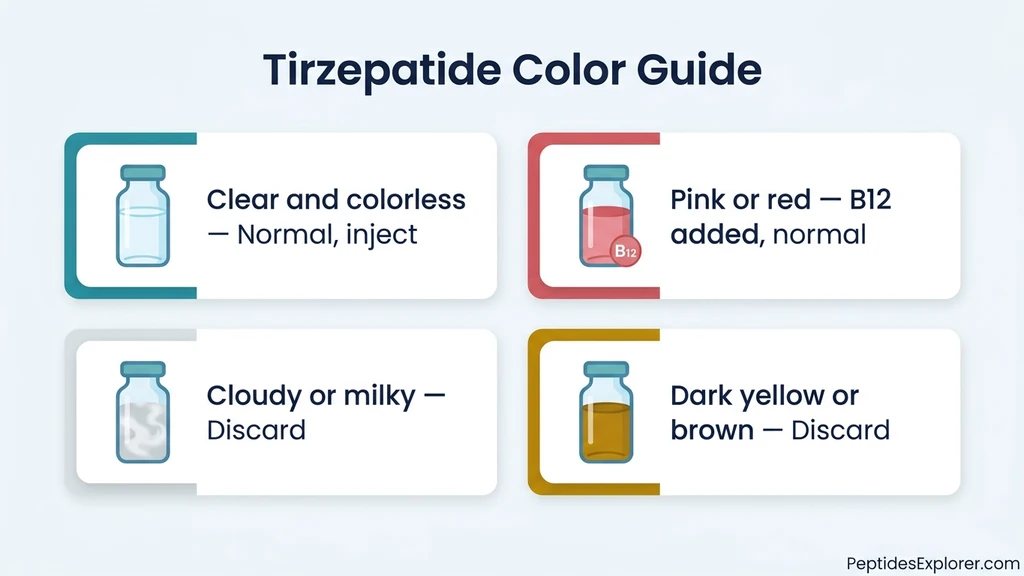
You just reconstituted your tirzepatide and the solution is not what you expected. Maybe it is bright red. Maybe it is cloudy. Maybe it has a faint yellow tint that makes you second-guess the whole vial. Properly reconstituted tirzepatide is clear and colorless, or at most a very faint straw tint. Brand Mounjaro and Zepbound pens are always clear and colorless. Compounded tirzepatide mixed with plain bacteriostatic water is clear and colorless. Compounded tirzepatide with added B12 is pink or red because B12 (cyanocobalamin) is inherently red. Cloudy, dark yellow, brown, or visibly particulate tirzepatide should be discarded. The color in your vial tells you three things at a glance: what you bought, how well it was reconstituted, and whether it is still safe to inject.
| Appearance | What It Means | Action |
|---|---|---|
| Clear, colorless (water-like) | Brand pen OR compounded + BAC water | Normal. Inject |
| Very faint straw-yellow | Edge of normal for compounded | Usually fine. Inject |
| Pink or red | Compounded with B12 added | Normal for T+B12. Inject |
| Cloudy or milky | Protein denaturation, over-agitation, or contamination | Discard |
| Crystals on bottom | Cold-storage precipitation | Warm gently; if crystals dissolve, OK; if not, discard |
| Dark yellow or amber | Oxidation or heat damage | Discard |
| Brown | Advanced degradation | Discard |
| Particles or fibers floating | Contamination | Discard |
Color is a safety check, not a potency test. A perfectly clear vial can still be underdosed, and a slightly yellow vial from a reputable compounder can still be fully potent. But color is the fastest no-equipment signal you have that something is wrong. This guide walks through every color you might see, what is behind it, and when to throw the vial out. For the reconstitution steps that produce the correct color in the first place, see how to reconstitute tirzepatide and the peptide reconstitution calculator.
This is educational content. Consult a licensed healthcare provider before using any peptide, and do not inject any solution you are unsure about.
Get your custom peptide protocol:
- Tailored to your body and goals
- Precise dosing and cycle length
- Safe stacking combinations
- Backed by peer-reviewed studies
- Ready in under 2 minutes
What Properly Reconstituted Tirzepatide Should Look Like
Tirzepatide is a 39-amino-acid synthetic peptide with two non-coded α-aminoisobutyric acid residues at positions 2 and 13, and a C20 fatty diacid moiety acylated to lysine at position 20 through a γGlu-2×OEG linker. This acylation enables albumin binding for the once-weekly dosing schedule (Bastin & Andreassen, 2023). In its stable, correctly dissolved state it produces a clear solution. "Clear" is the word the USP uses for pharmaceutical peptide solutions: you should be able to read printed text through the vial without distortion, and there should be no haze when you hold it up to a light.
Brand-name Mounjaro and Zepbound (manufactured by Eli Lilly) are pre-mixed and sealed in a pen. You do not reconstitute them. The pen contains a clear, colorless solution buffered at pH 7.0 with sodium chloride, sodium phosphate, and metacresol as a preservative. If you unbox a Mounjaro or Zepbound pen and the solution looks anything other than water-clear, call the pharmacy. This is rare but it does happen with pens exposed to freezing temperatures during shipping.
Compounded tirzepatide comes as a lyophilized (freeze-dried) powder that you reconstitute yourself with bacteriostatic water. The correct appearance after reconstitution: - Immediately after mixing (before swirling): a white film or disc of powder sitting at the bottom or on the wall of the vial, with water above it - After gentle swirling for 30 to 60 seconds: a clear, colorless solution with no visible powder - After 5 minutes sitting: still clear and colorless, no precipitate on the bottom
A faint straw-yellow tint at the very edge of perception is acceptable in some compounded batches, particularly those with small amounts of sodium phosphate buffer. If the tint is strong enough that you would describe the solution as "yellow" at a glance, treat it as a problem (discussed below). For the step-by-step method that produces the correct color, see how to reconstitute tirzepatide.
Never shake the vial. Shaking introduces air, denatures the peptide, and can produce permanent cloudiness even in a product that was fine seconds before. Swirl gently in a circular motion or roll the vial between your palms. If you see foam, stop and let it settle for 10 minutes before assessing color.
Why Some Tirzepatide Is Red or Pink (It's the B12)
If your compounded tirzepatide is pink, rose, red, or even magenta, the most likely explanation is that a B12 vitamin was added to the formulation. This is intentional and normal for many compounding pharmacies.
Cyanocobalamin (vitamin B12) is inherently red. The cobalt atom at the center of the corrin ring absorbs green light and transmits red, giving pure cyanocobalamin solutions a striking cherry-red color even at low concentrations. A 1 mg/mL cyanocobalamin solution is dark red; diluted into a tirzepatide vial it produces everything from pale pink to full red depending on the ratio. Cyanocobalamin is also light-sensitive: 950 µg/mL solutions exposed to sunlight for 2 hours lose 14.7-21.0% of activity, and lower concentrations (95 µg/mL) lose 56.3-81.5%, with light intensity being the rate-limiting factor (Ahmad et al., 2014). This is why B12-containing compounded vials should be stored protected from light.
Why compounders add B12: - Marketed as a nausea-reduction adjunct (though clinical evidence is weak) - Thought to support energy levels during caloric restriction (limited evidence) - Some pharmacies also add niacinamide, which is clear, to blunt flushing - It serves as a visual marker that differentiates the compounded product from brand pens
Is red tirzepatide safe? The tirzepatide itself is unchanged by B12 addition. B12 is water-soluble, has a very wide safety margin, and is routinely injected in doses far higher than those used in weight-loss compounds. The main risk is inaccurate dosing: if your compounding pharmacy added B12 without telling you, the concentration ratio on the label still refers to tirzepatide only, so your draw volume does not change. If you see red solution and you did not expect it, call the pharmacy and confirm before injecting.
If your label says "tirzepatide + B12" and the solution is clear instead of red: that is a problem. Either the B12 was omitted or the product is degraded. Do not assume it is fine.
For a deeper look at this combination, see tirzepatide with B12 and the parallel what color is tirzepatide with B12 reference. A similar dynamic exists with semaglutide; see why is my semaglutide red.
Cloudy Tirzepatide: What Went Wrong
Cloudy tirzepatide is never normal. A milky, hazy, or opalescent solution means the peptide structure has been disrupted and proteins have aggregated into particles large enough to scatter light. Cloudy solutions should be discarded and not injected.
The three most common causes of cloudy tirzepatide:
1. Over-agitation or shaking. Tirzepatide is sensitive to mechanical stress. Vigorous shaking creates shear forces that unfold the peptide and expose hydrophobic residues, which then clump together. This is the single most common mistake beginners make. Always swirl, never shake.
2. Temperature shock. Reconstituting with cold bacteriostatic water straight from the fridge, or freezing a reconstituted vial, can cause irreversible aggregation. Bacteriostatic water should be at room temperature when added to the powder. Reconstituted tirzepatide should be kept refrigerated (2 to 8 degrees C / 36 to 46 degrees F) but never frozen. See how long does tirzepatide last in the fridge for storage windows.
3. Contamination. Bacterial or fungal growth in a vial that was not stored properly, or in which the rubber stopper was punctured too many times, produces cloudiness. This is the worst-case scenario: injecting a contaminated solution can cause infection at the site or systemic illness. If you see cloudy solution in a vial that has been open for more than a week or that was not refrigerated, assume contamination.
Less common but still possible: - Using sterile water instead of bacteriostatic water (no preservative, bacterial growth possible). The two are not interchangeable; see bacteriostatic water vs sterile water. - Using wrong diluent (bacteriostatic saline, injectable saline without preservative, or a buffer the compound is not formulated for) - Underlying product defect (rare from reputable compounders, more common with unregulated sources)
What to do with cloudy tirzepatide: discard the vial. Do not try to filter, warm, or re-swirl it. The peptide is denatured; no technique restores it. Contact your pharmacy for replacement if the vial came to you cloudy or became cloudy within the labeled stability window. For broader safety context on compounded versions, see is compound tirzepatide safe.
Crystallized Tirzepatide: Sometimes Salvageable
Crystals or visible solid flakes on the bottom of a previously-clear vial indicate that something has precipitated out of solution. This is distinct from cloudiness: cloudy is diffuse haze, crystallized is discrete particles. The cause and outcome are different.
The most common cause is cold-induced precipitation. Tirzepatide and its buffer salts have reduced solubility at low temperatures. If a reconstituted vial spent time below freezing, or was kept at the back of a fridge near the cold plate, some components can crystallize out.
How to assess: 1. Take the vial out of the fridge and let it sit at room temperature (20 to 25 degrees C) for 30 to 60 minutes 2. Gently swirl every 10 minutes (do not shake) 3. After 60 minutes, check whether the crystals have redissolved
If the crystals dissolve and the solution returns to clear: the product is most likely still usable, though potency may be reduced by a small amount. One-time cold exposure rarely destroys the full dose, but repeated freeze-thaw cycles degrade tirzepatide significantly. Use the vial and replace it on your next order.
If the crystals remain after 60 minutes at room temperature: discard the vial. Persistent precipitation indicates more than a temperature fluctuation, typically a diluent incompatibility or advanced degradation.
Prevention: - Store reconstituted tirzepatide in the main body of the fridge, not the door (temperature swings) and not near the cooling element (freeze zone) - Target 36 to 46 degrees F (2 to 8 degrees C) - Never put the vial in the freezer "just to keep it cold while I travel". Freezing destroys it - If you travel with tirzepatide, use a medication cooler with gel packs kept above freezing
Crystallization is the one color-related problem that is sometimes reversible. Everything else on this list is one-way damage. See does tirzepatide expire for the combined impact of time and temperature on potency.
Dark Yellow, Amber, or Brown: Discard
A clearly yellow, amber, or brown tirzepatide solution indicates oxidative damage or thermal degradation. These colors mean the peptide has broken down and the vial should not be used regardless of how it got that way.
What causes it: - Prolonged heat exposure. Tirzepatide is labeled for refrigerated storage after reconstitution. Sitting at room temperature for days, or in a warm car, drives oxidation of the methionine residue and other sensitive positions in the molecule. - Light exposure. UV and visible light accelerate peptide oxidation. Reconstituted vials should be stored in their original opaque packaging or in a dark corner of the fridge. - Rubber stopper interaction. Some compounded vials use stoppers that leach minute amounts of plasticizer over time. Combined with heat, this produces yellowing. This is more common in vials older than 60 days. - Contamination with dissolved iron or copper. Trace metals catalyze peptide oxidation. This is rare but happens with certain diluent batches.
The specific chemistry: the fatty-acid side chain and aromatic residues in tirzepatide oxidize to form chromophores (colored breakdown products) that absorb blue light. The more advanced the degradation, the darker the color, progressing from pale yellow to amber to brown.
Why you discard rather than inject reduced-potency product: - Degraded tirzepatide has unknown activity. It might be 80% potent, 50% potent, or produce off-target effects from degradation products. - Oxidation products can be immunogenic, potentially increasing the risk of injection-site reactions or antibody formation that reduces future doses' effectiveness. - You lose the ability to titrate accurately. If the vial in your hand is 60% potent, your 7.5 mg dose is really 4.5 mg, and next week's 10 mg might be 4 mg if the degradation is progressing.
The quick test: compare the suspect vial to a fresh one from the same pharmacy. If the side-by-side color difference is obvious under white light (smartphone flashlight works), discard the darker vial. For storage guidance that prevents this, see how to store peptides and how long does tirzepatide last in the fridge.
Particles, Fibers, and Floaters: Contamination Signals
Even in a clear, properly colored solution, visible particulates are a discard signal. Pharmaceutical-grade peptide solutions are filtered to remove anything larger than 0.22 microns; anything you can see with the naked eye is 50 to 100 times that size and should not be present.
Types of particulates and what they suggest: - Black or dark specks: rubber stopper fragments from repeated needle punctures (coring). Common in vials used for many draws. The solution is not necessarily contaminated, but the specks themselves should not be injected. - White flakes or clumps: incomplete dissolution or protein aggregation. Try gentle swirling at room temperature. If they remain, discard. - Translucent fibers: airborne contamination (dust, clothing fibers, hair). Contaminated; discard. - Cloudy halos around the needle track: early bacterial growth concentrated near where the needle entered. Discard immediately. - Iridescent sheen on the surface: film of contamination or precipitated lipid components. Discard.
Coring prevention: every time you push a needle through the stopper, you risk dislodging a small piece of rubber into the vial. Use 27 to 30 gauge needles (smaller cores), insert at a 45 to 60 degree angle with the bevel up, and avoid using the same puncture point twice. If you draw from the vial more than 10 to 15 times, consider the vial used up and discard any remainder.
The simple rule: if you can see it floating, do not inject it. The cost of a replacement vial is a fraction of the cost of an injection-site infection or allergic reaction to contamination.
For guidance on how the needle size and technique affect coring and longevity, see how to inject peptides.
Color Differences Between Brands and Compounders
Not every clear tirzepatide looks identical. Subtle differences are normal between manufacturers and batches, and they do not indicate a problem by themselves.
Brand Mounjaro and Zepbound (Eli Lilly): water-clear, colorless, no visible tint. The formulation is tightly controlled and consistent across batches. Any visible color in these pens is abnormal.
Major compounded tirzepatide (505B facilities, high-volume compounders): typically water-clear or with a barely-perceptible straw tint. Buffer composition (sodium phosphate, sodium chloride, metacresol in some products) can produce slight variation in tint between batches.
Compounded tirzepatide + B12: ranges from pale pink (low B12 dose, roughly 0.05 to 0.1 mg/mL) to bright red (higher B12, 0.5 mg/mL or more). The color intensity is a rough indicator of B12 content but not a precise measurement.
Compounded tirzepatide + niacinamide: clear or very faintly yellow. Niacinamide is colorless in solution at the concentrations used.
Compounded tirzepatide + glycine or arginine buffers: water-clear, sometimes with a very slight yellow tint from the amino acid itself.
What to do with batch-to-batch variation: accept small differences between vials from the same compounder, but investigate large changes. If vial 3 is noticeably darker or cloudier than vials 1 and 2 from the same order, contact the pharmacy. If you switch pharmacies, expect the color to shift; this is buffer composition, not a quality signal.
For how tirzepatide compares to semaglutide in color and reconstitution, see the semaglutide mixing chart. The two peptides behave similarly but semaglutide is less prone to the faint yellow tint because its formulation is simpler.
The 30-Second Color Check Before Every Injection
Get in the habit of a quick visual check before you draw every dose. It takes 30 seconds and catches the problems that actually put you at risk.
The checklist: 1. Hold the vial up to a white background (printer paper, white wall, smartphone flashlight on white wall). Look for color relative to the expected color. 2. Invert the vial gently (do not shake). Watch for particles falling or rising. Any visible movement of solids is a discard signal. 3. Check the rubber stopper for puncture damage, visible tears, or discoloration around the puncture site. 4. Compare to your last dose if you remember the color. Sudden change over a week usually means temperature or light exposure. 5. Check the expiration date on the vial. Compounded tirzepatide typically has a 28 to 60 day stability window after reconstitution; most pharmacies label 30 days. See does tirzepatide expire for the detailed breakdown.
If any of these five items raises a concern, do not inject. Take a photo of the vial in good lighting, note the lot number and date, and contact the pharmacy. Reputable compounders will replace a defective vial at no cost.
Documentation for pharmacy disputes: - Photograph under consistent lighting conditions - Note the reconstitution date, the storage location, and any recent temperature exposures (travel, power outage) - Save the outer packaging and the lot number label
This habit also helps you catch the slow drift that leads to the "it looked fine last week but now it looks off" moment. Consistent observation gives you a baseline. Without a baseline, every vial looks normal until it does not.
Frequently Asked Questions
What color is tirzepatide supposed to be?
Properly reconstituted tirzepatide is clear and colorless, like water. Brand Mounjaro and Zepbound pens are always clear and colorless. Compounded tirzepatide mixed with plain bacteriostatic water should also be clear and colorless, though a very faint straw tint is acceptable in some batches. Any color stronger than a barely-perceptible yellow is a reason to investigate. For the mixing steps that produce the correct appearance, see how to reconstitute tirzepatide.
Is clear or yellow tirzepatide normal?
Clear is always normal and expected. A very faint straw-yellow tint at the edge of perception is acceptable in compounded tirzepatide with certain buffer systems. A clearly yellow, amber, or darker solution is not normal and indicates oxidation or thermal degradation. Compare the suspect vial to a fresh one under white light; if the difference is obvious, discard the darker vial. See how long does tirzepatide last in the fridge for storage windows that prevent yellowing.
Why is my tirzepatide pink or red?
Pink or red tirzepatide almost always means your compounder added vitamin B12 (cyanocobalamin) to the formulation. B12 is inherently red because of the cobalt atom at the center of its molecular ring. The tirzepatide itself is unchanged and the combination is safe, but your label should say 'tirzepatide + B12' or similar. If the pharmacy did not mention B12 and your vial is red, call them to confirm before injecting. See tirzepatide with B12 for the full combination guide.
Is cloudy tirzepatide safe to inject?
No. Cloudy tirzepatide is never safe to inject. Cloudiness indicates protein denaturation (from shaking or temperature shock), precipitation, or bacterial contamination. All three are grounds to discard the vial. No technique restores cloudy tirzepatide to usable condition. Contact your pharmacy for a replacement if the vial came cloudy or became cloudy within the labeled stability window. For more on what makes compounded products safe or not, see is compound tirzepatide safe.
Can I still use tirzepatide if it has crystals on the bottom?
Sometimes. Crystals usually indicate cold-induced precipitation. Let the vial sit at room temperature (20 to 25 degrees C) for 30 to 60 minutes with occasional gentle swirling. If the crystals dissolve and the solution returns to clear, the product is typically still usable, though potency may be slightly reduced. If the crystals remain after an hour at room temperature, discard the vial. Never put tirzepatide in the freezer; use a medication cooler above freezing when traveling. See how long does tirzepatide last in the fridge for storage details.
Why did my tirzepatide turn yellow after a few weeks?
Progressive yellowing in a vial that started clear indicates ongoing oxidative damage, usually from light exposure, heat, or simply age beyond the stability window. Tirzepatide's aromatic residues and fatty-acid side chain oxidize to form colored breakdown products. Once the color is visible, potency is reduced by an unpredictable amount and degradation products can be immunogenic. Discard darkened vials. Prevention: store reconstituted vials in the main fridge body (not door, not near the freezer plate) and in opaque packaging. See does tirzepatide expire for the stability timeline.
Do I need to worry about small black specks in my tirzepatide vial?
Usually yes. Black specks are most often rubber stopper fragments from repeated needle punctures (a phenomenon called coring). The tirzepatide solution itself may be fine, but injecting rubber particles is not. Draw from a different, cleaner area of the stopper, or transfer to a new vial if you have many doses remaining. To reduce future coring, use 27 to 30 gauge needles, insert bevel up at a 45 to 60 degree angle, and rotate your puncture site. For technique, see how to inject peptides.
Does the color of tirzepatide tell me how potent it is?
Only indirectly. A clear vial does not prove full potency, and a slightly off-color vial from a reputable compounder might still be fully potent. But color is the fastest no-equipment signal you have that something is wrong. Clear and colorless: expected; most likely full potency. Pink or red with B12 label: expected; tirzepatide potency unchanged. Cloudy, dark yellow, amber, brown, or with visible particles: degraded or contaminated; discard. The peptide reconstitution calculator helps you calculate dose volume for a properly-prepared vial, but it cannot assess potency of a questionable one.
The Bottom Line
Tirzepatide color is a safety check, not a potency measurement. Properly reconstituted tirzepatide is clear and colorless, or at most a very faint straw tint in some compounded batches. Brand-name Mounjaro and Zepbound pens are always water-clear. Compounded tirzepatide with B12 is pink or red because the B12 itself is red. Anything cloudy, dark yellow, amber, brown, or with visible particles or fibers should be discarded regardless of how it got that way.
The four problems worth memorizing: cloudy means denatured or contaminated, yellow to brown means oxidized, crystals mean temperature exposure (sometimes reversible), and particles mean contamination or coring. All are discard signals except early-stage crystallization that resolves with gentle warming. Do not try to filter, heat, or re-mix a vial that looks wrong; the peptide chemistry is not recoverable once major damage has occurred.
Build a 30-second color check into your routine. Hold every vial up to a white background before every dose. Compare to your last dose. Investigate any sudden change. This habit catches the slow drift that otherwise leads to injecting degraded product for a week before you notice. For the reconstitution technique that produces the correct color, the storage rules that preserve it, and the pharmacy diligence that keeps contamination out, see the full reconstitution and storage chain: how to reconstitute tirzepatide, bacteriostatic water vs sterile water, how long does tirzepatide last in the fridge, and does tirzepatide expire.
Related Articles: - How to Reconstitute Tirzepatide - Why Is My Semaglutide Red - Is Compound Tirzepatide Safe - Does Tirzepatide Expire
Related Articles
Does Tirzepatide Help With Inflammation?
Does tirzepatide help with inflammation? Yes: CRP drops 32.9%, IL-6 drops 17.8% in trials. SURMOUNT data and adipose tissue mechanisms.
Does Compounded Tirzepatide Work? Real Data
Does compounded tirzepatide work? Review SURMOUNT data, salt form differences (base, acetate, sodium), potency gaps, and FDA status in 2026.
Does Oral Tirzepatide Work? The Facts
Oral tirzepatide is not FDA-approved. Why peptide pills face absorption barriers, sublingual drops vs injections, and oral GLP-1 alternatives in 2026.
Tirzepatide and Wellbutrin: Safety Guide
Tirzepatide and Wellbutrin (bupropion): no direct PK interaction, but watch seizure threshold, appetite stacking, and mood. Full safety guide.