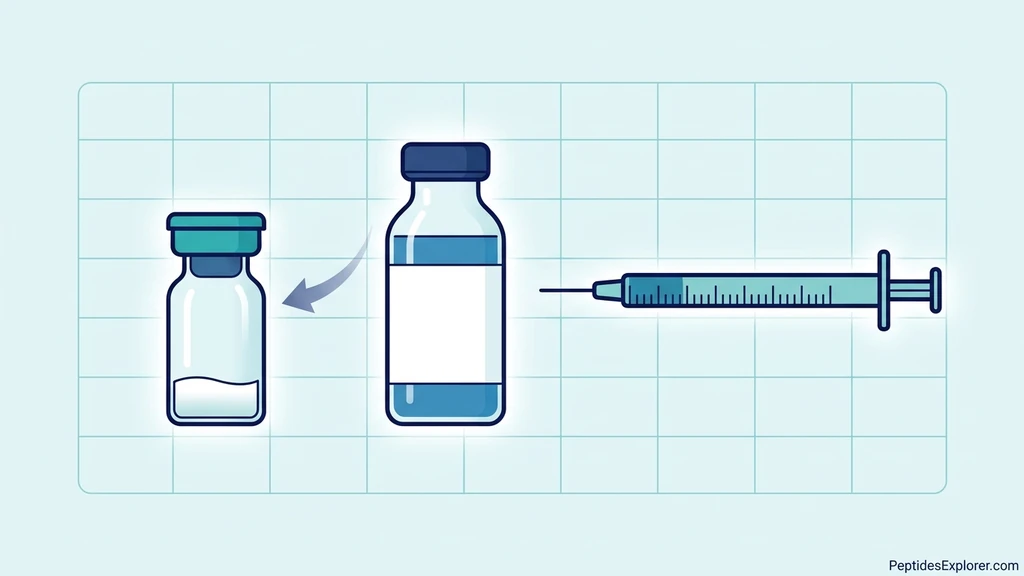
A 10 mg vial of white powder, a bottle of bacteriostatic water, and a syringe marked in units instead of milligrams. Here is the whole chart in one sentence: concentration equals vial milligrams divided by water millilitres, and the units to draw on a U-100 syringe equal your dose in mg divided by that concentration, times 100. A 10 mg vial mixed with 2 mL gives 5 mg/mL, so 2 mg is 40 units and 4 mg is 80 units.
| Vial | Bac water | Concentration | 1 mg | 2 mg | 4 mg | 8 mg |
|---|---|---|---|---|---|---|
| 5 mg | 1 mL | 5 mg/mL | 20 units | 40 units | 80 units | 160 units (two draws) |
| 10 mg | 2 mL | 5 mg/mL | 20 units | 40 units | 80 units | 160 units (two draws) |
| 10 mg | 1 mL | 10 mg/mL | 10 units | 20 units | 40 units | 80 units |
| 20 mg | 2 mL | 10 mg/mL | 10 units | 20 units | 40 units | 80 units |
| 20 mg | 1 mL | 20 mg/mL | 5 units | 10 units | 20 units | 40 units |
| 30 mg | 2 mL | 15 mg/mL | 6.7 units | 13.3 units | 26.7 units | 53.3 units |
| 30 mg | 3 mL | 10 mg/mL | 10 units | 20 units | 40 units | 80 units |
This page is the chart and the arithmetic behind it. The mixing procedure itself, swab to stopper, is in how to reconstitute retatrutide. Which dose to start at and when to step up belongs to the retatrutide dosage guide. How long the mixed vial keeps is covered in how long reconstituted peptides last, and the water question is settled in bacteriostatic water vs sterile water. Retatrutide is an investigational compound with no FDA approval; the doses in these tables are the ones its trials tested, not a prescription.
Get your custom peptide protocol:
- Tailored to your body and goals
- Precise dosing and cycle length
- Safe stacking combinations
- Backed by peer-reviewed studies
- Ready in under 2 minutes
The Reconstitution Chart: Vial Size × Water Volume = Concentration
Picture a 10 g sugar packet. Stir it into an espresso cup and every spoonful is sweet. Stir the same packet into a jug and each spoonful carries a fraction of the sugar. The packet never changed; the water did.
Literally: the milligrams of retatrutide in the vial are fixed at the factory. The water you add decides how many of those milligrams ride in each millilitre, and that number is the concentration.
Concentration (mg/mL) = peptide in the vial (mg) ÷ bacteriostatic water added (mL). Example: 10 mg ÷ 2 mL = 5 mg/mL. The lyophilized powder itself adds no measurable volume, so the water volume is the solution volume.
| Vial size | 1 mL water | 2 mL water | 3 mL water |
|---|---|---|---|
| 5 mg | 5 mg/mL | 2.5 mg/mL | 1.67 mg/mL |
| 10 mg | 10 mg/mL | 5 mg/mL | 3.33 mg/mL |
| 15 mg | 15 mg/mL | 7.5 mg/mL | 5 mg/mL |
| 20 mg | 20 mg/mL | 10 mg/mL | 6.67 mg/mL |
| 30 mg | 30 mg/mL | 15 mg/mL | 10 mg/mL |
Two cells need a caveat. 1.67 and 3.33 and 6.67 are rounded from repeating decimals; the rounding error is under 0.2%, far below what any syringe can resolve. And a standard 2 mL peptide vial will not take 3 mL of water with room to swirl; the 3 mL column assumes a 3 mL or larger vial.
The same formula drives every other weekly incretin, which is why the tirzepatide reconstitution guide reads almost identically. Only the vial sizes and the doses change. If you prefer the machine to do the division, the peptide reconstitution calculator accepts any vial and any volume.
The Units Chart: Research Doses on a U-100 Insulin Syringe
U-100 means 100 units per millilitre. One unit is 0.01 mL, ten units are 0.1 mL, and the full 1 mL barrel is 100 units. The syringe does not know what is inside it; the number printed on the barrel is a volume with a different name.
Units to draw = (dose in mg ÷ concentration in mg/mL) × 100. Example: 4 mg at 10 mg/mL is 0.4 mL, and 0.4 mL × 100 is 40 units. Run it once by hand before you trust any chart, including this one.
| Target dose | 2.5 mg/mL | 5 mg/mL | 10 mg/mL | 15 mg/mL | 20 mg/mL |
|---|---|---|---|---|---|
| 0.5 mg | 20 units | 10 units | 5 units | 3.3 units | 2.5 units |
| 1 mg | 40 units | 20 units | 10 units | 6.7 units | 5 units |
| 2 mg | 80 units | 40 units | 20 units | 13.3 units | 10 units |
| 4 mg | 160 units | 80 units | 40 units | 26.7 units | 20 units |
| 6 mg | 240 units | 120 units | 60 units | 40 units | 30 units |
| 8 mg | 320 units | 160 units | 80 units | 53.3 units | 40 units |
| 12 mg | 480 units | 240 units | 120 units | 80 units | 60 units |
The dose rows follow the trial record. The phase 2 obesity trial randomized 338 adults to 1, 4, 8 or 12 mg weekly for 48 weeks (Jastreboff et al., N Engl J Med, 2023, PMID 37366315), and the type 2 diabetes phase 2 trial ran from 0.5 mg up to 12 mg (Rosenstock et al., Lancet, 2023, PMID 37385280). Nothing below 0.5 mg or above 12 mg has published human data.
Any cell above 100 units does not fit a single U-100 syringe. Two draws double the needle sticks and double the chance of losing count, so the fix is upstream: less water in the next vial. Any cell with a decimal cannot be read exactly on a syringe graduated in whole units; the next section explains which syringe resolves what. For odd doses, the peptide unit converter returns units for any mg and mg/mL pair.
How to Read Units on the Three Syringe Sizes
Insulin syringes come in three barrels, and the markings differ. Reading the wrong barrel the same way as the right one is how whole doses go missing.
| Syringe | Capacity | Marked every | Best for |
|---|---|---|---|
| 0.3 mL | 30 units | 1 unit (some half-unit) | Draws of 2.5 to 30 units |
| 0.5 mL | 50 units | 1 unit | Draws of 10 to 50 units |
| 1 mL | 100 units | 2 units | Draws of 40 to 100 units |
A 1 mL syringe has a line every 2 units, so 13.3 units is a guess between the 12 and 14 lines. On a 0.3 mL syringe the same draw sits a third of the way past the 13 line, and a half-unit barrel resolves it to 13.5. Match the barrel to the draw: the smaller the volume, the smaller the syringe.
Read the dose at the flat leading edge of the black plunger tip, at eye level, after flicking out air. The rounded dome of the tip sits beyond the flat edge; reading from the dome shaves roughly 1 unit from every draw, which is a 10% error on a 10-unit dose and a 40% error on a 2.5-unit dose.
Insulin syringes are accurate instruments when the concentration is known. A hospital that switched paediatric enoxaparin dosing to insulin syringes, so nurses could draw whole-milligram doses on a finer scale, reported fewer dosing errors in a retrospective chart review (Bauman et al., Thromb Res, 2009, PMID 19038418). The scale is only as good as the mg/mL written on your vial; the same reading drill, with a labelled syringe, is in how many units is 2.5 mg of tirzepatide.
Choosing the Water Volume for Your Vial
There is no single correct volume. There is a correct volume for your dose, and the chart above is a menu. Four rules pick the line.
- 1.Land your usual dose between 10 and 50 units. Below 10 units a 1-unit misread is a 10% or larger error; above 50 you are into the coarse 2-unit markings of a 1 mL syringe.
- 2.Prefer whole numbers. 20 mg in 2 mL gives 10 mg/mL and every dose in the trial range lands on an even unit count. 30 mg in 2 mL gives 15 mg/mL and three of the seven doses need thirds of a unit.
- 3.Stay inside the vial. Fill a 2 mL vial to 2 mL and there is no headspace to swirl; a 3 mL vial takes 3 mL comfortably.
- 4.Keep each injection under 0.5 mL. Larger subcutaneous volumes sting and pool. At 2.5 mg/mL an 8 mg dose is 3.2 mL, which is not a shot, it is a project.
| Vial | Dose 0.5 to 2 mg | Dose 4 to 12 mg |
|---|---|---|
| 5 mg | 2 mL, 2.5 mg/mL, 20 to 80 units | 1 mL, 5 mg/mL; the vial holds one 4 mg dose |
| 10 mg | 2 mL, 5 mg/mL, 10 to 40 units | 1 mL, 10 mg/mL, 40 to 120 units |
| 15 mg | 3 mL, 5 mg/mL, 10 to 40 units | 1.5 mL, 10 mg/mL, 40 to 120 units |
| 20 mg | 2 mL, 10 mg/mL, 5 to 20 units | 1 mL, 20 mg/mL, 20 to 60 units |
| 30 mg | 3 mL, 10 mg/mL, 5 to 20 units | 1.5 mL, 20 mg/mL, 20 to 60 units |
More water does not weaken the preservative. Bacteriostatic water is 0.9% benzyl alcohol whether you draw 1 mL or 3 mL of it, and that concentration is what suppresses microbial growth across repeated stopper punctures in a multiple-dose vial (Meyer et al., J Pharm Sci, 2007, PMID 17722087). Sourcing is covered in where to buy bacteriostatic water, and the labelling trap of vendor "reconstitution solution" in is reconstitution solution the same as bacteriostatic water.
Why a Unit Error Compounds With a Weekly Drug
Retatrutide does not leave the body between injections. In the phase 1b multiple-dose study its pharmacokinetics were dose proportional with a half-life of about 6 days (Urva et al., Lancet, 2022, PMID 36354040). Seven days after a dose, roughly 45% of it is still circulating when the next one lands.
Dose proportional means a syringe error passes straight through. Draw double every week and steady-state exposure settles at double. Draw double once and the excess is still 45% present a week later, on top of a correct dose. In the first-in-human study, weight reduction after a single dose persisted to day 43 (Coskun et al., Cell Metab, 2022, PMID 35985340); an overdose is not a one-day event either.
The cost is paid in the gut. Gastrointestinal adverse events in the phase 2 obesity trial were dose related, and the groups that began at 2 mg rather than 4 mg had fewer of them (Jastreboff et al., N Engl J Med, 2023, PMID 37366315). A chart error that silently doubles your dose skips the step that trial design existed to protect. The symptom map is in retatrutide side effects and the hour-by-hour nausea timeline in the retatrutide nausea guide.
Common Calculation Mistakes, Quantified
Reading 0.1 mL as 1 mL. Someone writes your dose as "0.1 mL" and you pull the plunger to the 1 mL line, which is the 100-unit mark. At 10 mg/mL that is 10 mg instead of 1 mg, a 10× overdose, and a first-ever dose close to the highest level the trials ever reached after 20 weeks of escalation. Expect vomiting, dehydration and days of nausea. Fix: never draw to a millilitre figure. Convert to units first and write the units on the vial.
Treating "10 mg vial" as "10 mg/mL". You add 2 mL to a 10 mg vial, then draw 20 units for 2 mg because the label said 10. The real concentration is 5 mg/mL, so 20 units is 1 mg: a half dose. Nothing hurts, nothing works, and six weeks later someone doubles the units to "catch up". Fix: the number that matters is on your handwritten label, never the factory one.
Borrowing a unit count from someone else's vial. A forum post says "4 mg is 20 units". That is true at 20 mg/mL (20 mg in 1 mL). If your 20 mg vial took 2 mL, 20 units is 2 mg; if you instead copied a 10 mg/mL user while running 20 mg/mL, you doubled. Hospitals learned this class of error from concentrated U-500 insulin: a tenfold overdose caused by concentration confusion forced one health system to rebuild its entire medication-use process for the product (Monroe et al., Am J Health Syst Pharm, 2012, PMID 23172268). Fix: units are only valid with their mg/mL attached.
Confusing the mL scale with the unit scale. Some 1 mL syringes print both. You compute 0.4 mL, see "0.4" and stop at 4 units, a 10× underdose. Fix: use a syringe with one scale, or black out the other with a marker.
Topping off the vial. A 10 mg vial got 1 mL last month; this month you add another 1 mL to "stretch" it, and the concentration halves from 10 to 5 mg/mL while the label still says 10. Fix: water goes in once, before the first draw, and the label is written at that moment.
Labeling the Vial
The label is the only place the concentration lives once the water is in. Write it on a strip of medical tape before you draw the water, in fine permanent marker, and wrap it so the writing faces you in the fridge door.
Six lines, in this order:
- 1.Compound: Retatrutide
- 2.Vial: 10 mg
- 3.Water added: 2 mL
- 4.Concentration: 5 mg/mL
- 5.Units per mg: 20
- 6.Date mixed: the day, month and year
Line 5 is the one you use every week. Multiply your dose in mg by the units per mg and you have the draw with no division at the kitchen counter. At 5 mg/mL, 20 units per mg × 4 mg = 80 units.
If you keep more than one vial, label them with different coloured tape. Two 10 mg vials mixed at 1 mL and 2 mL look identical through the glass and differ by exactly 2× in every draw. The retatrutide dosage calculator prints a units-per-mg figure you can copy straight onto line 5, and the retatrutide profile covers everything about the compound that is not arithmetic.
Frequently Asked Questions
How many units is 2 mg of retatrutide?
It depends on the concentration. At 5 mg/mL (10 mg vial in 2 mL), 2 mg is 40 units. At 10 mg/mL (20 mg vial in 2 mL), it is 20 units. At 20 mg/mL (20 mg vial in 1 mL), it is 10 units. The formula is dose divided by mg/mL times 100; the peptide unit converter runs it for any pair.
How much bacteriostatic water for a 10 mg retatrutide vial?
Add 2 mL for 5 mg/mL if your doses are 0.5 to 2 mg (10 to 40 units), or 1 mL for 10 mg/mL if your doses are 4 to 8 mg (40 to 80 units). Both are correct; the choice decides where your dose lands on the syringe. The peptide reconstitution calculator shows the units for every option.
How much bac water goes in a 20 mg reta vial?
Most people use 2 mL, giving 10 mg/mL, so every trial dose from 1 to 12 mg is an even number of units: 10, 20, 40, 60, 80 and 120. Use 1 mL (20 mg/mL) if you want 12 mg to fit in one syringe at 60 units. The retatrutide dosage calculator converts any dose at either concentration.
How many units is 4 mg of retatrutide at 10 mg/mL?
40 units. 4 mg divided by 10 mg/mL is 0.4 mL, and 0.4 mL on a U-100 syringe is 40 units. Use a 0.5 mL syringe marked in single units rather than a 1 mL syringe marked in twos. The same arithmetic for tirzepatide is worked through in how many units is 7.5 mg of tirzepatide.
Is there a retatrutide reconstitution chart PDF?
PeptidesExplorer does not publish a separate PDF; the two tables on this page print cleanly on one sheet and cover 5 to 30 mg vials at 1, 2 and 3 mL, plus 0.5 to 12 mg doses at five concentrations. For a vial size or volume outside the chart, the peptide reconstitution calculator produces the row on demand.
What does 1 unit on an insulin syringe equal in mL?
0.01 mL. U-100 means 100 units per millilitre, so 10 units are 0.1 mL, 50 units are 0.5 mL, and a full 1 mL barrel is 100 units. The unit is a volume, not an amount of drug; the mg per unit depends entirely on the mg/mL on your vial. The retatrutide profile lists the trial doses in mg.
Can I put 3 mL of water in a 30 mg retatrutide vial?
Yes, if the vial is a 3 mL or larger size, and it gives a clean 10 mg/mL: 1 mg is 10 units, 4 mg is 40, 12 mg is 120 (two draws). A standard 2 mL vial has no room for 3 mL. Water volume does not dilute the 0.9% benzyl alcohol preservative; see the reta peptide overview for the compound itself.
What if my retatrutide dose is more than 100 units?
It does not fit one U-100 syringe. 12 mg at 10 mg/mL is 120 units; 8 mg at 5 mg/mL is 160. Splitting into two injections works once, but the durable fix is less water in the next vial: 20 mg in 1 mL puts 12 mg at 60 units. Check any vial and volume pair in the peptide unit converter.
The Bottom Line
Concentration is vial milligrams divided by water millilitres; units are dose milligrams divided by that concentration, times 100. A 10 mg vial in 2 mL is 5 mg/mL, and 2 mg is 40 units. Every row of the chart is that pair of divisions.
The principle: the syringe measures volume, your label supplies the concentration, and the dose exists only when both are right. Pick a water volume that lands your dose between 10 and 50 whole units, write the mg/mL and units per mg on the vial before the first draw, and never borrow a unit count without its concentration.
Retatrutide is investigational and not FDA-approved, and the doses in these tables are the ones its trials studied, not recommendations. Check your own vial and volume in the peptide reconstitution calculator, then find the rest of the retatrutide cluster at PeptidesExplorer. Educational content, not medical advice.
Related Articles
Microdosing GLP-1: What It Is and the Risks
Microdosing GLP-1 means dosing below the range trials tested. What the dose-response data shows, how it differs from titration, and the cost and safety risks.
Retatrutide Dosage: Titration Schedule
Retatrutide dosage chart with weekly titration schedule. Phase 2 & 3 trial data: up to 28.7% weight loss at 12 mg. Dose escalation and side effects.
How to Reconstitute Retatrutide
How to reconstitute retatrutide step by step for 5mg, 10mg, and 20mg vials. Concentration tables, BAC water volumes, syringe units per dose, and storage guide.
How to Reconstitute 60 mg Tirzepatide (3 ml = 20 mg/ml)
Reconstitute 60 mg tirzepatide: 3 ml bacteriostatic water = 20 mg/ml, so 5 mg is 25 units and 15 mg is 75. Water volume table, doses per vial, error math.