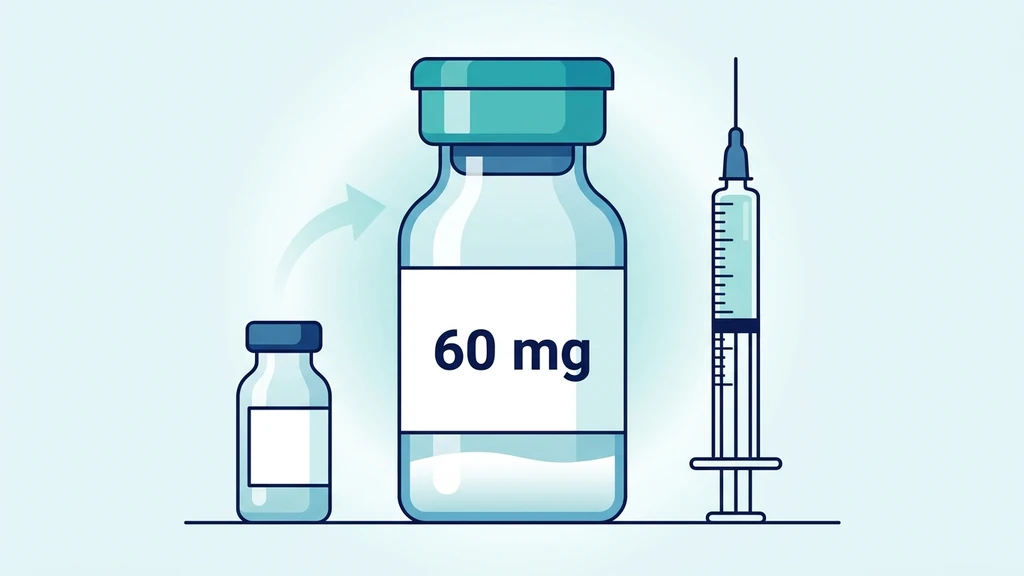
The vial on your counter says 60 mg, the largest size pharmacies and research vendors ship, and every guide you have read assumes 10 or 30 mg. Here is the answer: add 3 ml of bacteriostatic water to a 60 mg tirzepatide vial. That gives 20 mg/ml, so every 1 mg of dose is 5 units on a U-100 insulin syringe: 5 mg = 25 units, 10 mg = 50 units, 15 mg = 75 units. Two ml suits 12.5 to 15 mg doses only; 4 or 6 ml needs a vial with room for it.
| Question | Short answer |
|---|---|
| How much bac water? | 3 ml (20 mg/ml) by default; 2 ml only for 12.5 to 15 mg doses |
| Units for 5 mg at 20 mg/ml | 25 units |
| Units for 10 mg at 20 mg/ml | 50 units |
| Units for 15 mg at 20 mg/ml | 75 units |
| Doses per vial at 15 mg | 4 (exactly one 28-day window) |
| Time to dissolve | 3 to 10 minutes of slow swirling, never shaking |
| Discard | 28 days after mixing |
This page covers the 60 mg vial only. The stopper, needle-angle and aim-at-the-glass procedure that applies to every vial size is in how to reconstitute tirzepatide, the units at every concentration are in the compound tirzepatide dosage chart, the single-dose conversion is in how many units is 7.5 mg of tirzepatide, and the fridge rules are in how long tirzepatide lasts in the fridge. The pharmacology lives on the tirzepatide profile.
Get your custom peptide protocol:
- Tailored to your body and goals
- Precise dosing and cycle length
- Safe stacking combinations
- Backed by peer-reviewed studies
- Ready in under 2 minutes
Why the 60 mg Vial Is Different
A 60 mg vial holds six times the peptide of the 10 mg vial most instructions are written for. The powder cake is visibly taller, it takes longer to wet through, and the usual 1 ml of water produces a 60 mg/ml solution, twice as concentrated as anything Eli Lilly sells. Mounjaro and Zepbound pens deliver 2.5 to 15 mg in 0.5 ml, so their concentrations run from 5 to 30 mg/ml. Nothing above 30 mg/ml has a manufacturer precedent.
Think of sugar in a glass of water. One teaspoon vanishes in a few swirls; six teaspoons need more water and more time, and the syrup you end up with carries a lot of sugar in every drop. Literally stated: at 60 mg/ml, one unit on an insulin syringe is 0.6 mg of tirzepatide, and a 2-unit misread is a 1.2 mg error, almost half a starting dose.
Three ml fixes that. At 20 mg/ml one unit is 0.2 mg, every rung of the dose ladder lands on a readable mark, and the maximum 15 mg dose is 75 units inside a single 1 ml syringe. This is why 20 mg/ml is the working convention for 60 mg vials and the concentration pharmacies dispense for high-dose tirzepatide. The same logic drives reconstituting a 50 mg GHK-Cu vial: large mass, more water, readable units.
Check the glass before you choose a volume. Most 60 mg vials ship in 3 ml or 10 ml glass. A nominal 3 ml vial takes 3 ml of water plus the powder, and it will not take 4 or 6 ml.
A Vial Is Not a Pen
Compounded and research tirzepatide vials are not the FDA-approved Mounjaro or Zepbound pens. The pens fix the dose at the factory; the vial hands the concentration decision to you, and that is where the errors happen. The FDA has warned about dosing errors with compounded semaglutide and tirzepatide, including patients drawing the wrong number of units from multi-dose vials.
The published record agrees. A pharmacovigilance analysis of FDA adverse event reports catalogued the safety signals of compounded GLP-1 receptor agonists (McCall et al., Expert Opin Drug Saf, 2026, PMID 40285721), a population-based study documented a rise in accidental overdose reports with GLP-1 receptor agonists (McIntyre et al., Expert Opin Drug Saf, 2026, PMID 39552465), and poison centers recorded more exposure calls as demand for these drugs climbed (Ho et al., J Pharm Technol, 2025, PMID 40371098). A 60 mg vial mixed wrong is the largest single error a tirzepatide user can make at home.
Water Volume Table: 2, 3, 4 or 6 ml
Concentration is 60 mg divided by the millilitres of water you add. Units are the dose in mg divided by the concentration, times 100. Every cell below is that arithmetic for a U-100 insulin syringe.
| Water added | Concentration | 2.5 mg | 5 mg | 7.5 mg | 10 mg | 12.5 mg | 15 mg |
|---|---|---|---|---|---|---|---|
| 2 ml | 30 mg/ml | 8.3 units | 16.7 units | 25 units | 33.3 units | 41.7 units | 50 units |
| 3 ml | 20 mg/ml | 12.5 units | 25 units | 37.5 units | 50 units | 62.5 units | 75 units |
| 4 ml | 15 mg/ml | 16.7 units | 33.3 units | 50 units | 66.7 units | 83.3 units | 100 units |
| 6 ml | 10 mg/ml | 25 units | 50 units | 75 units | 100 units | 125 units* | 150 units* |
*Exceeds a 1 ml (100-unit) syringe and needs two draws.
Choosing a row:
- 3 ml (20 mg/ml) for almost everyone. Clean marks from 5 mg upward and 15 mg in one syringe.
- 2 ml (30 mg/ml) only when your dose is 12.5 or 15 mg and the vial is small. 8.3 units for 2.5 mg cannot be drawn reliably.
- 4 ml (15 mg/ml) when you have a 10 ml vial and a 7.5 or 15 mg dose, which land on a round 50 or 100 units.
- 6 ml (10 mg/ml) matches a 10 mg vial mixed with 1 ml, but doses above 10 mg need two injections.
Fractional units such as 8.3 or 16.7 do not exist on a syringe graduated in 1 or 2 units; change rows rather than round. The tirzepatide dosage calculator and the peptide reconstitution calculator handle any volume you actually added, including the 2.8 ml that happens when the drawing syringe comes up short.
Mixing a High-Mass Vial: Time, Foam and Patience
Stopper swabbing, needle angle and aiming at the glass are the same as for any vial. Five things change when the cake weighs 60 mg.
- 1.Draw the water in one syringe. A 3 ml or 5 ml syringe holds the full 3 ml. Three 1 ml draws triple the stopper punctures and hide a 2.8 ml total you never noticed.
- 2.Run the water down the glass over a full minute. A 60 mg cake sits higher in the vial, and a stream that hits it directly whips far more peptide into foam than it would in a 10 mg vial.
- 3.Let it sit before you swirl. Give the water 2 minutes to soak the cake from below. Then swirl in slow circles for 30 seconds, rest, and repeat.
- 4.Expect 3 to 10 minutes. A 10 mg vial clears in 1 to 3 minutes. The last flecks clinging to the shoulder of a 60 mg vial are slow, and they count.
- 5.Never shake, never warm. Tirzepatide is a 39-amino-acid peptide carrying a C20 fatty diacid side chain (Martin et al., Eur J Pharm Sci, 2024, PMID 39243911), and lipidated peptides are handled gently. Foam that has not settled after 10 minutes means air was beaten in: refrigerate for 15 minutes and draw from beneath it.
Inspect against a light once the foam is gone. Clear to faintly yellow is normal; cloudiness, strands or particles mean discard. The tirzepatide color guide shows what each shade means. Use bacteriostatic water for a vial you will puncture four to six times over a month; bacteriostatic water vs sterile water explains why.
How Many Doses One 60 mg Vial Yields
Reconstituted tirzepatide in bacteriostatic water is used within 28 days, the same window the general guide applies to every size. Hold the dose count against that window and the 60 mg vial is honest about who it is for.
| Weekly dose | Doses in 60 mg | Weeks of supply | Inside the 28-day window? |
|---|---|---|---|
| 2.5 mg | 24 | 24 | No; 20 doses discarded |
| 5 mg | 12 | 12 | No; 8 doses discarded |
| 7.5 mg | 8 | 8 | No; 4 doses discarded |
| 10 mg | 6 | 6 | No; 2 doses discarded |
| 12.5 mg | 4, with 10 mg left over | 4 | Yes |
| 15 mg | 4 | 4 | Yes |
The vial fits people at 12.5 or 15 mg, where four weekly doses empty it in exactly four weeks. At 10 mg, the fifth and sixth doses fall outside the window. At 2.5 mg it would last 24 weeks against a 4-week shelf life, so starters belong on a 10 or 15 mg vial even though the 60 mg vial wins every cheapest tirzepatide comparison per milligram.
The ladder itself, 2.5 mg for four weeks and then 2.5 mg steps every four weeks up to 15 mg, is the SURMOUNT-1 protocol (Jastreboff et al., N Engl J Med, 2022, PMID 35658024). Where people settle after the climb is covered in the maintenance dose guide.
Splitting a 60 mg Vial
Two reasons to split hold up, and one popular reason does not.
A dose above 100 units. At 10 mg/ml, 12.5 mg is 125 units and 15 mg is 150 units. Draw two syringes, 75 and 75 or 100 and 50, and inject at two sites a hand's width apart; rotation rules are in the tirzepatide injection sites guide. Better still, choose 3 ml and no dose needs two syringes.
Fewer punctures per vial. Right after mixing, transfer half the solution, 1.5 ml at 20 mg/ml, into a sterile empty vial with a fresh needle, label both, and leave the second vial untouched until the first is empty. The concentration does not change; only the puncture count does.
What splitting cannot do is reset the clock. Both halves expire 28 days after the mixing day. Freezing the second half is often suggested online, but no stability study has tested frozen reconstituted tirzepatide, so this site does not count on it. The dry cake cannot be split either: it is one piece, and weighing a fraction of it at home is guesswork.
Quantified Error Scenarios
Scenario 1: 1 ml instead of 3 ml. You intend 20 mg/ml, add 1 ml, and the vial is 60 mg/ml. You draw 50 units for what should be 10 mg and inject 30 mg: three times your dose and twice the 15 mg maximum. Every dose from that vial is tripled until someone notices. Tirzepatide's half-life is about 5 days (Schneck et al., CPT Pharmacometrics Syst Pharmacol, 2024, PMID 38356317), so blood levels need roughly 8 days to fall to what a 10 mg dose would have produced. Expect vomiting and diarrhea severe enough to risk dehydration. Fix: the vial is still usable at 60 mg/ml if you relabel it and draw one third of the units, 17 units for 10 mg, but do not inject again until you have recalculated on paper.
Scenario 2: the 30 mg recipe. The general guide uses 1.5 ml for a 30 mg vial, giving 20 mg/ml. Apply the same 1.5 ml to a 60 mg vial and you have 40 mg/ml. The 25 units you draw for 5 mg deliver 10 mg, double, the equivalent of skipping two titration steps. Gastrointestinal adverse events in the head-to-head SURPASS-2 trial rose with dose across the 5, 10 and 15 mg arms (Frías et al., N Engl J Med, 2021, PMID 34170647). Fix: recipes are per vial mass, never per water volume. Say the concentration out loud before you draw.
Scenario 3: 6 ml when you meant 3. The reverse error halves every dose: 50 units at 10 mg/ml is 5 mg. Nobody is hurt, but a month of returning appetite looks like the drug failing, and doubling the units without rechecking is how an under-dose becomes the next overdose. Fix: recalculate from the water actually added and rewrite the label.
Scenario 4: 12.5 units on a 100-unit syringe. At 20 mg/ml, 2.5 mg is 12.5 units. On a 1 ml syringe with 2-unit ticks the plunger sits between marks, and a one-tick slip is 0.4 mg, 16% of the dose. Fix: a 0.3 ml syringe with half-unit marks, or do not start on a 60 mg vial at all.
Mis-drawn GLP-1 doses reach the medical literature as case reports of serious reactions after a single error (Kraft et al., J Clin Med, 2026, PMID 42194666). Those numbers are why the label step below exists.
Labeling and Dating
Write before the vial goes in the fridge, while the mixing syringe is still in your hand. Four lines, in this order:
- Name and mass: Tirzepatide 60 mg
- Water and concentration: 3 ml, 20 mg/ml
- The unit rule: 5 units per mg
- Mixed and discard dates: mixed 25 Nov, discard 23 Dec
Put the same four lines on the box and in your phone. A clear solution in a 3 ml vial looks identical to a 10 mg vial mixed at 10 mg/ml, and the only thing separating a 5 mg dose from a 10 mg dose is ink. The water bottle gets its own date; its limits are in how long bacteriostatic water lasts.
Frequently Asked Questions
How much bacteriostatic water do I add to 60 mg of tirzepatide?
Add 3 ml for 20 mg/ml, the standard for a 60 mg vial. Every 1 mg is then 5 units: 5 mg is 25 units, 10 mg is 50 units, 15 mg is 75 units. Use 2 ml (30 mg/ml) only for 12.5 to 15 mg doses. The peptide reconstitution calculator recalculates for any other volume.
How many units is 10 mg of tirzepatide from a 60 mg vial?
It depends on the water you added. With 3 ml (20 mg/ml), 10 mg is 50 units. With 2 ml (30 mg/ml) it is 33 units, with 4 ml (15 mg/ml) 67 units, and with 6 ml (10 mg/ml) a full 100 units. Confirm your own concentration with the tirzepatide dosage calculator before drawing.
Can I add just 1 ml of water to a 60 mg tirzepatide vial?
You can, but the result is 60 mg/ml, twice the strongest Mounjaro pen. One unit then carries 0.6 mg, a 2.5 mg dose is 4 units and a 15 mg dose is 25 units, so a single-tick misread is a 10 to 25% error. The tirzepatide profile explains why that margin matters for a drug with a 5-day half-life.
How long does a 60 mg tirzepatide vial last?
Four weeks at 15 mg (4 doses), four weeks at 12.5 mg with 10 mg left over, and 28 days regardless of dose once mixed with bacteriostatic water. At 10 mg the vial holds 6 doses but only 4 fall inside the window. Unmixed powder keeps far longer; see does tirzepatide expire.
Why is my 60 mg tirzepatide taking so long to dissolve?
Because the cake is six times larger than a 10 mg vial. Expect 3 to 10 minutes: run the water down the glass, wait 2 minutes, then swirl for 30 seconds at a time. Never shake or warm it. If flecks remain after 15 minutes, refrigerate and swirl again. The general technique is in how to reconstitute peptides.
Is a 60 mg tirzepatide vial the same as Mounjaro or Zepbound?
No. Mounjaro and Zepbound are FDA-approved pens with the dose fixed at 2.5 to 15 mg per 0.5 ml. A 60 mg vial is compounded or research-grade tirzepatide whose concentration you set yourself, which is where the FDA says dosing errors occur. Whether compounded vials perform like the pens is covered in does compounded tirzepatide work.
Can I split a 60 mg vial into two vials?
Yes. Transfer half the solution, 1.5 ml at 20 mg/ml, into a sterile empty vial with a fresh needle straight after mixing and label both. Each vial then takes half the punctures. Both still expire 28 days from the mixing date. Injection technique for the doses themselves is in how to inject tirzepatide.
The Bottom Line
Add 3 ml of bacteriostatic water to a 60 mg tirzepatide vial for 20 mg/ml, and every milligram becomes 5 units: 25 units for 5 mg, 50 for 10 mg, 75 for 15 mg. Give the cake 3 to 10 minutes of slow swirling, label the vial with the concentration and a 28-day discard date, and use it for 12.5 or 15 mg doses, which are the only ones that empty it inside the window.
The principle: a 60 mg vial multiplies every water mistake by the size of the vial. One ml instead of three triples every dose from that vial, and nothing on the syringe tells you so.
Compounded and research tirzepatide is not the FDA-approved pen, and the dosing-error warnings about it exist because of vials like this one. Run your water volume and dose through the tirzepatide dosage calculator before the first draw, and find the rest of the tirzepatide cluster at PeptidesExplorer. Educational content, not medical advice.
Related Articles
How to Reconstitute Tirzepatide
How to reconstitute tirzepatide step by step for 5mg, 10mg, 15mg, and 30mg vials. Concentration tables, BAC water volumes, syringe units, and storage guide.
How to Reconstitute Retatrutide
How to reconstitute retatrutide step by step for 5mg, 10mg, and 20mg vials. Concentration tables, BAC water volumes, syringe units per dose, and storage guide.
How to Reconstitute PT-141: Water, Units & Shelf Life
How to reconstitute PT-141: 2 mL bacteriostatic water per 10 mg vial gives 5 mg/mL, so 1 mg is 20 units. Steps, 1/2/3 mL unit table, and how long it keeps.
How to Reconstitute Cagrilintide (5 mg, 10 mg)
How to reconstitute cagrilintide: bacteriostatic water for 5 mg and 10 mg vials, mg to units on a U-100 syringe, fridge storage and the 28-day clock.