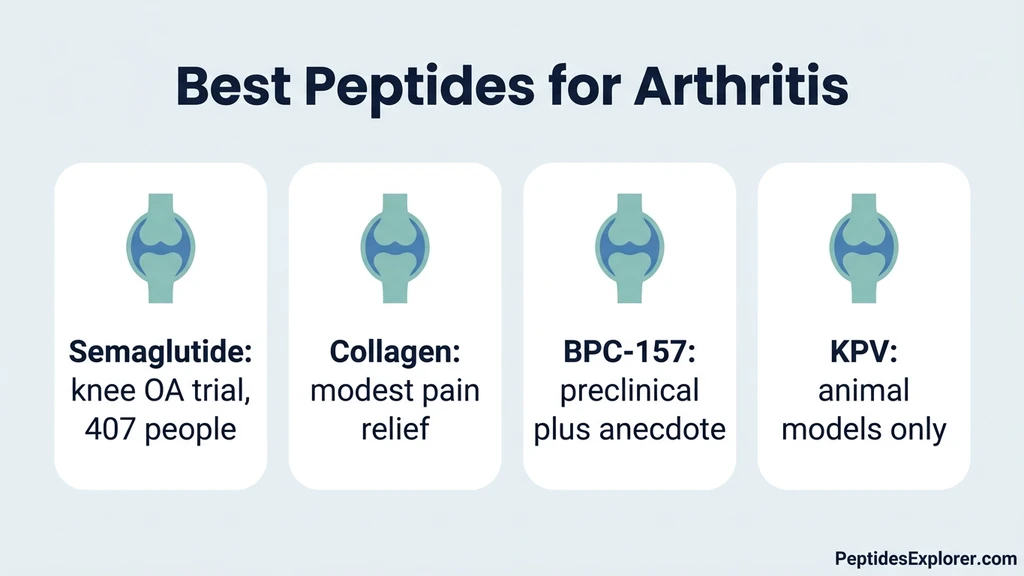
Your knee is stiff on the stairs again, the rheumatology appointment is six weeks out, and a forum thread says BPC-157 fixed someone's arthritis in a month. Here is the honest ranking: the only peptide with a randomized arthritis trial is semaglutide, which cut knee osteoarthritis pain by an extra 14 WOMAC points through weight loss. Oral collagen peptides have small positive OA trials. BPC-157, TB-500, KPV and thymosin alpha-1 have animal data, case series, or nothing at all, and none regrows cartilage.
| Peptide | Arthritis type | Human evidence | Verdict |
|---|---|---|---|
| Semaglutide (GLP-1) | Knee OA with obesity | 407-person RCT, 68 weeks | Strongest, but indirect (weight loss) |
| Collagen peptides (oral) | Mild knee OA | Several small RCTs | Modest pain relief, no structural change |
| BPC-157 | OA (knee), rat RA model | 16-patient chart review | Preclinical plus anecdote |
| TB-500 | OA, RA | None as treatment | Elevated in diseased joints; unclear role |
| KPV | RA, psoriatic | Animal models only | Plausible for autoimmune, untested |
| Thymosin alpha-1 | RA, psoriatic | Serum-level studies only | Speculative |
| GHK-Cu | None specific | None | No arthritis data |
None of these compounds is FDA-approved for any form of arthritis. This page covers arthritis only: osteoarthritis, rheumatoid arthritis and psoriatic arthritis. Non-arthritic joint and tendon pain is ranked separately in peptides for joint pain, acute injury repair in peptides for healing, and inflammation as a general topic in peptides for inflammation.
Get your custom peptide protocol:
- Tailored to your body and goals
- Precise dosing and cycle length
- Safe stacking combinations
- Backed by peer-reviewed studies
- Ready in under 2 minutes
Three Kinds of Arthritis, Three Different Problems
Think of a road. Osteoarthritis is potholes: decades of traffic wear the surface down, and the cracks eventually reach the base. Rheumatoid arthritis is a crew tearing up a sound road on bad orders. Psoriatic arthritis is the same crew, with different orders, that also attacks the junctions where guardrails bolt on.
Literally stated: osteoarthritis is cartilage loss with low-grade inflammation driven by mechanical load and age. Rheumatoid arthritis is an autoimmune attack on the synovium, the joint lining, driven by cytokines such as TNF and IL-6, and it affects roughly 1% of adults (Getting et al., ScientificWorldJournal, 2009, PMID 20024514). Psoriatic arthritis runs on the IL-23 to IL-17 axis and inflames entheses, the points where tendons anchor to bone.
This split decides which peptide has any rationale. A peptide that lowers joint load or protects cartilage has a case in OA and none in RA. A peptide that dampens cytokines has a case in RA and psoriatic arthritis, where the standard of care is already methotrexate or a biologic that does exactly that, with trial data behind it.
The evidence bar also differs. OA is measured with the WOMAC pain scale (0 to 100, lower is better) and joint space on X-ray. RA is measured with the DAS28 disease activity score and erosion counts. A peptide that moves neither has not been shown to treat arthritis, whatever it does to a tendon in a rat.
Peptides for Arthritis, Ranked by Evidence
Ranking is by the strength of human arthritis data, then animal arthritis models, then mechanism alone. Dose ranges are what research users report, not prescriptions.
1. Semaglutide and Other GLP-1s: The Only Randomized Arthritis Trial
The STEP 9 trial enrolled 407 adults with obesity (mean BMI 40) and moderate knee OA, randomized them to weekly 2.4 mg semaglutide or placebo for 68 weeks, and measured both weight and WOMAC pain. Weight fell 13.7% on semaglutide against 3.2% on placebo, and WOMAC pain fell 41.7 points against 27.5, a 14.2-point advantage (Bliddal et al., N Engl J Med, 2024, PMID 39476339). Serious adverse events were similar in both groups; 6.7% quit the drug, mostly for gut side effects.
The effect is mechanical, which is why it is indirect. In the IDEA trial, 10% diet-induced weight loss cut knee compressive force by about 200 newtons per step and lowered plasma IL-6 compared with exercise alone (Messier et al., JAMA, 2013, PMID 24065013). Semaglutide works for knee OA because it removes load; a GLP-1 has no trial in RA, psoriatic arthritis, hip or hand OA, or lean patients. Whether the drug itself lowers inflammation is examined in does tirzepatide help with inflammation, and the opposite complaint in can tirzepatide cause joint pain.
Semaglutide is FDA-approved for obesity and diabetes, not for osteoarthritis. If you have obesity and knee OA, this is the one peptide a rheumatologist can prescribe on evidence today.
2. Collagen Peptides: Small Trials, Modest Pain Relief, No Cartilage Change
Oral hydrolyzed collagen is the one over-the-counter peptide with repeated placebo-controlled OA trials. In an 80-person, 180-day trial of 3,000 mg per day in Kellgren-Lawrence grade I to II knee OA, WOMAC pain fell 1.90 points on collagen and rose 0.61 on placebo (p = 0.006), with no change in joint space width or inflammatory markers and no adverse events (Park et al., Front Nutr, 2025, PMID 40977985).
The wider picture is mixed. A meta-analysis of 69 OA supplement trials found collagen hydrolysate among seven supplements with a large short-term pain effect (effect size above 0.80), graded the evidence very low quality, and found no supplement with a clinically important effect at long-term follow-up (Liu et al., Br J Sports Med, 2018, PMID 29018060).
Collagen has no trial in rheumatoid or psoriatic arthritis. Typical research use is 3 to 10 g daily for at least 12 weeks, and the Park trial needed 6 months. The downside is cost and time, not harm.
3. BPC-157: Rat Arthritis Data and One Chart Review
BPC-157 is the peptide most people mean when they ask about arthritis, and its arthritis evidence is older than most realize. In rats with Freund's adjuvant arthritis, a rodent model of RA, 10 micrograms or 10 nanograms per kg of BPC-157 reduced lesion development, and in established arthritis the benefit appeared after 2 weeks of daily dosing and persisted at 1 year (Sikiric et al., J Physiol Paris, 1997, PMID 9403784). The same paper found it protected the stomach against indomethacin, aspirin and diclofenac.
Its orthopedic data is mostly tendon. After Achilles tendon-to-bone transection in 72 rats, BPC-157 improved functional recovery at every time point and increased new vessel formation, while methylprednisolone suppressed inflammation but blocked vessel growth and did not improve function (Krivic et al., Inflamm Res, 2008, PMID 18594781).
Human arthritis data is one retrospective chart review: 16 patients with mixed knee pain, 12 given intra-articular BPC-157 alone, 11 of whom reported significant improvement by phone, with no imaging and no validated pain scale (Lee et al., Altern Ther Health Med, 2021, PMID 34324435). A 2026 systematic review found only three human BPC-157 studies in total, 30 participants, all of poor methodological quality, and rated the certainty of evidence very low (Poolton et al., Acta Orthop Belg, 2026, PMID 42885452).
Research users inject 250 to 500 mcg subcutaneously near the joint once daily for 4 to 8 weeks; the site technique is in where to inject BPC-157 for knee pain and the expected onset in how long BPC-157 takes to work. BPC-157 is not FDA-approved for any use.
4. TB-500 (Thymosin Beta-4): Elevated in Arthritic Joints, Untested as Treatment
TB-500 is a synthetic fragment of thymosin beta-4, a protein that drives cell migration and tissue repair in preclinical wound, cardiac and eye models (Goldstein et al., Expert Opin Biol Ther, 2015, PMID 26096726). That repair profile is why it is paired with BPC-157; the pairing logic is in BPC-157 vs TB-500.
The arthritis data points the other way. In 40 RA patients, serum thymosin beta-4 ran about tenfold higher than in healthy controls (577 vs 57 ng/mL) and tracked the DAS28 disease activity score (Song et al., Clin Rheumatol, 2012, PMID 22653616). In 216 knee OA patients, serum and synovial fluid levels rose with Kellgren-Lawrence grade (Wei et al., Regul Pept, 2013, PMID 23816466).
Nobody knows whether that elevation is the joint's repair response or part of the damage. No trial has given thymosin beta-4 to arthritis patients, so adding more to a joint that already has ten times the normal amount is a guess. Research users take 2 to 2.5 mg twice weekly; side effects and the cancer-signalling caveat are in TB-500 side effects.
5. KPV and Melanocortin Peptides: The Autoimmune Rationale
KPV is the C-terminal tripeptide of alpha-MSH, and most of alpha-MSH's anti-inflammatory activity sits in those three amino acids. Alpha-MSH has reduced inflammation in animal models of rheumatoid arthritis, contact dermatitis, asthma and colitis, and the authors list arthritis among the target diseases for KPV-type peptides (Luger et al., Ann Rheum Dis, 2007, PMID 17934097).
The mechanism is specific: nanomolar KPV blocks NF-kB and MAP kinase signalling, and oral KPV reduced colitis in two mouse models (Dalmasso et al., Gastroenterology, 2008, PMID 18061177). Because NF-kB sits upstream of TNF, IL-1 and IL-6, the cytokines that destroy an RA joint, KPV is the peptide with the cleanest rationale for rheumatoid and psoriatic arthritis.
Rationale is all it has. No human arthritis trial exists, and the melanocortin review that covers arthritic pathologies describes the field as in its infancy (Getting et al., ScientificWorldJournal, 2009, PMID 20024514). Research users take 200 to 500 mcg daily, oral or subcutaneous; the KPV dosage chart covers both routes.
6. Thymosin Alpha-1 and GHK-Cu: Thin or Absent
Thymosin alpha-1 modulates immunity and is licensed in some countries for hepatitis B and as a vaccine adjuvant, never for arthritis. Serum levels are lower in rheumatoid arthritis, psoriatic arthritis and lupus than in healthy donors, lowest of all in psoriatic arthritis (Pica et al., Clin Exp Immunol, 2016, PMID 27350088). A low level does not prove that replacing it helps, and no RA or psoriatic trial has tested the idea. Its general profile is in thymosin alpha-1 benefits.
GHK-Cu resets gene expression toward repair and raises collagen synthesis in skin and wound models (Pickart et al., Oxid Med Cell Longev, 2012, PMID 22666519). It has no arthritis study of any kind, in any species. Its real uses are listed in GHK-Cu benefits.
What No Peptide Can Do: Regrow Cartilage
Every trial that measured structure found none. Collagen peptides improved WOMAC pain without moving joint space width over 180 days (Park et al., Front Nutr, 2025, PMID 40977985). The supplement meta-analysis found no supplement with a clinically important structural effect (Liu et al., Br J Sports Med, 2018, PMID 29018060). The BPC-157 chart review took no images at all.
Articular cartilage has no blood supply and almost no cells, which is why adult cartilage does not heal on its own and why no injectable has rebuilt it in humans. A peptide that reduces pain or inflammation is doing something real; a vendor promising "cartilage regeneration" is quoting a rat tendon.
In rheumatoid arthritis the stakes are higher. Erosions are permanent, and the window to prevent them is the first months of disease. Any peptide experiment in RA sits on top of a DMARD, never in place of one.
Stacks People Use, and Realistic Timelines
| Stack | Arthritis type | Rationale | Honest timeline |
|---|---|---|---|
| GLP-1 + oral collagen | Knee OA with obesity | Load reduction plus the one OTC peptide with OA trials | Weight-driven relief over 6 to 16 months |
| BPC-157 + TB-500 | Knee OA, post-injury OA | Repair pairing; animal data only | Users report 2 to 6 weeks; no trial |
| BPC-157 + collagen | Mild OA | Local repair signal plus systemic substrate | Collagen needs 12 to 24 weeks |
| KPV + thymosin alpha-1 | RA, psoriatic | Cytokine damping plus immune modulation | Untested; adjunct to DMARD only |
The BPC-157 and TB-500 pairing is the Wolverine stack, and its unit math is in BPC-157 and TB-500 dosage. Run any combination through the peptide stack calculator before drawing a syringe, and read the peptide stacking guide for the rules on overlapping half-lives.
Set the timeline from the evidence. Semaglutide's pain advantage was measured at 68 weeks. Collagen needed 180 days. The BPC-157 rats improved at 2 weeks; humans have no measured onset. If a peptide has done nothing for OA pain by week 8, more weeks rarely change the answer.
Red Flags and Interactions With DMARDs, Biologics and NSAIDs
Scenario 1: methotrexate swapped for KPV. You stop 15 mg weekly methotrexate because a research peptide felt gentler. Methotrexate's effect fades over 4 to 8 weeks, the synovitis returns, and every month of uncontrolled RA adds erosions that no later treatment removes. Fix: peptides in RA are add-ons; the DMARD stays unless your rheumatologist stops it.
Scenario 2: thymosin alpha-1 on top of a TNF blocker. You add an immune modulator to adalimumab. No study has combined the two, so the infection risk of stacking two immune-active agents is unknown rather than low. Fix: tell the prescribing rheumatologist about every peptide, and do not start one in the 2 weeks around a biologic dose change.
Scenario 3: BPC-157 read as NSAID protection. The 1997 rat paper found BPC-157 reduced indomethacin and diclofenac stomach lesions (Sikiric et al., J Physiol Paris, 1997, PMID 9403784). A user doubles his ibuprofen to 2,400 mg a day on the strength of it. Rat gastric protection has never been tested in a human, and 2,400 mg of ibuprofen carries a measurable bleed risk on its own. Fix: NSAID dose is set by the NSAID label, never by a peptide.
Scenario 4: a home intra-articular injection. The chart-review patients received BPC-157 inside the knee from a physician under sterile technique. A home user copying it through skin into the joint space risks septic arthritis, a surgical emergency that can destroy a joint in days. Fix: subcutaneous only, near the joint, with the sterile steps in the peptide safety guide.
GLP-1s carry their own list, including slowed absorption of oral drugs and additive effects with other glucose-lowering agents; the full set is in tirzepatide drug interactions.
Comparison Table: Peptide, Arthritis Type, Evidence, Route
| Peptide | Best-supported arthritis type | Evidence level | Route | Research dose range |
|---|---|---|---|---|
| Semaglutide (GLP-1) | Knee OA with obesity | Phase 3 RCT, n = 407 | Subcutaneous weekly | 2.4 mg (titrated) |
| Collagen peptides | Mild knee OA (KL I to II) | Small RCTs, very low to moderate quality | Oral | 3 to 10 g daily |
| BPC-157 | Knee OA; rat RA model | Rat models plus 16-patient chart review | Subcutaneous daily | 250 to 500 mcg |
| TB-500 | None established | Biomarker studies; no treatment trial | Subcutaneous | 2 to 2.5 mg twice weekly |
| KPV | RA, psoriatic (rationale) | Animal inflammation models | Oral or subcutaneous | 200 to 500 mcg daily |
| Thymosin alpha-1 | RA, psoriatic (rationale) | Serum-level studies only | Subcutaneous | 1.6 mg twice weekly |
| GHK-Cu | None | No arthritis data | Subcutaneous or topical | 1 to 2 mg daily |
Evidence level means arthritis-specific evidence. Tendon, muscle or wound studies do not count toward it, which is why BPC-157 ranks below collagen here despite having far more total publications.
Common Mistakes
Treating RA like OA. Loading up on BPC-157 and collagen for swollen, symmetrical hand joints that are hot in the morning. Those are RA signs, the problem is immune, and the fix is a rheumatologist within weeks, not a repair peptide.
Reading a pain response as cartilage repair. Pain down 30% at week 6 on BPC-157 says nothing about the joint surface. Fix: get a baseline X-ray or MRI, repeat it at 12 months, and judge structure from imaging only.
Skipping the weight lever. A 100 kg person with knee OA who spends on peptides and ignores the 13.7% weight loss that produced the only randomized arthritis result. Fix: if BMI is over 30, semaglutide or tirzepatide through a prescriber is the evidence-based first move.
Stacking three injectables at once. Starting BPC-157, TB-500 and KPV the same week, so any side effect cannot be traced. Fix: one compound, 4 weeks, then add the next; the peptide stack calculator keeps the doses straight.
Frequently Asked Questions
What is the best peptide for arthritis?
For knee osteoarthritis with obesity, semaglutide: in a 407-person, 68-week trial it cut WOMAC pain 14.2 points more than placebo by driving 13.7% weight loss (PMID 39476339). For mild OA without obesity, oral collagen peptides have small positive trials. Research peptides like BPC-157 have only animal data and a 16-patient chart review.
Which peptides are used for rheumatoid arthritis?
None has a human RA trial. KPV has the strongest rationale because alpha-MSH peptides reduced inflammation in animal RA models (PMID 17934097), and BPC-157 reduced adjuvant arthritis in rats within 2 weeks (PMID 9403784). Both are add-ons to a DMARD at most, never replacements. The KPV dosage chart covers research doses.
Does BPC-157 help osteoarthritis?
Possibly for pain; nothing shows it rebuilds cartilage. The only human data is a chart review in which 11 of 12 patients given intra-articular BPC-157 reported less knee pain by phone, with no imaging (PMID 34324435). A 2026 systematic review rated all human BPC-157 evidence very low certainty. Injection technique is in where to inject BPC-157 for knee pain.
Can peptides regrow cartilage?
No human study has shown it. Collagen peptides improved pain without changing joint space width over 180 days (PMID 40977985), and no OA supplement has a clinically important structural effect in meta-analysis. Adult cartilage lacks blood supply and barely heals. Peptides can lower pain or inflammation; claims of regrowth come from rat tendon work. See peptides for healing for what repair data really covers.
Is TB-500 good for arthritis?
Unproven, and the data is odd: thymosin beta-4 runs about tenfold higher in RA serum (577 vs 57 ng/mL) and rises with OA severity (PMID 22653616, PMID 23816466). No trial has given it to arthritis patients, so whether more helps or harms is unknown. The TB-500 profile and BPC-157 vs TB-500 cover what it is actually studied for.
Can I take peptides with methotrexate or a biologic?
No interaction study exists for any research peptide with methotrexate, adalimumab or other DMARDs, so the risk is unknown rather than low. Never stop a DMARD for a peptide; uncontrolled RA adds permanent erosions within months. Tell your rheumatologist about every compound, and read the peptide safety guide before adding anything to immune-active therapy.
How long do peptides take to work for arthritis?
Set expectations from the trials. Semaglutide pain relief was measured at 68 weeks; collagen needed 180 days at 3,000 mg per day; BPC-157 rats improved at 2 weeks but humans have no measured onset. If an 8-week trial of a peptide changes nothing, extending it rarely does. Onset detail is in how long BPC-157 takes to work.
The Bottom Line
The best peptide for arthritis depends on the arthritis. For knee osteoarthritis with obesity, semaglutide has the only randomized result, a 14.2-point WOMAC pain advantage earned through 13.7% weight loss. For mild OA, oral collagen peptides give modest, slow pain relief. BPC-157, TB-500, KPV and thymosin alpha-1 rest on animal models, biomarker studies or a single chart review, and no peptide has rebuilt cartilage in a human.
The principle: match the peptide to the mechanism. Load and cartilage wear respond to weight loss and, modestly, to collagen. Autoimmune joint destruction responds to DMARDs and biologics, with KPV as an untested adjunct at most.
None of these compounds is FDA-approved for arthritis, and this is educational content, not medical advice. Build any combination in the peptide stack calculator and explore the rest of the evidence library at PeptidesExplorer.
Helpful Tools
Related Articles
Best Peptides for Joint Pain: 6 Ranked
BPC-157, TB-500, collagen peptides, GHK-Cu, KPV, and AOD-9604 ranked for joint pain by evidence strength. Dosages, studies, and safety data included.
Peptides for Healing: What the Evidence Shows
Peptides for healing by tissue: tendon, bone, wound, gut, post-surgery. Which claims rest on human trials, which rest on rat studies, and what is unsafe.
KLOW Peptide: Benefits, Dosage, and KLOW vs GLOW
KLOW peptide benefits, blend composition (GHK-Cu, BPC-157, TB-500, KPV), per-component dosing math, the copper ceiling, and how KLOW differs from GLOW.
How Long Do Reconstituted Peptides Last?
Reconstituted peptide shelf life by type: BPC-157, semaglutide, TB-500, GHK-Cu. Bac water vs sterile water, storage temps, and signs of degradation.