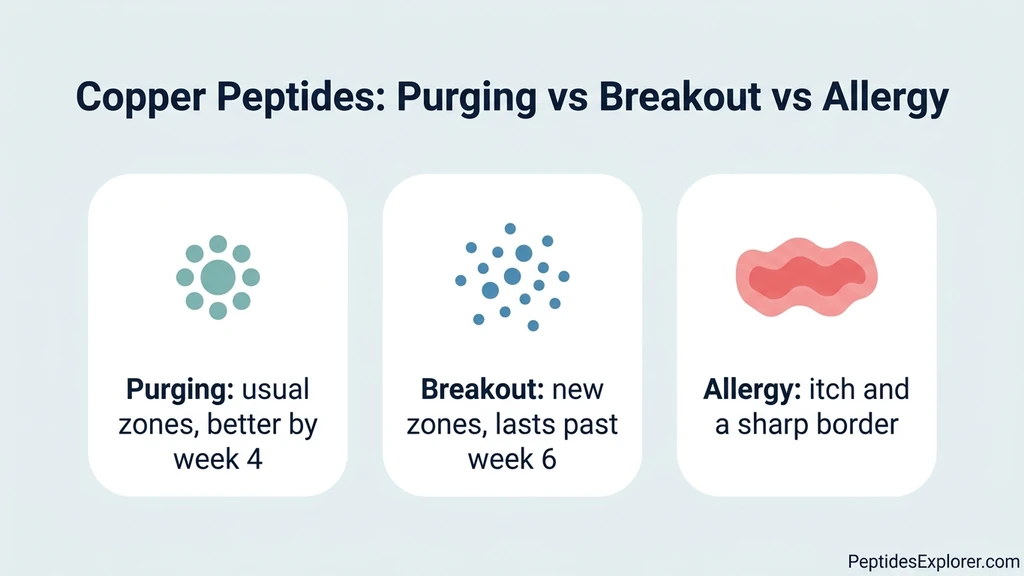
Day nine on a new copper peptide serum, and there is a cluster of small bumps along your jaw that was not there last week. Here is the answer: GHK-Cu itself is not comedogenic and has no record of causing acne in the published literature; when a copper serum breaks you out, the cause is almost always the serum base, a product you layered with it, or a skin reaction that only looks like acne. The lesion type, the location and the clock tell you which one you have.
| Question | Short answer |
|---|---|
| Does GHK-Cu clog pores? | No. The tripeptide is water-soluble and non-occlusive |
| Then why am I breaking out? | The carrier (oils, esters, silicones), a new retinoid or acid, or over-application |
| Purging or breakout? | Purging: usual zones, small, improving by week 4. Breakout: new zones, persisting past week 6 |
| Allergy or acne? | Allergy itches, burns and follows the application border. Acne does not itch |
| Who is prone? | Oily or acne-prone skin, serums above 2%, twice-daily use, layering with vitamin C or acids |
| When to stop? | Spreading lesions past 6 weeks, any itch or swelling, or new cysts within 2 weeks |
This page covers one question only: acne and breakouts. The wider "did copper peptides damage my skin" question, with redness, flaking and barrier recovery, lives in copper peptides ruined my skin. Procedure-related reactions are in GHK-Cu microneedling, scalp use in GHK-Cu for hair growth, and dosing for the injectable form in GHK-Cu injection dosage.
Get your custom peptide protocol:
- Tailored to your body and goals
- Precise dosing and cycle length
- Safe stacking combinations
- Backed by peer-reviewed studies
- Ready in under 2 minutes
Purging, Breakout or Reaction: How to Tell Within 48 Hours
Three different things get filed under "copper peptides gave me acne." They look alike on day two and completely different by day fourteen. Sort yours with four signals: where the bumps are, what they look like, when they appeared, and which direction they are heading.
| Signal | Purging | True breakout | Allergic or irritant reaction |
|---|---|---|---|
| Location | Your usual spots: chin, jaw, forehead | New zones you never break out in, often where the serum pools | Wherever the serum touched, with a sharp edge at the border |
| Lesion type | Small whiteheads and closed comedones that come to a head fast | Closed comedones, inflamed papules, sometimes deep nodules | Itchy red patches, fine scaling, tiny fluid bumps, burning |
| Onset | Days 3 to 14 | Days 7 to 21, building slowly | Minutes (irritant) or 24 to 72 hours (allergic) |
| Trend | Peaks around week 3, clearly improving by week 4 to 6 | Flat or worsening past week 6 | Worsens with every application |
| Itch | None | None | Yes, usually the first symptom |
| Action | Hold the routine steady | Stop the serum, change the base | Stop immediately, patch test later |
Purging is a specific event. It happens when an ingredient speeds up how fast the follicle sheds its lining, so microcomedones that were going to surface over the next month surface in two weeks instead. Topical retinoids do exactly this, which is why they normalize follicular desquamation and unplug comedones (Leyden et al., Dermatol Ther (Heidelb), 2017, PMID 28585191).
GHK-Cu does not belong to that class. Its documented actions are collagen and glycosaminoglycan synthesis, antioxidant gene regulation and tissue remodeling (Pickart et al., Int J Mol Sci, 2018, PMID 29986520), none of which force a follicular turnover spike. A "copper peptide purge" is usually a purge from the retinoid or acid you started in the same fortnight, or an early breakout from the base. The 2 to 6 week window still applies: if what you see is in your usual zones and shrinking by week 4, wait it out. If it is still growing at week 6, the serum is the problem.
Why GHK-Cu Itself Does Not Clog Pores
Think of a letter and the envelope it arrives in. The letter is three amino acids, glycine, histidine and lysine, holding one copper ion. The envelope is everything else in the bottle: water, humectants, oils, esters, silicones, preservatives and thickeners. Pores cannot be clogged by the letter. They can be clogged by the envelope.
Literally stated: GHK-Cu is a small, water-soluble tripeptide complex that occurs naturally in human plasma, saliva and urine, and its plasma level falls from about 200 ng/mL at age 20 to about 80 ng/mL by age 60 (Pickart et al., Biomed Res Int, 2015, PMID 26236730). It does not form a film, it does not oxidize into a sticky residue, and it carries no fatty chain to pack into a follicle. Nothing in its chemistry fits the profile of a comedogenic ingredient.
The clinical record points the same way. Across the human and animal wound-healing and skin-remodeling studies summarized by Pickart, GHK-Cu accelerated healing and improved skin density without reports of acneiform eruptions (Pickart et al., J Biomater Sci Polym Ed, 2008, PMID 18644225). No published trial has tested topical GHK-Cu specifically in acne-prone skin, so "no reports" is the honest ceiling of the evidence, and that gap is worth holding in mind. The wider list of what the peptide is known to do is in GHK-Cu benefits.
The Carrier Problem: What in a Copper Serum Actually Breaks You Out
Copper serums are built to look and feel luxurious, and the ingredients that deliver that feel are the ones that cause trouble on oily skin. A blue, slippery, slow-absorbing serum is usually carrying esters, plant oils or heavy silicones alongside a fraction of a percent of peptide.
Acne caused by a cosmetic vehicle has a name and a long history. Kligman and Mills described "acne cosmetica" in 1972: low-grade, persistent closed comedones in adult women traced to the base ingredients of their creams, which cleared when the products were withdrawn (Kligman et al., Arch Dermatol, 1972, PMID 4264346). That pattern, small closed comedones in someone past the usual acne years, is the single most common thing behind a "GHK-Cu breakout."
The ingredient list alone will not settle it. When Draelos re-tested finished products on acne-prone human backs, formulas that contained famously comedogenic ingredients were often non-comedogenic as finished products, and the reverse also occurred (Draelos et al., J Am Acad Dermatol, 2006, PMID 16488305). Concentration, the rest of the formula and your own skin decide the outcome. The practical test is the one you run on your own face, which is why the patch-test section below matters more than any "non-comedogenic" badge on the label.
| Component of a copper serum | Pore-clogging risk on oily skin | What to look for |
|---|---|---|
| GHK-Cu (0.5% to 3%) | None documented | The active; keep it |
| Water, glycerin, butylene glycol, propanediol | Very low | Ideal base for acne-prone skin |
| Hyaluronic acid, panthenol, allantoin | Very low | Fine |
| Light silicones (dimethicone, cyclopentasiloxane) | Low, but can trap sebum under heavier layers | Acceptable alone, risky under an oil |
| Fatty esters (isopropyl myristate, isopropyl palmitate, myristyl lactate) | High | Classic acne cosmetica culprits |
| Rich plant oils and butters (coconut, cocoa, wheat germ) | High | Avoid in a leave-on serum for oily skin |
| Lanolin and its derivatives | Moderate to high | Avoid |
A copper serum with the first three rows and nothing from the bottom three is the right starting point for oily skin. If your breakouts came with a serum from the bottom rows, you have your answer before you blame the peptide. The same vehicle logic applies to AHK-Cu, compared in AHK-Cu vs GHK-Cu.
Copper, Sebum and Inflammation: What the Literature Shows
The common claim is that copper "feeds" acne by increasing oil or feeding bacteria. The published data on GHK-Cu point the other direction, and the gaps in it are specific.
On inflammation, the signal is suppressive. In normal human dermal fibroblasts, GHK-Cu reduced TNF-alpha-driven secretion of IL-6, one of the cytokines that amplifies an inflamed papule (Gruchlik et al., Acta Pol Pharm, 2012, PMID 23285694). On oxidative stress, GHK-Cu regulates expression of multiple antioxidant genes and quenches the lipid-peroxidation byproducts that irritate the follicle wall (Pickart et al., Oxid Med Cell Longev, 2012, PMID 22666519). An ingredient that dampens IL-6 and oxidative stress is an unlikely candidate for driving inflammatory acne.
On sebum, there is no evidence either way. No published study measures sebum output before and after topical GHK-Cu, and no study shows the peptide stimulates sebocytes. If your skin feels oilier on a copper serum, the shine is almost always the base, since humectant-heavy and ester-heavy formulas sit on the surface for hours.
On bacteria, the peptide has nothing to feed. The copper in GHK-Cu is chelated, held inside the peptide rather than floating free, and free copper ions are antimicrobial rather than nutritive. The one thing a copper serum can do that resembles "worse acne" is make existing congestion more visible: skin that is remodeling and better hydrated shows texture that dull, dehydrated skin was hiding. That is cosmetic, it resolves in 1 to 2 weeks, and it is covered in what peptides do for skin.
Allergic Reaction or Acne? Copper Contact Dermatitis
The search "ghk cu allergic reaction" usually comes from someone who has red, itchy skin and is calling it a breakout. Acne and allergic contact dermatitis are different diseases with different timelines, and confusing them leads to the wrong fix.
Acne does not itch. Allergic contact dermatitis almost always does, and the itch arrives before the visible rash. It starts 24 to 72 hours after an application, sits exactly where the serum went with a clear edge at the hairline or jaw, and shows red patches with fine scale or tiny fluid-filled bumps rather than whiteheads. An irritant reaction is faster: stinging or burning within minutes, redness within the hour, calming within a day once you stop.
Genuine copper allergy is uncommon. A review of copper hypersensitivity concluded that copper is a weak sensitizer, that positive patch tests to copper are rare, and that many positives occur in people who also react to nickel, which makes cross-reactivity the usual explanation (Fage et al., Contact Dermatitis, 2014, PMID 25098945). A broader review of metal contact dermatitis ranks nickel, cobalt and chromium far ahead of copper as causes (Chamani et al., J Trace Elem Med Biol, 2023, PMID 37331278). If you react to a copper serum, the preservative, a fragrance or a botanical extract in the base is a likelier culprit than the copper.
The one group that should treat a copper serum with suspicion from day one: anyone with a known nickel allergy or a history of reacting to copper jewelry, an IUD or dental metal. If that is you, run the 7-day patch test below before any facial use. Reactive skin conditions in general are handled in peptides for eczema, and nothing on this page replaces a dermatologist when swelling, blistering or spreading is involved.
Who Breaks Out: Oily Skin, High-Strength Serums and Bad Layering
The same bottle behaves differently on different faces and in different routines. Three variables account for nearly every copper peptide breakout.
Oily or acne-prone skin. More sebum means more raw material for a comedone, so a base that is harmless on dry skin can be enough on an oily T-zone. Acne-prone skin also has follicles that are already primed to plug.
High-strength serums used too often. A 3% serum applied twice daily delivers 6 times the peptide and, more importantly, 14 coats of base per week instead of 3. The peptide is not the issue at any of those exposures; the base is, and it is being applied far more often than it was tested.
Layering with vitamin C or acids. This is the trigger behind most "purges" blamed on copper, because people often start a copper serum and a new active together. Check any combination in the peptide interaction checker before you stack.
Scenario 1: the double start. You begin a 2% GHK-Cu serum at night and a 10% glycolic toner the same week on combination skin. By day 10 your chin has 6 to 8 new whiteheads. The glycolic acid is accelerating follicular turnover, so this is a purge, and it is the acid's purge. It peaks near week 3 and clears by week 5 if you hold the acid at 3 nights a week. Fix: never start two actives inside the same 4 weeks. Add one, wait a full skin cycle, then add the other.
Scenario 2: the rich serum on oily skin. You use a copper serum whose fourth ingredient is isopropyl myristate, morning and night, on an oily forehead. By week 3 you have 10 to 15 closed comedones across your forehead and temples, zones you rarely break out in, and nothing is improving at week 6. That is acne cosmetica from the ester, not from the copper. Fix: stop that bottle, let the comedones clear over 4 to 8 weeks, and restart with a water-glycerin base at 3 nights a week.
How to Patch-Test, Reintroduce and Know When to Stop
A patch test answers the allergy question. A slow reintroduction answers the acne question. They are two separate tests, run in that order.
The 7-day open patch test (ROAT). The repeated open application test applies a product twice daily to the same small area for up to 7 days and reads the skin each day for redness, itch or bumps (Hannuksela et al., Contact Dermatitis, 1986, PMID 2941220). It catches delayed allergic reactions that a single application misses.
- 1.Choose the site. A 2 cm square on the inner forearm, or behind the ear if you want a sebaceous site that mirrors the face.
- 2.Apply twice daily for 7 days. A thin layer, no other product on top.
- 3.Read it every morning. Itch, redness, fine scale or tiny blisters at any point means stop and do not put the serum on your face.
- 4.Pass means 7 clean days. Then move to the face.
The 6-week reintroduction. Start with one coat, 3 nights a week, on clean skin, no other new product. Hold for 2 weeks, then move to every other night for 2 weeks, then nightly if you want. Count lesions in your problem zone once a week in the same light. A count that rises for 2 weeks and then falls is a purge of something you layered; a count that keeps rising at week 6 is the base.
When to stop for good. Any itch, swelling or spreading redness at any point. New nodules or cysts within the first 2 weeks. A lesion count still climbing at week 6. A second failed reintroduction with a different base, which means your skin and this peptide are not going to agree, and that is allowed. What happens to your skin when you stop is in if you stop GHK-Cu.
Injectable GHK-Cu and Breakouts
Subcutaneous GHK-Cu bypasses the vehicle question entirely, since bacteriostatic water carries no esters or oils. Users rarely report facial acne from the injectable form, and no study links systemic GHK-Cu to acne. What the injectable form does produce is a local reaction at the site: a red, slightly itchy wheal within an hour that fades inside a day. That is a histamine response to the injection, not acne and not an allergy, and it is covered with the site-rotation rules in where to inject GHK-Cu.
Injectable GHK-Cu is a research compound. It is not FDA-approved for any use, the long-term systemic effects are unstudied in humans, and the regulatory position is laid out in is GHK-Cu FDA approved. Mixing and storage rules are in how to reconstitute GHK-Cu.
Decision Table and the 6-Week Plan
Match what you see to the row, then follow the action. Each row assumes you changed nothing else in your routine; if you did, undo that change first.
| What you see | Most likely cause | Action |
|---|---|---|
| Small whiteheads in your usual zones, days 3 to 14, shrinking by week 4 | Purge from a retinoid or acid started alongside | Hold steady, no new products, reassess at week 6 |
| Closed comedones in new zones, building past week 3 | Comedogenic base (esters, oils, butters) | Stop the bottle, restart with a water-glycerin base |
| Itchy red patches with a sharp border, 24 to 72 hours after use | Allergic contact dermatitis, usually to a base ingredient | Stop, patch test the next product for 7 days |
| Stinging within minutes, red for a few hours | Irritant reaction, often from acid pH or alcohol in the base | Stop, retry on a repaired barrier in 2 weeks |
| Oilier, shinier skin with no new lesions | Humectant-heavy or ester-heavy base sitting on the surface | Switch to a lighter base or apply at night only |
| Nodules or cysts within 2 weeks | Unrelated flare or a heavily occlusive base | Stop, see a dermatologist |
| Week | What to do | What to check |
|---|---|---|
| 0 | 7-day ROAT on the forearm; no facial use | Zero itch, redness or bumps for 7 straight days |
| 1 to 2 | 1 coat, 3 nights a week, no other new product | Baseline lesion count in your problem zone |
| 3 to 4 | Every other night | Count should be level or falling; itch at any point means stop |
| 5 to 6 | Nightly if you want it | Count lower than baseline; if rising, the base is wrong |
| 7+ | Add one other active, 4 weeks apart from any next change | Repeat the weekly count for 4 weeks after each addition |
Keep a vitamin C serum in the morning and the copper serum at night throughout, and never introduce an acid or a retinoid in the same 4-week block as the copper. How long the peptide's effects persist between applications, and why a few skipped nights change nothing, is in how long GHK-Cu lasts.
Frequently Asked Questions
Can copper peptides cause acne?
Not the peptide itself. GHK-Cu is a water-soluble tripeptide with no comedogenic chemistry and no reported acneiform eruptions across the wound-healing and skin studies reviewed by Pickart (PMID 18644225). Breakouts on a copper serum trace to the base, to an acid or retinoid started alongside, or to a skin reaction. The GHK-Cu profile covers the peptide itself.
Does GHK-Cu cause purging?
GHK-Cu is not a purging agent. Purging needs an ingredient that speeds follicular turnover, which is what topical retinoids do (PMID 28585191). A "copper peptide purge" is nearly always a purge from a retinoid or acid begun in the same 2 to 4 weeks. Check your stack in the peptide interaction checker before blaming the copper.
How do I tell copper peptide purging from a breakout?
Purging sits in your usual zones, starts within days 3 to 14, and is clearly shrinking by week 4 to 6. A true breakout appears in new zones, builds slowly and is still growing at week 6. Allergy itches; acne never does. For the wider recovery question after irritation, see copper peptides ruined my skin.
What does a GHK-Cu allergic reaction look like?
Itch first, then red patches with fine scale or tiny fluid bumps, sharply limited to where the serum was applied, appearing 24 to 72 hours after use. True copper allergy is rare and often reflects nickel cross-reactivity (PMID 25098945); preservatives and fragrance in the base are likelier triggers. Reactive-skin guidance is in peptides for eczema.
How long does a copper peptide breakout last?
A purge from a co-started active peaks near week 3 and clears by week 5 to 6. Acne cosmetica from a comedogenic base keeps building until you stop the product, then takes 4 to 8 weeks to clear. Lesions still rising at week 6 mean the serum is wrong for you. What to expect once you stop is in if you stop GHK-Cu.
Can I use copper peptides if I have oily or acne-prone skin?
Yes, with the right base. Pick a water-and-glycerin serum at 1% to 2% with no fatty esters, plant oils or butters, patch test for 7 days, and start at 3 nights a week. Finished-product testing shows the formula matters more than any single ingredient (PMID 16488305). Benefits worth the effort are in GHK-Cu benefits.
Does injectable GHK-Cu cause breakouts?
No study links subcutaneous GHK-Cu to acne, and there is no vehicle to clog pores. The common reaction is a red, itchy wheal at the injection site that fades within 24 hours, a histamine response rather than acne or allergy. Injection frequency and site rotation are in how often to inject GHK-Cu. It is not FDA-approved for any use.
The Bottom Line
GHK-Cu does not cause acne. A copper serum can, through fatty esters, oils or butters in its base, through an acid or retinoid started in the same month, or through an allergic reaction that looks like a breakout but itches. Location, lesion type and the 2 to 6 week trend tell them apart.
The principle: judge the envelope, not the letter. The peptide dampens IL-6 and oxidative stress and carries no comedogenic chemistry, so a breakout is a message about the formula and the routine, and both are fixable without giving up the peptide.
Patch test for 7 days, reintroduce over 6 weeks with a water-based serum, and stop at the first itch or at a lesion count still climbing at week 6. Topical GHK-Cu is a cosmetic ingredient and the injectable form is a research compound not approved by the FDA; nothing here is medical advice. The rest of the copper peptide cluster is at PeptidesExplorer.
Helpful Tools
Related Articles
Copper Peptides Ruined My Skin: Why
Copper peptides ruined my skin? Why GHK-Cu can cause breakouts, redness, purging, and irritation, who is at risk, how to recover, and when to stop.
Does Retatrutide Make You Poop More? What to Expect
Does retatrutide make you poop more? Usually yes in the first weeks of each dose. Trial GI rates, the day-by-day pattern after the shot, constipation, fixes.
Can Peptides Cause Diarrhea? Which Ones Do and Why
Can peptides cause diarrhea? Yes, mostly the GLP-1 class: semaglutide 29.7%, tirzepatide up to 22.7% in trials. Ranked table, mechanisms and red flags.
How Long Does Retatrutide Nausea Last? Timeline
Retatrutide nausea peaks 24 to 48 hours after the shot, eases by day 3 to 4 and fades by week 2 to 4 at a stable dose. Hour-by-hour timeline, relief, red flags.