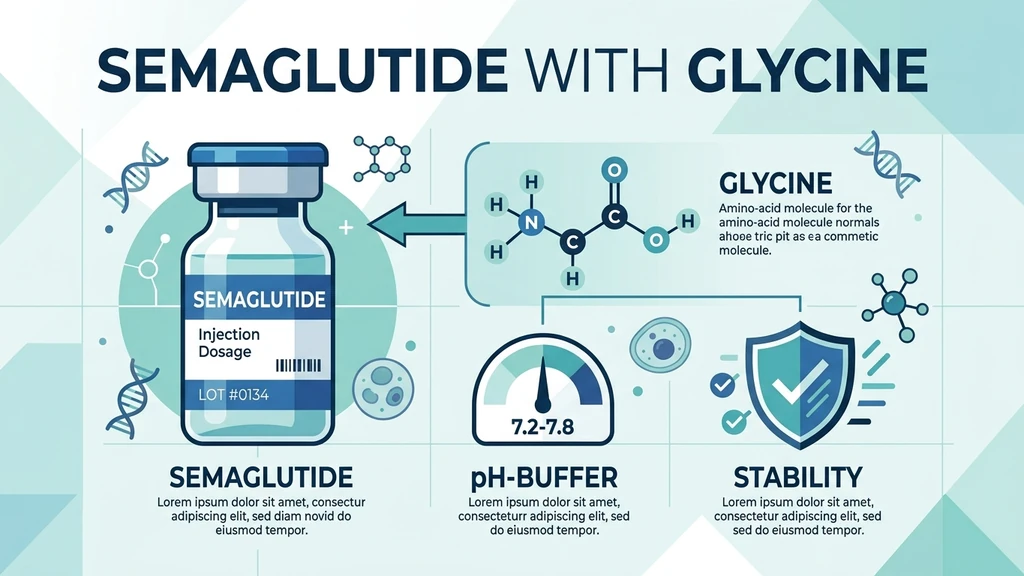
Your compounded vial says "semaglutide with glycine" and you want to know what the glycine is doing there and whether it changes anything. Glycine is a simple amino acid added by compounding pharmacies as a stabilizer and buffer, not as an active weight-loss ingredient. It helps keep semaglutide stable in solution and can reduce injection-site stinging. It does not boost fat loss on its own.
| Quick Reference | Details |
|---|---|
| What is glycine? | A simple amino acid used as a buffer/stabilizer |
| Why it's added | Stabilizes semaglutide, buffers pH, eases injection |
| Affects weight loss? | No direct effect; semaglutide does the work |
| Affects dosing? | No, dose is based on semaglutide content |
| Common alternatives | Semaglutide with B12, with niacinamide |
| FDA status | Compounded; not an FDA-approved formulation |
| Main consideration | Pharmacy quality matters most |
Compounded semaglutide formulations are not FDA-approved products. The glycine itself is benign, but the quality of any compounded vial depends on the pharmacy. This guide explains the why behind the additive. Consult a licensed provider before changing or starting any GLP-1 protocol.
For other co-formulations, see compound semaglutide with B12 and our niacinamide semaglutide guide.
Get your custom peptide protocol:
- Tailored to your body and goals
- Precise dosing and cycle length
- Safe stacking combinations
- Backed by peer-reviewed studies
- Ready in under 2 minutes
Why Compounders Add Glycine to Semaglutide
Glycine is the smallest amino acid, and pharmacies use it for boring, functional reasons rather than therapeutic ones. Understanding those reasons removes most of the confusion.
pH buffering. Semaglutide is most stable within a specific pH window. Glycine acts as a buffer, resisting pH swings that could degrade the peptide. A stable pH means a longer-lasting, more reliable vial.
Stabilization. As a bulking and stabilizing agent, glycine helps protect the peptide structure during compounding, storage, and freeze-drying. This is the same role glycine plays in many injectable and lyophilized pharmaceuticals.
Reduced injection discomfort. A properly buffered solution at near-physiological pH tends to sting less on subcutaneous injection. Some users report smoother injections with glycine-buffered formulations.
Think of glycine as the packing material around a fragile object. It does not change what is inside the box; it keeps the contents intact during handling. The semaglutide is still the only molecule driving appetite suppression and weight loss (Wilding et al., N Engl J Med, 2021).
This is a formulation choice, not a different drug. See why is my semaglutide red for how other additives like B12 change appearance.
Does Glycine Change How Semaglutide Works?
The short answer is no. Glycine is a buffer and stabilizer, not a co-active drug. Your weight loss comes from semaglutide's action on GLP-1 receptors, which slows gastric emptying and reduces appetite.
Glycine does have mild biological roles in the body. It is involved in collagen synthesis, neurotransmission, and sleep quality, and some people take oral glycine as a supplement. But the trace amount used to buffer an injectable semaglutide vial is far below any meaningful supplemental dose. You are not getting a glycine "benefit" from your weekly shot.
This matters because some marketing implies that "semaglutide with glycine" is an upgraded or enhanced version. It is not. It is standard compounded semaglutide with a common pharmaceutical excipient. A vial with glycine and a vial without it deliver the same active drug, assuming equal semaglutide content and quality.
Do not pay a premium expecting glycine to accelerate results. Judge the vial on its semaglutide content, pharmacy accreditation, and price. See does compounded tirzepatide work for how to evaluate compounded products.
Is Semaglutide With Glycine Safe?
Glycine itself is among the safest substances used in injectables. It is naturally present in the body, used widely as a pharmaceutical excipient, and not associated with the kind of additive concerns some other compounding agents raise.
The real safety question is not glycine. It is the compounded product as a whole. Compounded semaglutide is not FDA-approved, and the FDA has issued warnings about quality and dosing inconsistencies in the compounded GLP-1 market. The risk lives in the pharmacy, not the buffer.
Quantified concern: an underdosed or contaminated compounded vial is a far bigger risk than the glycine. If a pharmacy cuts corners on sterility or gets the semaglutide concentration wrong, you could under-dose, over-dose, or inject a contaminated product. None of that is the glycine's fault, but glycine on the label does not protect you from it.
Protect yourself by sourcing from an accredited compounding pharmacy that provides a certificate of analysis, and by following proper injection hygiene. See our peptide safety guide, is compounded tirzepatide safe, and FDA peptide crackdown 2026 coverage.
How Glycine Affects Dosing and Reconstitution
Your semaglutide dose is based on the semaglutide content, not the glycine. The glycine does not enter the dosing math at all.
| Scenario | What to Use | Notes |
|---|---|---|
| Pre-mixed glycine solution | Dose by semaglutide mg/mL on the label | Glycine already accounted for |
| Lyophilized with glycine | Reconstitute per pharmacy instructions | Glycine is part of the powder |
| Calculating units | Use semaglutide concentration only | Ignore glycine for unit math |
If your vial arrives as a pre-mixed solution, the label states the semaglutide concentration (for example, 2.5 mg/mL). You draw your dose against that number exactly as you would for any semaglutide vial. The glycine is already dissolved and requires no separate calculation.
If it arrives lyophilized (freeze-dried with glycine as a bulking agent), follow the pharmacy's reconstitution instructions for how much bacteriostatic water to add. Once reconstituted, you again dose against the semaglutide concentration. Use the peptide reconstitution calculator and semaglutide dosage calculator to confirm your numbers, and see semaglutide dosage chart in ml.
The presence of glycine never changes your titration schedule. Follow the same standard ramp. See our semaglutide titration schedule.
Glycine vs B12 vs Niacinamide Formulations
Compounding pharmacies add different excipients to semaglutide, and they serve different purposes. Knowing the difference prevents marketing confusion.
| Additive | Primary Role | Effect on Weight Loss | Visual Sign |
|---|---|---|---|
| Glycine | Buffer, stabilizer, eases injection | None directly | Clear solution |
| B12 (cyanocobalamin) | Marketed for energy; buffering | None proven for weight | Red/pink color |
| Niacinamide | Stabilizer, pH buffer | None directly | Clear solution |
| None (plain) | N/A | Semaglutide alone | Clear solution |
All of these are excipient choices. None of the additives meaningfully accelerates fat loss; the semaglutide does that. B12 is the most heavily marketed because the red color and "energy" angle sell well, but the evidence for added weight-loss benefit is thin.
The practical takeaway: do not choose a vial based on the additive. Choose it based on semaglutide quality, pharmacy accreditation, and price. The buffer is a footnote, not a feature. Compare the B12 version in our compound semaglutide with B12 and what color is semaglutide guides.
Side Effects: Glycine or Semaglutide?
When people on glycine-buffered semaglutide experience side effects, the cause is almost always the semaglutide, not the glycine.
From semaglutide (expected): - Nausea, especially during dose increases - Constipation or diarrhea - Fatigue - Reduced appetite (the intended effect)
Theoretically from injection (rare): - Mild injection-site reactions, which glycine buffering may actually reduce
Glycine-buffered solutions tend to cause less injection-site stinging than poorly buffered ones, so if anything, glycine is on the helpful side of the ledger. The systemic side effects, the nausea and GI changes everyone asks about, come from the GLP-1 mechanism.
If you switched to a glycine formulation and side effects changed, the likely cause is a difference in semaglutide concentration or quality between vials, not the glycine. Track your dose carefully when switching products. See does semaglutide cause nausea, how to relieve nausea from semaglutide, and tirzepatide injection site reaction.
Common Mistakes With Glycine Formulations
Mistake 1: Thinking glycine boosts weight loss. It does not. Semaglutide does all the work. The fix: judge the vial on semaglutide content and quality, not the buffer.
Mistake 2: Paying a premium for the additive. Glycine is a cheap, common excipient. The fix: do not let "with glycine" justify a higher price.
Mistake 3: Recalculating dose because of glycine. Your dose is based on semaglutide only. The fix: ignore glycine in your unit math.
Mistake 4: Ignoring pharmacy accreditation. The buffer is benign, but the compounded product's safety depends on the pharmacy. The fix: source from an accredited pharmacy with a certificate of analysis.
Mistake 5: Blaming glycine for side effects. Nausea and GI changes come from semaglutide. The fix: manage them as standard GLP-1 effects and verify your concentration if symptoms change. See how long does semaglutide side effects last.
Frequently Asked Questions
What does glycine do in semaglutide?
Glycine is a simple amino acid added by compounding pharmacies as a pH buffer and stabilizer. It keeps semaglutide stable in solution and can reduce injection-site stinging. It does not contribute to weight loss directly. The semaglutide alone drives appetite suppression. See does compounded tirzepatide work for evaluating compounded products.
Does semaglutide with glycine work better?
No. Glycine is a buffer, not an active weight-loss ingredient. A vial with glycine and one without deliver the same results at equal semaglutide content and quality. Do not pay a premium expecting glycine to accelerate fat loss. Judge the vial on semaglutide quality and pharmacy accreditation instead.
Is semaglutide with glycine safe?
Glycine itself is among the safest injectable excipients, naturally present in the body. The real safety question is the compounded product as a whole, which is not FDA-approved and depends on pharmacy quality. Source from an accredited pharmacy with a certificate of analysis. See our peptide safety guide.
Does glycine change my semaglutide dose?
No. Your dose is calculated from the semaglutide concentration on the label, not the glycine. Draw your units against the mg/mL of semaglutide exactly as you would for any vial. Confirm with our semaglutide dosage calculator and semaglutide dosage chart in ml.
Glycine vs B12 semaglutide: which is better?
Neither additive meaningfully boosts weight loss; both are excipients. B12 turns the solution red and is marketed for energy, while glycine is a clear buffer that may ease injection. Choose based on semaglutide quality and price, not the additive. Compare in our compound semaglutide with B12 guide.
Why does my semaglutide have glycine in it?
Your compounding pharmacy added glycine to buffer the pH and stabilize the peptide, which extends shelf life and can make injections more comfortable. It is a routine formulation choice, not a sign of a different or enhanced drug. The semaglutide content is what matters for your results.
Can glycine cause side effects with semaglutide?
The trace glycine used to buffer a vial is well below any dose that would cause effects, and it may actually reduce injection-site stinging. Side effects like nausea and constipation come from semaglutide's GLP-1 action, not the glycine. See does semaglutide cause nausea for managing them.
The Bottom Line
Semaglutide with glycine is simply compounded semaglutide buffered with a common, safe amino acid. Glycine stabilizes the peptide, holds the pH steady, and can make injections sting less. It does not accelerate weight loss, change your dose, or turn the product into something different. The semaglutide does all the therapeutic work.
The label phrase can read like an upgrade, but it is a formulation detail, not a feature worth paying extra for. What actually matters is the semaglutide content, the accreditation of the compounding pharmacy, and proper injection hygiene. The glycine is the packing material, not the product.
If you are choosing between formulations, ignore the buffer and focus on quality and price. Confirm your dosing with the semaglutide dosage calculator, review the compound semaglutide with B12 comparison, and always consult a licensed healthcare provider before starting or switching a GLP-1 protocol.
Related Articles
Best Time to Take Retatrutide: Morning or Night?
Best time to take retatrutide: any hour, same weekday. Evening blunts nausea, morning suits diarrhea. Missed-dose rule, day switching, food, travel, alcohol.
GLP-1 Injection Sites: The 3 Approved Spots
GLP-1 injection sites: abdomen, front thigh, back of upper arm. What the Ozempic, Wegovy, Mounjaro and Zepbound labels say, plus a rotation plan that works.
Retatrutide Cost: 2026 Price Guide
Retatrutide cost in 2026: research vial pricing, projected prescription price, per-mg breakdown, and what drives the numbers. Why no insurance covers it yet.
Switching Tirzepatide to Retatrutide
Switching from tirzepatide to retatrutide: dose conversion logic, washout, titration restart, side effects to expect, and why a clean restart matters.