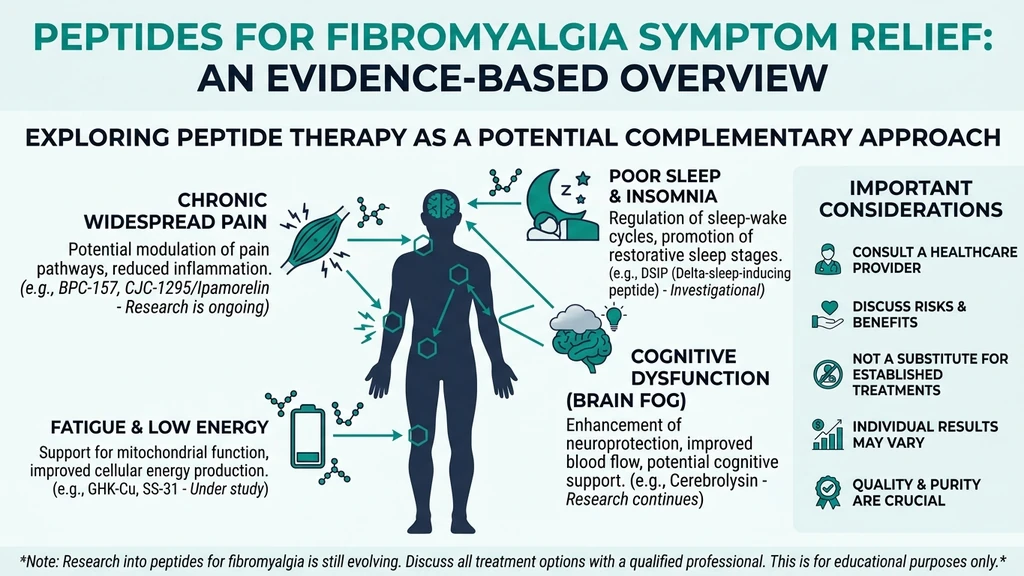
You have a fibromyalgia diagnosis, standard care has not touched the pain or the fatigue, and a forum thread is telling you peptides are the answer. Here is the honest read first. No peptide is FDA-approved for fibromyalgia, and none has completed a human clinical trial for the condition, so any use is experimental and belongs alongside standard care, not in place of it. The peptides discussed most are BPC-157 for pain and inflammation, Selank and Semax for anxiety and central pain processing, DSIP and the CJC-1295/ipamorelin pair for sleep and recovery, and thymosin alpha-1 and KPV for immune pathways. The strongest human evidence in this whole space belongs to two non-peptide agents: growth hormone replacement in low-IGF-1 patients and low-dose naltrexone.
Fibromyalgia is a central nervous system disorder of pain processing, not a disease of damaged tissue. Pain is amplified in the spinal cord and brain without an injury to explain it, a state called central sensitization (Sluka and Clauw, Neuroscience, 2016, PMID 27393152). That is why several peptides get studied at once: they act on inflammation, neurotransmitters, sleep, and hormones, which are all dysregulated in fibromyalgia.
| Peptide | Target Symptom | Proposed Mechanism | Evidence Level | Key Caution |
|---|---|---|---|---|
| BPC-157 | Pain, inflammation | Anti-inflammatory (TNF-alpha, IL-6), gut-brain axis, dopamine/serotonin modulation | Preclinical only (rodent); no human FM trials | Not FDA-approved; not compoundable as of June 2026 |
| Selank | Anxiety, central pain | GABA-A modulation, BDNF upregulation | Human anxiety data; no FM trials | Research-grade only; limited Western studies |
| Semax | Brain fog, mood | BDNF/NGF upregulation, neuroprotection | Human cognition data; no FM trials | Research-grade only |
| DSIP | Unrefreshing sleep | Sleep-cycle modulation (mechanism unresolved) | Mixed 1980s human data; no FM trials | Receptor never isolated; weak evidence |
| CJC-1295/Ipamorelin | Fatigue, sleep, recovery | GH secretagogue, raises GH/IGF-1 | Indirect: GH replacement helped low-IGF-1 FM patients; secretagogues untrialed | GH effects do not equal secretagogue effects |
| Thymosin alpha-1 | Immune dysregulation | T-cell maturation, cytokine regulation | One 2020 mouse study; no human FM data | No lawful US compounding pathway for FM |
| KPV | Systemic inflammation | NF-kB anti-inflammatory tripeptide | Preclinical only | Research-grade only |
| Low-dose naltrexone (comparator) | Pain, function | Glial/TLR4 modulation, central pain | Multiple human RCTs; positive meta-analysis | Not a peptide; off-label; needs a prescriber |
This is educational content, not medical advice. The FDA-approved treatments for fibromyalgia are duloxetine, milnacipran, and pregabalin, and the strongest non-drug evidence supports graded exercise and cognitive behavioral therapy. Talk to a physician before adding anything to that foundation.
Get your custom peptide protocol:
- Tailored to your body and goals
- Precise dosing and cycle length
- Safe stacking combinations
- Backed by peer-reviewed studies
- Ready in under 2 minutes
Fibromyalgia in Brief: Why It Is Hard to Treat
Central sensitization is the core problem. The nervous system turns up the volume on pain signals, so a light touch can register as deep ache and normal stimuli become painful (Sluka and Clauw, Neuroscience, 2016, PMID 27393152). There is no tissue lesion to cut out or repair, which is exactly why standard painkillers underperform.
The condition shows up as symptom clusters, and those clusters anchor every peptide section below. The main ones are chronic widespread pain, persistent fatigue, unrefreshing sleep, brain fog, and mood or anxiety problems. Most patients carry several at once.
One subgroup matters for the peptide story. Roughly 30 percent of fibromyalgia patients have low IGF-1, a marker of growth hormone deficiency, and that deficiency tracks with worse symptoms (Cuatrecasas et al., Pain, 2012, PMID 22078064). This sets up the growth hormone section, which holds the only positive human trial evidence in the field.
Standard care comes first, and the guidelines are clear. The FDA-approved drugs are duloxetine, milnacipran, and pregabalin, while graded aerobic exercise and cognitive behavioral therapy carry the strongest guideline support (Macfarlane et al., Ann Rheum Dis, 2017, PMID 27377815). Peptides, if used at all, sit on top of that foundation. For the broader safety frame, read the peptide safety guide before going further.
BPC-157: The Most-Discussed Peptide for Pain and Inflammation
BPC-157 leads almost every fibromyalgia peptide list because of its anti-inflammatory profile. In rodent models it downregulates pro-inflammatory cytokines including TNF-alpha and IL-6, supports the gut-brain axis, and modulates dopamine and serotonin systems (Sikiric et al., Curr Pharm Des, 2018, PMID 29879879). Those are plausible levers for a condition involving neuroinflammation and disturbed neurotransmission.
The evidence ceiling is low. All of that work is in rats and mice, and there is no human trial of BPC-157 in fibromyalgia at all. The mechanism is interesting; the clinical proof does not exist yet.
The regulatory reality is the bigger constraint in 2026. The FDA removed BPC-157 from the 503A bulk compounding Category 2 list on April 22, 2026, with a Pharmacy Compounding Advisory Committee review scheduled for July 23, 2026, which means it is not legally compoundable and remains not FDA-approved (Loti Labs, BPC-157 legal status 2026). Most BPC-157 sold today is research-grade material labeled for laboratory use only.
If you are weighing BPC-157 for fibromyalgia pain, treat it as experimental and read the full risk picture first. See the BPC-157 profile for mechanism detail and BPC-157 side effects for the documented adverse-event picture. For the general anti-inflammatory category, the overview of peptides for inflammation covers where BPC-157 sits relative to others.
Selank and Semax: The Neurological and Central-Pain Dimension
Fibromyalgia is as much a brain condition as a body one, which is why these two Russian-developed peptides come up. Selank acts as an allosteric modulator at GABA-A receptors and upregulates BDNF, a growth factor tied to nervous system signaling (Kasian et al., Mol Biol Rep, 2017, PMID 28316002). Low BDNF is linked to heightened central pain sensitization, which is the mechanistic hook here.
In animal models Selank produces an anxiety-reducing effect comparable to benzodiazepines without the sedation or dependence (Kozlovskii and Danchev, Eksp Klin Farmakol, 2002, PMID 12596524). Human anxiety data exist, mostly from Russian studies, but no trial has tested Selank in fibromyalgia patients.
Semax targets a different cluster. It upregulates BDNF and NGF, is neuroprotective, and has human data for cognition and mood, which maps onto the brain fog that defines fibromyalgia for many people (Dolotov et al., J Neurochem, 2006, PMID 16805805). Again, the fibromyalgia-specific trial does not exist; the use is extrapolated from cognition research.
Both are research-grade only with limited Western validation. For the symptom angles they target, see the Selank profile and Semax profile, plus the broader guides on peptides for anxiety and peptides for cognitive function.
DSIP and GH Secretagogues: The Sleep and Recovery Angle
Unrefreshing sleep and crushing fatigue are core fibromyalgia complaints, and two peptide approaches target them. One is weak on evidence. The other holds the only positive human trial in the entire field, with an important catch.
DSIP for Unrefreshing Sleep
Delta sleep-inducing peptide is named for its proposed role in deep sleep, and fibromyalgia patients have measurable disruption of slow-wave sleep. The honest caveat is large. Human insomnia studies from the 1980s were mixed, no specific DSIP receptor or gene has ever been isolated, and there is no fibromyalgia data (Kovalzon and Strekalova, Neurosci Biobehav Rev, 2006, PMID 16542728).
DSIP sits near the bottom of this list on evidence quality. Treat any sleep claim as speculative. For the dosing context people ask about, see the DSIP peptide dosage guide and the broader roundup of peptides for sleep.
CJC-1295 / Ipamorelin and the IGF-1 Connection
This is the strongest evidence anchor in the article, and it does not actually involve these peptides directly. Recall that about 30 percent of fibromyalgia patients have low IGF-1 (Cuatrecasas et al., Pain, 2012, PMID 22078064). In a nine-month double-blind placebo-controlled trial, Robert Bennett's group at Oregon Health and Science University gave growth hormone to low-IGF-1 fibromyalgia patients and saw improvement in symptoms and tender-point counts (Bennett et al., Am J Med, 1998, PMID 9552084). A later pilot combining growth hormone with low-IGF-1 selection supported the same direction (Cuatrecasas et al., 2007, PMC2212629).
Here is the honest bridge. That evidence is for recombinant growth hormone, an injected hormone, not for CJC-1295 or ipamorelin. The secretagogue peptides only raise growth hormone and IGF-1 indirectly by signaling the pituitary, and no trial has tested them in fibromyalgia.
So the IGF-1 angle is the most mechanistically grounded peptide story, while the peptides themselves remain untrialed for this condition. For the secretagogue mechanism, see CJC-1295 and ipamorelin benefits and the ipamorelin profile, and for the recovery framing see peptides for recovery.
Thymosin Alpha-1 and KPV: The Immune and Inflammatory Pathways
A subset of fibromyalgia research points to immune dysregulation and elevated inflammatory cytokines, which opens a third pathway. Thymosin alpha-1 drives T-cell maturation and regulates cytokine balance, and its relevance rests on that immune-dysregulation finding plus a single 2020 mouse pain-behavior study (Wang et al., Int Immunopharmacol, 2020, PMID 32172208). There is no human fibromyalgia data, and no lawful US compounding pathway for this use.
KPV is a three-amino-acid fragment with potent anti-inflammatory action. It suppresses NF-kB signaling, a master switch for inflammation, and is discussed for systemic inflammatory load (Dalmasso et al., Am J Physiol Gastrointest Liver Physiol, 2008, PMID 18497334). The evidence is entirely preclinical.
Both peptides target a real fibromyalgia subtype but rest on thin proof. For the immune framing, see thymosin alpha-1 benefits and peptides for immune system, and for the anti-inflammatory category, KPV peptide dosage covers the protocol detail people search for.
Honest Comparator: Low-Dose Naltrexone (Not a Peptide, But Higher Evidence)
Low-dose naltrexone is not a peptide, and it belongs here precisely because it has the best human evidence in the space. Naming it is a trust signal: the goal is an honest read, not a peptide sales pitch.
LDN works through glial cell and TLR4 modulation, dampening central pain amplification rather than blocking opioid receptors at the low 1.5 to 4.5 mg doses used. Multiple 2024 meta-analyses of randomized controlled trials show it reduces fibromyalgia pain, with a pooled standardized mean difference of roughly -0.85, and improves function on the Fibromyalgia Impact Questionnaire (PMC11450306).
Tolerability is good. The most common side effect is vivid dreams, and a second 2025 meta-analysis confirmed the pain and function benefits with a favorable safety profile (PMC12055162). It is prescribed off-label and requires a physician, but it sits on a level of proof that none of the peptides above can claim. If you bring one option to your doctor from this article, this is the one with human trials behind it.
Symptom-to-Peptide Map: How People Actually Choose
Readers rarely pick a peptide in the abstract. They pick by the symptom that hurts most. This map shows which agents are discussed for each fibromyalgia symptom, with the evidence level attached. It maps the conversation, not an endorsement.
| Symptom | Discussed Options | Evidence Reality |
|---|---|---|
| Chronic widespread pain | BPC-157, KPV | Preclinical only; LDN is the human-tested option |
| Fatigue and poor recovery | CJC-1295/ipamorelin, sermorelin | Indirect via the IGF-1/GH replacement angle |
| Unrefreshing sleep | DSIP, GH secretagogues | Weak (DSIP) to indirect (secretagogues) |
| Brain fog and cognition | Semax | Human cognition data, no FM trials |
| Anxiety and central pain processing | Selank | Human anxiety data, no FM trials |
The pattern holds across every row: none of these peptides is FDA-approved for fibromyalgia, and the only human trial evidence is indirect (growth hormone) or non-peptide (LDN). Use this table to frame a conversation with a prescriber, not to self-treat. For pain specifically, the overview of peptides for joint pain covers adjacent musculoskeletal use, even though fibromyalgia pain is centrally driven rather than joint-based.
Safety, Sourcing, and the Standard-Care Reminder
The single largest risk is not the molecule. It is the supply. Nearly all of these peptides are sold "for research use only," which means unregulated purity, no sterility guarantee, and documented contamination risk in grey-market products. They are not manufactured or labeled for human use.
Drug interactions are the second risk, and they are real for this population. Fibromyalgia patients often take duloxetine, milnacipran, pregabalin, or antidepressants, and layering unstudied compounds on top of those without oversight is how harm happens. A prescriber needs visibility into everything you take.
Standard care stays first, every time. The FDA-approved drugs, graded exercise, cognitive behavioral therapy, and sleep hygiene have the evidence; the peptides do not. Nothing here should replace a treatment your physician has prescribed.
For the legal and adverse-event detail, read whether peptides are legal in your situation and the documented peptide therapy side effects before sourcing anything. If a vendor promises a fibromyalgia cure, that claim alone is a reason to walk away.
Frequently Asked Questions
Are any peptides FDA-approved for fibromyalgia?
No. No peptide is FDA-approved for fibromyalgia and none has completed a human clinical trial for the condition, so all use is experimental and should sit alongside standard care. The FDA-approved drugs remain duloxetine, milnacipran, and pregabalin. Read the peptide safety guide before considering any unapproved compound.
Which peptide has the most research for fibromyalgia?
BPC-157 has the broadest preclinical research base, but that work is entirely in rodents with zero human fibromyalgia trials. The only positive human trial in this space used growth hormone replacement in low-IGF-1 patients, not a peptide marketed as one (PMID 9552084). See the BPC-157 profile for the mechanism detail.
Can peptides cure or replace my fibromyalgia medication?
No. Peptides should not replace FDA-approved drugs, graded exercise, or cognitive behavioral therapy, and any use belongs under physician supervision because of interaction risk with existing prescriptions. There is no evidence any peptide cures fibromyalgia. Review the documented peptide therapy side effects before adding anything to your regimen.
Do peptides help fibromyalgia fatigue and sleep?
Growth hormone secretagogues like CJC-1295/ipamorelin and DSIP are discussed for fatigue and sleep, but human fibromyalgia evidence is absent for the peptides themselves. The only support is indirect, through growth hormone replacement in the low-IGF-1 subgroup. See peptides for sleep and peptides for recovery for the broader category context.
Is BPC-157 legal in 2026?
BPC-157 was removed from the FDA 503A Category 2 list on April 22, 2026, and is under Pharmacy Compounding Advisory Committee review for July 23, 2026, so it is not FDA-approved and not yet legally compoundable. Most product sold is research-grade. Check whether peptides are legal for your situation first.
What about low-dose naltrexone for fibromyalgia?
Low-dose naltrexone is not a peptide, but it has the strongest human evidence in this space. 2024 meta-analyses show meaningful pain reduction (pooled SMD around -0.85) and improved function, with vivid dreams as the main side effect (PMC11450306). It is prescribed off-label, so discuss it with the same physician overseeing your peptide safety.
Are research-grade peptides safe to self-administer?
No. Products sold 'for research use only' are unregulated for purity and sterility, carry documented contamination risk, and are not intended or labeled for human use. Self-administering them while taking fibromyalgia drugs adds interaction risk on top. The full picture is in the peptide therapy side effects guide.
Why are peptides even studied for fibromyalgia if evidence is thin?
Fibromyalgia involves central sensitization, neuroinflammation, and immune and hormonal dysregulation at once, and several peptides act on those pathways, which makes them mechanistically interesting but not clinically proven. That overlap is why the field exists despite the lack of trials. See peptides for inflammation for the cytokine pathway most often cited.
The Bottom Line
No peptide is FDA-approved for fibromyalgia, and none has completed a human clinical trial for it. BPC-157 leads the discussion on pain and inflammation but is rodent-only and not legally compoundable in 2026, Selank and Semax target the neurological dimension on extrapolated human data, DSIP and the CJC-1295/ipamorelin pair address sleep and fatigue with weak or indirect support, and thymosin alpha-1 and KPV cover the immune angle on preclinical evidence alone.
The principle worth keeping is honesty about evidence. The only positive human trial in this field used growth hormone replacement in low-IGF-1 patients, and the agent with the best randomized-trial evidence is low-dose naltrexone, which is not a peptide at all. Standard care, the FDA-approved drugs plus graded exercise and cognitive behavioral therapy, stays first, and anything experimental belongs on top of it under a physician's eye.
Bring this evidence map to a prescriber rather than a vendor, and start with the option that has human trials behind it. Learn more at peptidesexplorer.com.
This is educational content. Consult a healthcare provider before starting any peptide or off-label treatment for fibromyalgia.
Related Articles: - Peptides for Inflammation - Peptides for Joint Pain - Peptides for Recovery - Peptides for Sleep - Peptide Safety Guide - BPC-157 - CJC-1295 and Ipamorelin Benefits
Related Articles
Where to Inject IGF-1 LR3: Sites, SubQ vs IM, Rotation
Where to inject IGF-1 LR3: abdomen, thigh or glute, subcutaneous, 29-31G needle. Why site-specific growth is a myth, a rotation map, and the hypoglycemia rule.
When to Take IGF-1 LR3: Best Time & Fed vs Fasted
When to take IGF-1 LR3: post-workout with carbs on training days, morning with breakfast on rest days, never fasted. Half-life, spacing from GH peptides, FAQ.
Where to Inject BPC-157 for Back Pain: Lower Back Sites
Where to inject BPC-157 for lower back pain, herniated disc, sciatica and SI joint pain: abdomen vs paraspinal sites, landmarks, zones to avoid, red flags.
Best Time to Take Retatrutide: Morning or Night?
Best time to take retatrutide: any hour, same weekday. Evening blunts nausea, morning suits diarrhea. Missed-dose rule, day switching, food, travel, alcohol.